Document
Keep your attention on the care encounter.
Record the conversation and clearly state your own findings and agreed actions.
Hysio Nurse Practitioner in Mental Healthcare
Hysio organises the psychiatric intake and medication and evaluation consultations during psychiatric treatment and recovery.
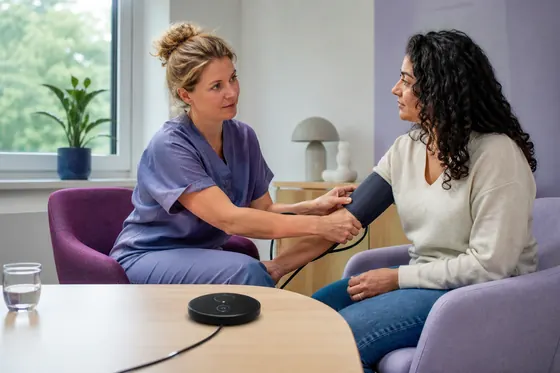
A structured report in your professional terminology
From care encounter to report
Hysio turns spoken information into a report. Choose the report format for the conversation you are documenting.
Document
Record the conversation and clearly state your own findings and agreed actions.
AI assistants
You stay in control of what gets saved.
In your workday
More attention for the conversation, less typing afterwards.
State relevant information, your own findings and agreed actions aloud so you can find them in your report.
The information appears under the headings of your chosen report format, so you can review each section.
Check names, facts and agreed actions. Edit the text where needed before using the report in your records.
Try it yourself
Try Hysio free for 14 days or schedule a personal demo.
For your team
Quick answer
Four documentation formats for consultation, psychiatric intake, medication evaluation and handover in mental healthcare.
Here is a brief overview of how Hysio writes up a mental healthcare consultation. You read every report back before it goes into the record, even after a sensitive conversation.
For nurse practitioners in mental healthcare there are 4 documentation formats: Hysio NP Mental Healthcare Consultation, Hysio NP Mental Healthcare Psychiatric Intake, Hysio NP Mental Healthcare Medication & Evaluation Consultation and Hysio NP Mental Healthcare MDT & Handover. The layout fits psychiatric treatment and recovery and keeps the psychiatric intake, a medication and evaluation consultation and the agreed follow-up clearly together. The nurse practitioner in mental healthcare chooses the appropriate care moment. [3] [4] [5] [6] [1]
Hysio NP Mental Healthcare Consultation records a regular contact and keeps the source and the next step together. If safety or suicidality plays a role in the conversation, observation, assessment and follow-up can still be read separately in the report. You review what the report notes, and your judgement takes precedence, not the text itself. That way this report also stays usable when a later medication and evaluation consultation builds on this conversation. [3]
Hysio NP Mental Healthcare Psychiatric Intake offers structure for the first meeting and also stays usable when that same information comes up later in a multidisciplinary team meeting. Your observation, the interpretation you gave it and the next step stay separately readable in the report. Compare the text with what was actually said during the meeting; your final assessment counts, not the first version. That way you can see straight away what is already established and what is still open. [4]
Hysio NP Mental Healthcare Medication & Evaluation Consultation keeps what the client and their loved one say about medication and its effect separate from your own evaluation and the decision that follows. At the intake you deliberately place fact, assessment and agreed follow-up side by side, without mixing them. Before the text moves on, you as a nurse practitioner in mental healthcare check that this separation has been preserved; you decide what remains as final. That way the consultation stays linked to the right care moment in the record. [5]
Hysio NP Mental Healthcare MDT & Handover brings the findings from a multidisciplinary team meeting together with the follow-up that was agreed. In the psychiatric intake, that structure helps keep input from several practitioners, decisions made and concrete actions clearly separate. You check that the report reflects the meeting correctly; final responsibility for what goes into the record stays with you as a nurse practitioner in mental healthcare. That way it stays clear which part of the text comes directly from the meeting and which part is your own interpretation. [6]
Hysio NP Mental Healthcare Consultation is intended for recording a regular care encounter and its structure matches how you describe a medication and evaluation consultation: source and next step stay visibly separate. A colleague who reads the report later can find your observation separately from the decision that followed. Before the report is saved, you check yourself that this separation is correct; as a nurse practitioner in mental healthcare you remain responsible for the final text. [3]
In a first intake in which safety and suicidality are discussed, Hysio NP Mental Healthcare Psychiatric Intake also keeps the perspective of the client and their loved one visible alongside your own observation. If a question remains open, you deliberately leave it open until it has been discussed, instead of filling something in. You compare the content of the report with the source before you continue; what you then do with the conversation is your own decision. [4]
Hysio NP Mental Healthcare Medication & Evaluation Consultation is designed for the moment when you discuss medication policy and treatment progress with the client. The format gives that information a fixed place, following on from what was already recorded at the intake. If the order of the care moment stays intact, even when safety or suicidality is the topic, you as a nurse practitioner in mental healthcare probe further into what is described; your interpretation remains necessary before the intake connects to the next step in care. [5]
For the nurse practitioner in mental healthcare, Starter costs €20 per month, Pro €40 and Unlimited €80, excl. VAT. The price is the same for an intake, a medication consultation or an MDT meeting report. When comparing, also count the time you now spend writing up. [7]
You first determine the care goal before you record anything about the client and their loved one. Record which information the intake needs and who gets access to it: only those who serve the care goal may listen, read, edit or approve. If there is a conversation about safety and suicidality, do not use anything that falls outside that goal, not even if it happens to be available. In a medication and evaluation consultation you decide yourself what is stored or shared; merely being present is not consent. [9]
Independent authority is the starting point for how far you as a nurse practitioner in mental healthcare may decide for yourself. Consult the source text: Independent authority: Regulated through the Regeling zelfstandige bevoegdheid verpleegkundig specialisten, linked to article 36, fifth, sixth and fourteenth paragraphs, Wet BIG (reserved procedures). In a multidisciplinary team meeting, observation, interpretation and the agreement made still stay recognisable as separate parts of the record. In a medication and evaluation consultation too, the professional responsibility for that assessment stays entirely with you. [12] [15]
During a multidisciplinary team meeting it often becomes clear how far that independent authority reaches in practice. Set this against the original source: Conditions on independent authority: Limited to one's own specialism, limited complexity, routine nature, foreseeable risks, and acting in accordance with nationally applicable guidelines, standards or protocols. Deliberately record, alongside the outcome, which point is still open. Before saving, you as a nurse practitioner in mental healthcare check for yourself whether the text reflects the meeting correctly. [19] [20]
This field of expertise also comes up when you discuss the nursing contribution in a multidisciplinary team meeting. For the exact wording, consult the source: Nursing field of expertise: Article 33 of the Wet BIG names observation, guidance, nursing and care, plus acting on the instruction of another practitioner, as core activities of the nursing profession. In a medication and evaluation consultation too, your own observation stays separately findable in the report, apart from the conclusion you draw from it. At the intake, as a nurse practitioner in mental healthcare, you deliberately leave out a conclusion that is not substantiated. [12]
Hysio NP Mental Healthcare MDT & Handover is intended for the multidisciplinary team meeting and makes room for what the client and their loved one contribute themselves. That input stays distinguishable in the report from the observations and professional interpretation of the treatment team, so nothing gets mixed up. You assess whether the account of the meeting is correct before a colleague works with it; responsibility for the care moment stays with the nurse practitioner in mental healthcare. [6]
At the intake, Hysio NP Mental Healthcare Consultation focuses on a clear source and a traceable follow-up, so a colleague can later see where information comes from. First note what happened and only then describe which step follows, in that order. You assess what the report brings together and keep control of the final text yourself. That way the conversation about safety and suicidality stays readable at the next handover. [3]
Hysio NP Mental Healthcare Psychiatric Intake is intended for the first intake and connects with what is discussed later in a medication and evaluation consultation. What you saw and what you decided stay distinguishable from each other in the report. You review the text and only keep substantiated information; you yourself remove assumptions that are not substantiated. That way what was actually discussed during the meeting is on record. [4]
When safety and suicidality are part of the consultation, Hysio NP Mental Healthcare Medication & Evaluation Consultation describes medication and next steps clearly and separately from each other. The fact you observed stays separate from the agreement you made about it. Before the contact is closed, you make the text match what was really discussed; your decision then takes precedence. That way the input of the client and their loved one stays available for the joint debrief. [5]
In mental health services, Hysio NP Mental Healthcare MDT & Handover fits as soon as a multidisciplinary team meeting in mental health services produces input, decisions and follow-up actions that you need to record for the handover. The format keeps observation, professional interpretation and agreement separately readable, even when a psychiatric intake has already taken place. You check before saving that the report reflects the meeting correctly; the healthcare professional remains ultimately responsible for what goes into the record. [6]
In mental health services, when you edit yourself, you write along directly in a mental health MDT meeting. If you dictate, Hysio first records the conversation and then organises the chosen source into readable text. In both routes the professional assessment stays with you as a nurse practitioner in mental healthcare, not with the documentation format. Compare for yourself fidelity to the source, correction time and readability, and choose the route that causes the least correction work in a medication and evaluation consultation. [10]
The general Hysio trial lasts 14 days in mental health services. Use the period for well-defined practice situations around the perspective of the client and their loved one. In the psychiatric intake you follow your own privacy agreements and note what works better and what does not. For nurse practitioners in mental healthcare, measure time, corrections and readability in comparable contacts around a conversation about safety and suicidality. [8]
The legal basis for record keeping determines what you may and may not record in a medication and evaluation consultation. This is the source text itself: WGBO (Dutch Civil Code, Book 7, Title 7, Section 5): Duty to keep a record (art. 7:454), retention period, right of access and to a copy, professional confidentiality (art. 7:457). During a multidisciplinary team meeting you only note what was actually established during that contact, nothing more. You as a nurse practitioner in mental healthcare safeguard the distinction between fact and assessment yourself, anew in every medication and evaluation consultation. [13]
Professional confidentiality also applies to data you record for the direct care goal. Compare this with the original source: Professional confidentiality (art. 7:457 BW, the Dutch Civil Code): No disclosure to third parties without consent, except for a legal exception or direct involvement in the treatment. If you come across an information gap during a conversation about safety and suicidality, make visible what you still need to check instead of filling it in. Before saving, you yourself look at the completeness and origin of every item of data that came up in the multidisciplinary team meeting. [14] [20]
Around a multidisciplinary team meeting it is good to know that not every retention period has been settled yet. The retention period for compulsory mental healthcare requires additional legal verification. The source provided does not establish that a successor to the Besluit cliëntendossier Bopz sets a different period. So only record the period that the competent source or local policy states. In a medication and evaluation consultation, describe the contact as it actually took place, not as you expect it to be arranged. [14]
This documentation guideline applies more broadly than only the mental healthcare sector. The source puts it as follows: This guideline is not specific to the nurse practitioner in mental healthcare nor even specific to the mental healthcare sector: the target group is nurses and carers at all levels of expertise (secondary vocational, higher professional and master's level) in all client groups, in all care settings and in all care organisations where nurses and carers work. At the intake you therefore keep observation, interpretation and agreement just as clearly separate as in any other contact. [17] [18] [21]
What the client and their loved one tell you remains distinct from your own observations and professional assessment in the record. Check this against the source text: Data collection, divided into personal data (name, address, date of birth, sex, nationality, contact person) and care data on health status and wellbeing, where the guideline explicitly distinguishes between subjective data, objective data and contextual data. Alongside the outcome of that conversation, you also deliberately record which question remained open. [22]
The term client problems helps to keep the terms used in the report recognisable. Test this against the source text: The guideline names client problems as an overarching term for nursing diagnoses, care problems, care recipient problems, client problems, nursing problems, health problems and support needs. Only adopt such a term when the source or your own professional assessment actually substantiates it. During the meeting your own observation stays a separate part of the report, and in the consultation you simply leave out a conclusion that you are not able to substantiate. [18] [21]
Quality and accountability requirements often come together during a multidisciplinary team meeting, where several practitioners rely on the same report. This is how the source itself puts it: The guideline itself recommends evaluating and monitoring the quality of documentation, at a minimum by checking whether the client or legal representative was involved, whether the documentation reflects all phases of the nursing process, and whether the eOverdracht (electronic nursing handover) was used. If the conversation is about safety and suicidality, you only note what you saw, did and discussed yourself. [15] [16] [17]
Consent and privacy deserve attention already at the intake, before more people read along during a multidisciplinary team meeting. For the exact wording, look at the source: Health data are special categories of personal data under the GDPR. Processing requires an appropriate legal basis, data minimisation and purpose limitation. Only note information in the record that is needed for care, and do not share it more widely than the purpose of the contact requires. In a medication and evaluation consultation, record your own observation and the follow-up, no more than is needed for that. At the intake, check yourself that date and meaning match the contact as it took place. [22]
No. Hysio has no link with your mental healthcare organisation's record. You transfer the approved text yourself, following your organisation's agreements. With voice-driven admin too, that stays your step. Take extra care with what you record about loved ones and about safety. [11] [10]
Read the report alongside your own notes. Pay attention to who said something: the client, a loved one or you. Look extra carefully at medication and at what was agreed about safety. With voice-driven reporting too, the final read is yours. [10]
Consultation-liaison psychiatry is part of the work of the nurse practitioner in mental healthcare. Check the source itself: Consultation-liaison psychiatry: Advice from the nurse practitioner in mental healthcare to another department or institution without a treatment relationship of their own. During a multidisciplinary team meeting it stays clear what you heard, saw and carried out yourself, separate from what someone else contributed. In the consultation you check both the source and the agreed follow-up, so the information fits your daily work. [13]
A multidisciplinary team meeting quickly touches on the question of who may actually perform which reserved procedure. The original source puts it this way: Reserved procedure: A procedure that, under the Wet BIG, may only be performed by authorised practitioners. At the intake you also name which question is still open after the conversation about safety and suicidality, instead of silently leaving it. You decide which interpretation is professionally justifiable; that choice stays usable for the next meeting. [12]
If information from a regular contact needs to come back in a multidisciplinary team meeting, Hysio NP Mental Healthcare Consultation makes source and follow-up easier to trace for everyone reading along. Observation, assessment and agreement each get their own place in the report, instead of running together. You check that no assumption has crept into the text; that choice stays with you. At the intake, the healthcare professional decides what is still needed afterwards. [3]
If the first meeting also brings the view of the client and their loved one into the picture, Hysio NP Mental Healthcare Psychiatric Intake still keeps observation, assessment and follow-up apart. You check yourself what the format has recorded before you continue; the eventual follow-up remains your decision. In a medication and evaluation consultation this leaves room for your own professional judgement, instead of the text already making that choice for you. [4]
Hysio NP Mental Healthcare Medication & Evaluation Consultation links medication and next steps with what was already recorded during the intake. You keep observation, assessment and follow-up each separate, even though it concerns the same contact. You review what the format notes, and your judgement takes precedence over the generated text. That way a conversation about safety and suicidality stays recognisable for the colleague who uses the report later. [5]
If the outcome of a medication and evaluation consultation comes back in the meeting, Hysio NP Mental Healthcare MDT & Handover offers structure for the input, the decisions and the actions that follow from it. Your observation, the interpretation you gave and the agreed next step stay distinguishable from each other in the text. Compare the report with what was really said during the meeting; your final assessment is decisive. That way you see clearly what is already established and what is still open. [6]
If the conversation is about safety and suicidality, Hysio NP Mental Healthcare Consultation links the reason for the contact with what you agreed afterwards, without letting the two merge. You deliberately set fact, assessment and next step side by side. Before the text moves on, you check it yourself; you as a nurse practitioner in mental healthcare decide what remains. That way the perspective of the client and their loved one also stays linked to the right care moment in the record. [3]
Around the intake, Hysio NP Mental Healthcare Psychiatric Intake makes room for the information you need during a later multidisciplinary team meeting. Observation and professional interpretation stay two separate parts of the report instead of one whole. You assess whether the text reflects the care moment well; that responsibility lies with you as a nurse practitioner in mental healthcare, not with the format itself. That way you can continue in a focused way at the next step in the meeting. [4]
A correction in mental health services starts with the original source. As a nurse practitioner in mental healthcare, first open the passage in the report that is not correct. Then check whether the change affects observation, agreement or handover, for example after a mental health MDT meeting. Only keep what you can substantiate yourself from the contact; Hysio does not independently adopt a professional correction. Only after your check is the amended text usable for the record. [10]
Leave the gap visibly open and do not fill anything in because it seems logical. Ask the colleague who was there, or the client at the next contact. With voice-driven reporting, a gap is better than a guess, especially with agreements about safety. [10]
You use the medication and evaluation consultation for every contact in which the medication or the continuation of treatment is central, for example after a dose adjustment. Keep established facts separate from the agreements you made. If safety or suicidality plays a part, you include it explicitly; the decision stays with you. [5]
If safety or suicidality comes up during a multidisciplinary team meeting, Hysio NP Mental Healthcare MDT & Handover keeps the team's input, the decisions made and the follow-up actions visibly separate from each other. A colleague who reads along later can read your observation separately from the agreement that followed. Before saving, you check the text; the healthcare professional then remains responsible for the decision. [6]
The Hysio NP Mental Healthcare Consultation format organises source and follow-up around a conversation in which safety and suicidality are discussed. Observation, assessment and follow-up each stay separately findable instead of being merged into one paragraph. Afterwards you read back yourself what has been noted; your judgement carries more weight than the automatically generated text. That way the input of the client and their loved one stays recognisable for whoever uses the report later. [3]
The input of the client and their loved one gets its own place in Hysio NP Mental Healthcare Psychiatric Intake, separate from your observation and the assessment you attach to it. You yourself probe further into what the format describes instead of adopting the text without question; your interpretation remains essential. That way the intake connects well with a later medication and evaluation consultation, the next step you take in care. [4]
If the consultation follows on from an earlier intake, observation, assessment and agreement each get their own place in the text within Hysio NP Mental Healthcare Medication & Evaluation Consultation. You check that no assumption has been added that is not substantiated by the conversation; that decision lies with you alone. If safety or suicidality also plays a part, you as the healthcare professional decide yourself what else is needed. [5]
In Hysio NP Mental Healthcare MDT & Handover, input, decisions and actions from the meeting come together, even when the reason was a medication and evaluation consultation. At the intake you still keep observation, assessment and follow-up apart, so nothing merges. You check yourself what the format has recorded; you decide on the follow-up, not the text. Around the meeting this leaves room for your own professional judgement. [6]
Hysio NP Mental Healthcare Consultation remains, even in a multidisciplinary team meeting, a format in which you as the healthcare professional decide yourself what goes into the report. Source and next step are placed visibly side by side, so a colleague will not mix them up. Before the meeting you check the text for assumptions that do not belong in it. At the intake you then weigh what else needs to happen. [3]
Hysio NP Mental Healthcare Psychiatric Intake gives the first meeting a fixed place and helps you recognise it later within a multidisciplinary team meeting. What you observed, how you interpreted it and which next step followed stay distinguishable in the text. You set the report against what was discussed during the meeting and make the final decision yourself about what is correct. That way you see straight away which part of the story is already established. [4]
First measure how long writing up and reading back take now after an intake or medication consultation. After a few weeks, do the same with dictating. It is only a gain if there is less to correct. That is how you judge AI documentation on what it really delivers. [10]
Start with one type of contact, for example the medication consultation. Agree who reads along with the first reports. Then expand voice-driven reporting to intake and MDT meeting. Your authority and your professional confidentiality stay the same. [10] [9]
Hysio creates the report. You remain responsible for what you save in the record.