Document
Keep your attention on the care encounter.
Record the conversation and clearly state your own findings and agreed actions.
Hysio Nursing
Stay with your client while Hysio organises observations, care provided, medication facts and open actions for each admission, care encounter, shift handover or discharge.
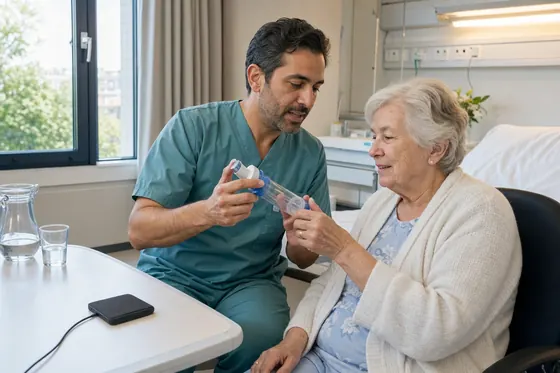
A structured report in your professional terminology
From care encounter to report
Hysio turns spoken information into a report. Choose the report format for the conversation you are documenting.
Document
Record the conversation and clearly state your own findings and agreed actions.
AI assistants
You stay in control of what gets saved.
In your workday
More attention for the conversation, less typing afterwards.
State relevant information, your own findings and agreed actions aloud so you can find them in your report.
The information appears under the headings of your chosen report format, so you can review each section.
Check names, facts and agreed actions. Edit the text where needed before using the report in your records.
Try it yourself
Try Hysio free for 14 days or schedule a personal demo.
For your team
Quick answer
Hysio distinguishes between admission, care encounter reports, shift handover and discharge handover. Observations, measured values, care provided, medication facts, response and open actions stay linked to the correct reference time and the source.
Nursing documentation revolves around four different contact purposes: the admission, a separate care moment, the change between two shifts and the transition to follow-up care. Hysio gives each of these its own documentation format and, within it, keeps observation, the client's perspective, care provided, medication facts and agreements clearly apart, with source and reference time included.
For Nursing, Hysio has 4 available documentation formats: Hysio Nursing Admission & Intake, Hysio Nursing Care Encounter Report, Hysio Nursing Shift Handover and Hysio Nursing Discharge Handover. Each of these four belongs to a different contact purpose: the admission, a separate care moment, the change between two shifts and the transition to follow-up care. In all four, the meaning, the priority and any action remain with the nurse. [2] [3] [4] [5] [7] [8]
Hysio Nursing Admission & Intake turns an open admission conversation, or a nursing dictation about it, into one complete admission and intake report. Hysio records what was said or measured about the reason for admission, the client's perspective, functioning, medical history, medication facts, observations and measurements, your stated nursing conclusion and the agreed care plan. It is a nursing data collection at admission, not a medical admission report, not a needs assessment for care eligibility and not a medication verification. [2] [8] [6]
Hysio Nursing Care Encounter Report turns a recorded care encounter, or a short dictation of one nursing care moment, into a compact record entry. The report keeps contact context and the client's report, nursing observations and measured values, care provided and medication facts, response and result, agreements and follow-up, and missing or conflicting information apart. Values, units, times and routes of administration stay exactly as the source provides them. [3] [6] [7]
Hysio Nursing Shift Handover organises a briefing from the outgoing shift and linked record sources into a compact handover report for the incoming nurse. The report records the handover framework and the reference time, separates the current situation from older context and gives care provided, medication and aids, response, points of attention and open actions each their own place. The nurse decides how urgent something is. [4] [7] [8]
Hysio Nursing Discharge Handover organises current discharge sources into a traceable report for the next healthcare professional. The structure follows the four content areas of eOverdracht 4.0.15: administrative data, general client context, medical context and nursing context. Medication, functional status, lines, wounds and follow-up appointments stay linked to their source moment and completion status. Hysio sends nothing and imports nothing. [5] [8] [6]
You use Hysio Nursing Admission & Intake at the moment of admission itself: during the admission conversation, or shortly afterwards when you dictate that conversation. From either, the assistant creates a complete nursing admission and intake report. For an interim care moment you choose the care encounter report, and for the change between two shifts the shift handover. You assess for yourself what the recorded information means and which action follows from it. [2] [6] [7]
The care encounter report organises exactly the information that belongs to one care moment: the contact context and the client's report, your own observations and measured values, the care provided and medication facts, the response and the result, and the agreements and follow-up. Missing or conflicting information gets its own heading instead of silently disappearing. This is how Nursing links this care encounter to the right documentation format. [3] [7] [8]
The shift handover belongs to the change between an outgoing and an incoming shift. The briefing from the departing nurse becomes a compact handover report for the colleague who takes over. Observations, care provided, medication facts, points of attention and open actions each get a reference time and status, so that the incoming nurse can follow them up. For the transition to care outside the ward, you use the discharge handover. [4] [8] [6]
Hysio distinguishes nursing admission and intake, care encounter reports, shift handover and discharge handover. The formats match the admission, a separate care moment, the change between two shifts and the transition to follow-up care. As a result, current observations, care provided, agreements and open points stay clearly separate for each contact purpose. As a nurse, you assess for yourself what that information means for care. [2] [3] [4] [5] [8] [6]
The admission format organises admission context and sources, data collection and history, observations and measurement data, nursing analysis, care plan and additional information. The structure supports a broad picture of the care situation. Hysio does not independently establish a nursing diagnosis or care goal and does not fill in missing measured values, medical history or agreements. [2] [6] [7]
MDO stands for multidisciplinair overleg (multidisciplinary meeting): a periodic meeting between doctor, nurse and possibly other disciplines, aimed at reviewing and adjusting treatment and care goals. That meeting is recorded in a separate report that goes into the record and sometimes also to the GP, apart from your regular care encounter reports. [1] [6] [7]
Some hospitals apply guidelines of around one nurse to five clients in the day shift, rising to nine to twelve clients in the evening and night shifts; other sources even mention one nurse to ten to fifteen clients. Those ratios come from secondary professional sources and differ between institutions. The more clients per shift, the more it matters that each care moment is recorded briefly and accurately. Recording briefly and reading back afterwards suits that busy pace; it is one way AI can take on your admin. [1] [7] [8]
An individual healthcare carer (Verzorgende IG, MBO level 3) works under the responsibility or on the instructions of a nurse or doctor, mainly provides basic care and some technical nursing procedures, does not hold a BIG article 3 title and does not make an independent nursing diagnosis. What this role records therefore stays linked to the instructions and responsibility of the supervising nurse or doctor. [1] [8] [6]
The nurse practitioner (verpleegkundig specialist, article 14 of the Wet BIG) may, within their own field of expertise, independently determine the indication for and perform some of the reserved procedures, and within that field also prescribe prescription-only (UR) medicines. For those reserved procedures, a nurse works on instructions and does not determine their own indications. That independent authority applies to their own field of expertise and remains with the doctor outside it. [1] [6] [7]
You get one discharge handover report with which the next healthcare professional can continue without first checking everything themselves. Medication, functional status, lines, wounds and follow-up appointments are listed with their source moment, and for each point you can see whether it has already been carried out. Missing or conflicting information stays visible. You check the report before it goes to the receiving healthcare professional. [5] [7] [8]
The admission and intake report has seven fixed sections: summary, admission context and sources, data collection and history, nursing observations and measurement data, nursing analysis, care plan and additional information. The additional information section is the only place for Hysio's own advice and appears only when it demonstrably helps you further. What the information means and which next steps follow from it remains with the nurse. [2] [8] [6]
In the care encounter report, care provided and medication facts get a different place from what has only been discussed or is still planned. An administration with time, route of administration and completion status is therefore not lumped together with an intention. If it remains unclear whether something has already been done, it stays as an open point. Hysio does not turn an intention into a procedure performed, nor a report into a conclusion. [3] [6] [7]
The shift handover first records the handover framework and the reference time: which shift is described and at what time the data applied. After that, the current nursing situation stands apart from historical context from older record sources. For each observation, care action and medication fact you can see at which moment it applied, and points of attention and open actions carry their own status. [4] [7] [8]
Use a care encounter report for a separate care moment with the client's report, nursing observations, measured values, care provided, medication facts, response, result and follow-up agreements. Only what was recorded in that contact belongs in it. Hysio does not turn a report into an urgent conclusion and does not create an instruction or intervention that was not mentioned. [3] [7] [8]
A shift handover looks at the handover moment between the outgoing and incoming shift. The format organises the current nursing situation, care provided, medication and aids, response, points of attention and open actions. Hysio does not set its own priority or instruction. The handover stays attributed, so that it is clear which source supports which information. [4] [8] [6]
A nursing handover often involves sensitive topics. Standardised in eOverdracht are delirium, pain, psychosocial care, fall risk, wound care and the sleep-wake rhythm. For suicide risk, a core set is in development that is not yet a fixed standard. The guideline helps you record such topics clearly, but weighing urgency and the care decision remain with you; Hysio does not take those over. [1] [8] [6]
A shift handover goes to the colleague who takes over your shift and stays within the same team. A discharge handover goes to the healthcare professional who continues care after discharge, outside your own ward. That is why the discharge format brings together a broader set of discharge sources. Medication, functional status, lines and wounds each get their own source moment in it, and follow-up appointments are listed with their completion status. [5] [6] [7]
The admission report has its own section for admission context and sources. It states which source supports which piece of information: your own observation, a statement by the client or a relative, or a linked record document with its own date. If two sources differ, that difference stays visible instead of the newest source silently overwriting the older one. This keeps it traceable which information comes from that one contact. [2] [7] [8]
Yes. What the client reports themselves is kept in the report separately from what you have observed and measured, and separately from what a relative or a colleague has said. Each source role thus keeps its own place in the compact record entry created from that care moment. Hysio does not turn a report into a finding, nor a finding into a judgement. This gives the information a recognisable place in the record within Nursing. [3] [8] [6]
The shift handover report has seven parts: summary, handover framework and reference time, current nursing situation, care provided with medication and aids, response and points of attention, open actions for the receiving shift, and missing or conflicting information. Each part gets its own reference time and status, so that the origin stays traceable in the record. [4] [6] [7]
You choose this format as soon as the client's discharge or transfer is on the agenda and someone else will continue the care. The current discharge sources are then processed into one report for the next healthcare professional. Functional status, medication, lines, wounds and follow-up appointments can be found in it with the moment at which they applied and their completion status. [5] [7] [8]
The admission format establishes no nursing or medical diagnosis, no indication, no urgency level, no risk class and no score. It does not verify medication and does not fill in a missing measured value, medical history or agreement itself. Consent or representation is not assumed. The report is a nursing data collection at admission, not a medical admission report and not a surgical or anaesthesia report. You decide what ultimately goes into the record. [2] [8] [6]
Yes. Values, units, times, routes of administration, equipment settings and completion statuses stay exactly as you provided them. Hysio does not convert anything, does not round anything and does not fill in a missing value. A deviating value is not given any weighting of its own either. This keeps the record structure for each care moment clear and verifiable within Nursing. [3] [6] [7]
A discharge handover organises administrative data, general and medical context, nursing health status, follow-up care and open transfer points. Missing or conflicting information should stay visible. Hysio does not create an independent discharge plan, does not verify a medication list beyond the source and does not determine which follow-up care the receiving healthcare professional should arrange. The receiving healthcare professional assesses for themselves what that information means for follow-up care. [5] [6] [7]
Good documentation shows what you collect and observe, which nursing problem or goal has been recorded, which care has been given and which result has been achieved. Hysio can organise the named parts within admission, care encounter or handover. With voice-driven reporting too, you decide whether the documentation is complete and appropriate for the care situation. [2] [3] [4] [7] [8]
For an open action, the shift handover records who the action owner is, at what time or under which condition the action applies and what the completion status is at the reference time. This lets the incoming nurse see whether something is already under way, still has to start or depends on a result. Hysio does not decide which action takes priority and does not add an escalation route that was not in the briefing. [4] [7] [8]
The discharge handover uses the four content areas of eOverdracht 4.0.15 as a human-readable structure: administrative data, general client context, medical context and nursing context with the specification of the health status. These are followed by follow-up care with open handover points and a heading for missing or conflicting information. For medication, functional status, lines, wounds and follow-up appointments, it always stays clear which source moment they come from and what their completion status is. [5] [8] [6]
The admission report uses the terms that are common in the profession: history, nursing care problem, observation and measured value, nursing analysis, care goal, intervention and evaluation. Hysio does not add terminology of its own and does not translate your wording into a classification or score. Where the source contains a word used by the client themselves, that word stays. [2] [6] [7]
Yes. A transcript, a dictation or a short note of one care moment can each serve as the source. If you dictate the contact shortly afterwards, Hysio processes it into the same compact record entry as with a recording of the conversation itself. What you do not mention does not end up in it either: Hysio does not supplement your account with what would be customary. [3] [7] [8]
Only when a current local source explicitly asks for that format. By default, the shift handover follows its own layout with handover framework and reference time, current situation, care provided, response and open actions. In the profession, SBAR is a useful sequence within a handover moment, not a mandatory heading. Hysio therefore does not impose a format that your ward does not use. [4] [8] [6]
No. The result is a readable report, not a technical message. Hysio exports nothing, sends nothing, imports nothing and does not prove receipt or acceptance of tasks. The receiving organisation decides for itself which data ends up in its own record. Lines, wounds, functional status and medication get their own source moment, and follow-up appointments their own completion status. [5] [6] [7]
The admission report has its own care plan section with the care goals discussed, interventions with the associated responsibilities, planning and evaluation, and agreements about communication and self-management. Only what was stated during the admission goes into it. Hysio does not invent a care goal, does not choose an intervention and does not set an evaluation moment that was not agreed. [2] [7] [8]
It does not disappear, but gets its own heading at the end of the report. If a time is missing, or two sources contradict each other about a dose, that stays as an open point with both sources mentioned. Hysio does not choose which source is right and does not fill the gap with an assumption. With voice-driven reporting, you decide whether to look into the point first or hand it over as it is. [3] [8] [6]
The observation, the measured value with its unit, the moment and, if known, the source come back in the report. A deviating value can be a point of attention, but Hysio does not independently determine urgency, deterioration or action. The nurse assesses the situation according to professional frameworks and records any action or escalation themselves. [3] [4] [8] [6]
Only include medication when the name, use, change, administration or discussion has been recorded as source information. Keep fact, client response and any agreement apart. Hysio does not change a dose, does not verify a prescription and does not give medication advice. You assess the medication facts against the current source before you update the record. [3] [4] [5] [6] [7]
About half of nurses and carers spend 2 to 3 hours a day on administration, and 20% even more than 3 hours; almost three quarters spend more than 25% of their time on record keeping. Those figures concern nurses and carers together and are not a profession-specific percentage for the hospital nurse. They do show why recording close to the care moment is worthwhile. You are best placed to measure whether AI reporting saves time on your ward. [1] [6] [7]
In long-term care, carers and nurses spend about a quarter of their time on administrative tasks, while the same source mentions 15% as a more realistic target. That gap between practice and target underlines the importance of documentation that stays close to the care moment itself. [1] [7] [8]
For hospital care under the Zvw (Dutch Health Insurance Act), funding runs via the DBC/DOT care product of the treating medical specialist. There is no separate care activity for each individual nursing procedure; common nursing input is funded through the registration of a nursing day within that care product. You therefore do not register your own service code, which is why nursing documentation does not need a billing link. [1] [8] [6]
No. The Kwaliteitsregister V&V is an additional, voluntary register alongside BIG registration and partly an individual accountability obligation that is separate from the client's health record; registration in it therefore says nothing about what must be in that record or how the contact went. In nursing, the care moment itself and the associated source role remain decisive for the record entry. [1] [6] [7]
No. The report records what the outgoing shift has handed over, nothing more. It does not prove that the incoming nurse has heard, received or accepted the handover. The verbal handover moment and its confirmation remain your responsibility. You also check the report before it goes into the record. [4] [7] [8]
Then the difference stays visible. A later-dated document does not automatically count as final; the source must demonstrably be current for the moment of discharge. If two sources differ about a medication list, for example, the report names both with source label and date and states that verification is needed. Medication, functional status, lines and wounds are listed with their source moment, and follow-up appointments with their completion status at that moment. [5] [8] [6]
Go through the report for identity, timeline, medication facts and open actions, and check whether your stated conclusion really appears as you intended it. Also check that an observation has not quietly turned into a judgement. Missing points are grouped under their own heading, so they are quick to find. You then decide what goes into the record. [2] [6] [7]
That depends on the recipient. If it concerns one care moment that belongs in the client's record, you choose the care encounter report. If you hand over the whole picture at the end of your shift to the colleague who takes over, you choose the shift handover. The first describes one contact, the second summarises the state of affairs at a reference time. This is how you choose a suitable documentation format within Nursing. [3] [7] [8]
No. Hysio can include a nursing analysis, diagnosis, care goal or intervention when you record it as the source. The system does not choose for itself what is going on, which care is needed or which action has priority. In a handover too, open actions stay source-bound and under your professional responsibility. [2] [4] [7] [8]
Assess client identity, reference time, source role, current situation, care and medication facts, response, open actions and contradictions. Check that an observation has not quietly become a judgement or instruction. With voice-driven reporting, Hysio creates an organised result; you decide which version can responsibly be saved or handed over to the next healthcare professional. [3] [4] [5] [8] [6]
Hysio creates the report. You remain responsible for what you save in the record.