Document
Keep your attention on the care encounter.
Record the conversation and clearly state your own findings and agreed actions.
Hysio Community Nursing
Hysio organises the needs assessment and a home visit to the client, with self-direction for the client in care at home.
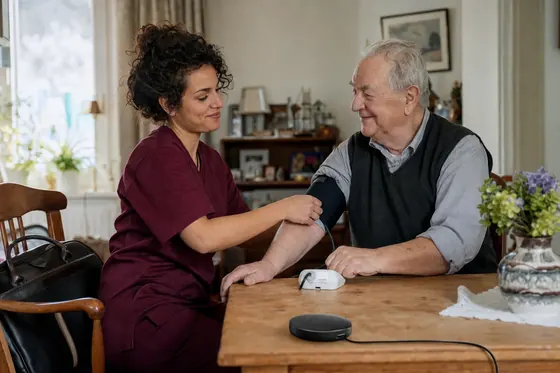
A structured report in your professional terminology
From care encounter to report
Hysio turns spoken information into a report. Choose the report format for the conversation you are documenting.
Document
Record the conversation and clearly state your own findings and agreed actions.
AI assistants
You stay in control of what gets saved.
In your workday
More attention for the conversation, less typing afterwards.
State relevant information, your own findings and agreed actions aloud so you can find them in your report.
The information appears under the headings of your chosen report format, so you can review each section.
Check names, facts and agreed actions. Edit the text where needed before using the report in your records.
Try it yourself
Try Hysio free for 14 days or schedule a personal demo.
For your team
Quick answer
Four documentation formats for needs assessment, the home visit, the care plan evaluation and handover in the care chain.
Here is a brief overview of how Hysio writes up a home visit or needs assessment conversation. You read every report back, even when it is busy in the community.
For community nursing, there are 4 documentation formats: Needs Assessment & Intake, Home Visit Report, Care Plan Evaluation and Care Chain Handover. The layout fits needs assessment, care at home and self-direction, and keeps the needs assessment and self-direction, a home visit to the client and the agreed follow-up recognisably together. The community nurse chooses the appropriate care moment. [3] [4] [5] [6] [1]
Needs Assessment & Intake is intended for community nursing. In the home setting, Needs Assessment & Intake helps you with the initial intake around a home visit to the client. Around the care chain handover, you read observation, assessment and follow-up each separately. For care at home with relatives, the community nurse reads back what Needs Assessment & Intake records; your judgement remains decisive. This keeps a home visit to the client recognisable for the next colleague. [3]
Home Visit Report is for community nursing. For the current care plan, Home Visit Report gives structure for observation and follow-up in the home situation. For care at home with relatives, your observation, interpretation and next step stay recognisable. The community nurse compares Home Visit Report for the needs assessment and self-direction with the contact; your final assessment remains necessary. This lets you point out straight away, for the current care plan, what has already been established and what still needs a next step. [4]
For community nursing, Care Plan Evaluation links goals and new agreements with the care chain handover in the home care situation. For the needs assessment and self-direction, you set fact, assessment and follow-up side by side. Around a home visit to the client, the community nurse checks the text of Care Plan Evaluation; you decide what carries forward. This keeps the care chain handover linked to the right care moment. [5]
Around care at home with relatives, Care Chain Handover makes room for condition and follow-up in the client's home environment. Around a home visit to the client, you do not mix observation and professional interpretation. For the current care plan, the community nurse checks whether Care Chain Handover reflects the care moment correctly; that interpretation remains your responsibility. This way the community nurse can continue working in a focused way on care at home with relatives. [6]
The Needs Assessment & Intake format is for community nursing. In the home setting, Needs Assessment & Intake fits the initial intake for the care chain handover. For the needs assessment and self-direction, the next colleague can read back your observation. Around a home visit to the client, the community nurse checks Needs Assessment & Intake before saving; you remain the one who decides. This gives the care chain handover a clear place in the follow-up. [3]
The source description lists the client perspective, observations, care provided, response and follow-up. Around observation and follow-up, Home Visit Report in the home situation also keeps care at home with relatives visible. During a home visit to the client, you leave an open question in place until it has been discussed. For the current care plan, the community nurse keeps the content of Home Visit Report next to the source; you determine the follow-up. This keeps the thread around care at home with relatives verifiable for you. [4]
The Care Plan Evaluation format gives community nursing a place for goals and new agreements in the needs assessment and self-direction. Around the current care plan, the order of the care moment stays intact. For the care chain handover, the community nurse asks follow-up questions about what Care Plan Evaluation describes; your interpretation remains necessary. This way the needs assessment and self-direction connect to the next step in care. [5]
For a community nurse, Starter costs €20 per month, Pro €40 and Unlimited €80, excl. VAT. The price is the same for needs assessment, home visit report and handover. When comparing, also count the time you now spend on reporting after your shift. [7]
At home you often hear more than you need, for example about family, money or neighbours. Agree with your organisation what you record and who may read the report. Only mention what is needed for the care and the needs assessment. A family carer being present is not yet consent to record everything. [9]
For community nursing, needs assessment, care at home and self-direction help you interpret a home visit to the client properly. For the current care plan, you read the original source together with this information: According to Article 33 of the Wet BIG (Dutch Individual Healthcare Professions Act), the nurse's scope of practice includes observation, support, nursing and personal care. This also includes procedures on the instruction of a doctor or another independently authorised professional that follow on from their diagnostic and therapeutic work. Around the care chain handover, you keep observation, interpretation and agreement clearly apart. During a home visit to the client in the home situation, the community nurse retains professional responsibility. [18]
For the care chain handover in the home care situation, the needs assessment, care at home and self-direction of community nursing come together. For the needs assessment and self-direction, you compare this information with the original source: Like the nurse working in an inpatient setting, the community nurse may, without supervision or intervention by the person giving the instruction, independently carry out certain reserved procedures within their scope of practice, provided they are competent and acting on the instruction of an independently authorised professional. For the current care plan, in the client's home environment, you record the open point alongside the outcome. For the care chain handover, the community nurse checks whether the text reflects the care moment correctly. [16] [17]
This way the needs assessment and self-direction in the home situation connect to needs assessment, care at home and self-direction for community nursing. For the care chain handover, you place this information next to the original source: The IGJ Normenkader (assessment framework) of January 2026 explicitly confirms this as an assessment standard: The community nurse carefully carries out the (re-)assessment according to the Normenkader Indicatieproces (standards framework for the needs assessment process) and translates it into a current support plan, with Wkkgz Articles 2 and 3 and Wet BIG Articles 3, 4 and 14 as legal sources. During a home visit to the client in the home care situation, your own observation stays traceable in the report. [13] [14]
For community nursing, needs assessment, care at home and self-direction are central to the current care plan. During a home visit to the client, you test this information against the original source: The higher professional education (hbo) programme in Nursing takes four years and is placed at NLQF level 6. A secondary vocational (mbo) nurse at level 4 can also work in the community, but with a more limited, more protocol-based role and without authority to assess needs in complex cases. Around the needs assessment and self-direction, you note what you yourself saw, did and discussed in the client's home environment. For the current care plan, the community nurse checks date, meaning and professional context before saving. [16] [17]
In community nursing, needs assessment, care at home and self-direction start with attention to the care situation and the relatives involved. For Zvw spending on community nursing in 2024, Vektis reports €3.2 billion. Use such a national spending figure solely as context for the sector, not as a conclusion about one client or community team. In the record, only document your own observations, agreements and follow-up actions from the specific contact, and check date, source and meaning before you adopt the information. [15] [19] [20]
Around a home visit to the client, needs assessment, care at home and self-direction take on concrete meaning for community nursing. For the current care plan, you keep this information next to the source text: Average volume and duration of care: about 4 hours of community nursing per week, for 6 months on average. For the care chain handover, you write down what actually happened during the care moment. Before saving in the home situation, the community nurse assesses what a home visit to the client means for this care situation. This keeps this knowledge applicable in the home care situation around a home visit to the client. [15] [19] [20]
In the client's home environment, community nursing links needs assessment, care at home and self-direction with the care chain handover. For the needs assessment and self-direction, you check this information against the original source: Regional distribution: nationally, an average of 3.3% of the population receives community nursing, with Westerwolde the highest (6.4%) and Amsterdam and Utrecht the lowest (1.8%). For the current care plan, you keep your observation separate from the professional assessment. Around the care chain handover, the community nurse reviews the passage in the home situation for context and rationale. This keeps this information practical in the home care situation for the care chain handover. [15] [19] [20]
For needs assessment, care at home and self-direction, the needs assessment and self-direction form an important starting point in community nursing. For the care chain handover, you read the original source together with this information: Number of community nursing providers (excluding personal budgets, pgb): 2,434 in 2024, down from 2,660 in 2020. This points to a consolidating but still highly fragmented market. Around a home visit to the client, it stays clear in the client's home environment what you heard, saw and did yourself. For the needs assessment and self-direction, the community nurse checks the source and the agreed follow-up. [15] [19] [20]
Writing yourself often happens at the end of the shift, for all clients at once. With dictating, you record what you did and saw straight after the home visit, and Hysio organises it. Compare for a week how much you need to correct and how well a colleague can read it. [10]
You can try Hysio free for 14 days. Make up a case, for example a first visit for wound care and help with medication. Record the visit and see whether care need, self-direction and agreements stay apart. [8]
Community nursing practice calls for needs assessment, care at home and self-direction during a home visit to the client. For the current care plan, you compare this information with the original source: The Normenkader Indicatieproces works out Norm 4 (the nursing process) in six interrelated steps that in practice form the heading structure of the needs assessment. Around the care chain handover, in the client's home environment, you note only what was established during this contact. During a home visit to the client, the community nurse guards the distinction between fact and assessment. This keeps this information in the home situation linked to the care moment during a home visit to the client. [13] [14]
Around the care chain handover, community nursing holds on to the thread of needs assessment, care at home and self-direction. For the needs assessment and self-direction, you place this information next to the original source: Peer review of the needs assessment, at least three times a year, is an explicit requirement from Norm 2 of the Normenkader. For the current care plan, in the home care situation, you make visible which information still needs to be checked. Before saving, the community nurse looks at completeness and origin for the care chain handover in the client's home environment. This keeps the distinction clear for you at the care chain handover. [13] [14] [17]
The Care Chain Handover is intended for community nursing. In the home situation, Care Chain Handover helps you with condition and follow-up around the needs assessment and self-direction. Around the current care plan, you read observation, assessment and follow-up each separately. For the care chain handover, the community nurse reads back what Care Chain Handover records; your judgement remains decisive. This keeps the needs assessment and self-direction recognisable for the next colleague. [6]
Needs Assessment & Intake is intended for community nursing in care at home with relatives. During a home visit to the client, Needs Assessment & Intake gives structure for the initial intake in the home care situation. For the care chain handover, your observation, interpretation and next step stay recognisable. The community nurse compares Needs Assessment & Intake for care at home with relatives with the contact; the final assessment is yours. This keeps it clear during a home visit to the client what has already been recorded and what still needs adding. [3]
Home Visit Report is intended for community nursing, for the needs assessment and self-direction. For community nursing, Home Visit Report links observation and follow-up with the current care plan in the client's home environment. For care at home with relatives, you set fact, assessment and follow-up side by side. Around the needs assessment and self-direction, the community nurse checks the text of Home Visit Report; you decide what carries forward. This keeps the current care plan linked to the right care moment. [4]
Around the care chain handover, Care Plan Evaluation makes room for goals and new agreements. Around the needs assessment and self-direction, you do not mix observation and professional interpretation. During a home visit to the client, the community nurse checks whether Care Plan Evaluation reflects the care moment correctly; that interpretation remains your responsibility. This way the community nurse can continue working in a focused way on the care chain handover. [5]
In the home situation, Care Chain Handover puts the emphasis on condition and follow-up for care at home with relatives. For a home visit to the client, you first note what happened and then the follow-up. For the current care plan, the community nurse assesses what Care Chain Handover brings together; you stay in control. This keeps care at home with relatives readable at the next handover. [6]
Needs Assessment & Intake is intended for the initial intake for the needs assessment and self-direction in the home care situation. For the current care plan, it stays visible what you saw and what you decided. The community nurse reads back Needs Assessment & Intake around the care chain handover; only substantiated text remains. This clearly records what was discussed for the needs assessment and self-direction. [3]
No. Hysio has no link with the EHR. You transfer the approved text yourself, following your organisation's agreements. Check the date, the care provided and what you agreed with the client. [11] [10]
Read the report while the visit is still fresh. Pay attention to who said something: the client, a relative or you. With voice-driven reporting, the check stays with you. Remove agreements that were not made that way. [10]
The Home Visit Report format is for community nursing. Around observation and follow-up, Home Visit Report in the home care situation also keeps the care chain handover visible. For the needs assessment and self-direction, you leave an open question in place until it has been discussed. During a home visit to the client, the community nurse keeps the content of Home Visit Report next to the source; you determine the follow-up. This keeps the thread around the care chain handover verifiable for you. [4]
The Care Plan Evaluation format gives community nursing a place for goals and new agreements in care at home with relatives. Around a home visit to the client, the order of the care moment stays intact. For the current care plan, the community nurse asks follow-up questions about what Care Plan Evaluation describes; your interpretation remains necessary. This way care at home with relatives connects to the next step in care. [5]
In the client's home environment, Care Chain Handover makes condition and follow-up easier to trace for the needs assessment and self-direction. For the current care plan, observation, assessment and agreement each get room. For the care chain handover, the community nurse checks that Care Chain Handover contains no assumption; you decide yourself. For the needs assessment and self-direction, the healthcare professional determines what is needed next. [6]
In the home setting, Needs Assessment & Intake brings together the initial intake around a home visit to the client. For the care chain handover, you keep observation, assessment and follow-up apart. For care at home with relatives, the community nurse checks what Needs Assessment & Intake has recorded; you decide on the follow-up. Around a home visit to the client, there remains room for your professional judgement. [3]
The source description lists the client perspective, observations, care provided, response and follow-up. Home Visit Report belongs to community nursing and fits the home visit itself. In the home situation, Home Visit Report helps you with observation and follow-up around the current care plan. Around care at home with relatives, you read observation, assessment and follow-up each separately. For the needs assessment and self-direction, the community nurse reads back what Home Visit Report records; your judgement remains decisive. This keeps the current care plan recognisable for the next colleague. [4]
For the care chain handover, Care Plan Evaluation gives structure for goals and new agreements in the home care situation. For the needs assessment and self-direction, your observation, interpretation and next step stay recognisable. The community nurse compares Care Plan Evaluation during a home visit to the client with the contact; the final assessment is yours. For the care chain handover, this shows at a glance what you already know for certain and what is still open. [5]
For community nursing, Care Chain Handover links condition and follow-up with care at home with relatives in the client's home environment. During a home visit to the client, you set fact, assessment and follow-up side by side. Around the current care plan, the community nurse checks the text of Care Chain Handover; you decide what carries forward. This keeps care at home with relatives linked to the right care moment. [6]
Around the needs assessment and self-direction, Needs Assessment & Intake makes room for the initial intake. Around the current care plan, you do not mix observation and professional interpretation. For the care chain handover, the community nurse checks whether Needs Assessment & Intake reflects the care moment correctly; that interpretation remains your responsibility. This way the community nurse can continue working in a focused way on the needs assessment and self-direction. [3]
Go back to what was actually agreed. Adjust the passage and check whether the care plan or the handover changes too. With voice-driven admin too, Hysio does not correct the professional content itself. The text is only ready after your check. [10]
Leave the gap visibly open and do not fill anything in by feel. Call the client or consult the colleague on the next shift if it matters. With voice-driven reporting, a gap is better than a guess, especially with medication. [10]
In community nursing, needs assessment, care at home and self-direction start with attention to a home visit to the client. For the current care plan, you test this information against the original source: The most concrete available figure comes from a V&VN study with the Vrije Universiteit among almost 4,000 nurses and carers, 35% of whom work in community nursing: 30% of working time was lost to recording and 39% of respondents spent more than 30% of their time on recording. For the care chain handover, you record your own observation and the follow-up in the client's home environment. [15] [19] [20]
Around the care chain handover, needs assessment, care at home and self-direction take on concrete meaning for community nursing. For the needs assessment and self-direction, you check this information against the source: For clients with a Wlz assessment who continue living at home (modular package at home or full package at home), funding runs through the Wlz instead of the Zvw, with a policy rule for modular care. For the current care plan, you write down what actually happened during the care moment. Before saving in the home situation, the community nurse assesses what the care chain handover means for this care situation. This keeps this knowledge applicable in the home care situation around the care chain handover. [18] [19]
In the client's home environment, community nursing links needs assessment, care at home and self-direction with the needs assessment and self-direction. For the care chain handover, you keep this information next to the source text: Since 1 January 2026, the Regeling verpleging en verzorging (BWBR0051200, nursing and personal care regulation) has applied. This regulation replaces the previous regulation and sets rules for administration and billing by care providers, with reference to the Wet marktordening gezondheidszorg (Healthcare Market Regulation Act). During a home visit to the client, you keep your observation separate from the professional assessment. Around the needs assessment and self-direction, the community nurse reviews the passage in the home situation for context and rationale. [18]
For needs assessment, care at home and self-direction, the current care plan forms an important starting point in community nursing. During a home visit to the client, you check this information against the original source: The registration unit is direct care delivery in hours, not a sum of individual procedures. The Zvw Regeling verpleging en verzorging and the Wlz policy rule for modular care distinguish between direct care, multidisciplinary consultation, coordination at the office and travel time. Around the needs assessment and self-direction, it stays clear in the home care situation what you heard, saw and did yourself. For the current care plan, the community nurse checks the source and the agreed follow-up in the client's home environment. [18]
Care at home with relatives is part of the needs assessment, care at home and self-direction of community nursing. Read the original source together with this information: There is an ongoing policy development to replace separate time recording with integrated care products (integrale prestaties) for community nursing, including the personal budget within the Zvw. On 1 July 2025, the NZa published implementation advice on feasibility, enforceability and fraud risks. Also state which question is still open. For care at home with relatives, the community nurse determines in the home care situation which interpretation can be professionally justified. [15] [19] [20]
In community nursing, you read a home visit to the client from the needs assessment, care at home and self-direction of the profession. For the current care plan, you compare this information with the original source: The Dutch Health and Youth Care Inspectorate (IGJ) assesses care providers in community nursing against the Normenkader (assessment framework) for care at home, in the community and in nursing homes (January 2026), with four themes (the client, the healthcare professional, managing quality and safety, and content standards) and a method of triangulation. For the care chain handover, in the client's home environment, you give facts and agreed next steps each their own place. [12] [13] [14]
Community nursing practice calls for needs assessment, care at home and self-direction during the care chain handover. For the needs assessment and self-direction, you place this information next to the original source: For the community nurse who carries out needs assessments, there is also a specific accountability obligation outside the record: peer review of their own needs assessments, as a condition from the Normenkader Indicatieproces for being allowed to assess needs independently. Around the current care plan, you note only what was established during this contact. For the care chain handover, the community nurse guards the distinction between fact and assessment in the home situation. This keeps this information in the home care situation linked to the care moment for the care chain handover. [13] [14]
The Home Visit Report is intended for community nursing. For the needs assessment and self-direction, Home Visit Report gives structure for observation and follow-up in the client's home environment. For the current care plan, your observation, interpretation and next step stay recognisable. The community nurse compares Home Visit Report for the care chain handover with the contact; the final assessment is yours. This way you make immediately visible, for the needs assessment and self-direction, what has been established and what still needs attention. [4]
Keep track for a week of how long reporting takes after your home visits. Then do the same for a week with dictating. Only count it as a gain if you have less to correct and the report is just as complete. [10]
Start with one type of contact, for example the regular home visits. Agree in the team who reads along with the first reports. Then expand voice-driven reporting to needs assessment and care plan evaluation. [10] [9]
Hysio creates the report. You remain responsible for what you save in the record.