Document
Keep your attention on the care encounter.
Record the conversation and clearly state your own findings and agreed actions.
Hysio Palliative Care Nursing
Hysio organises the palliative care conversation and advance care planning, with attention to values and comfort.
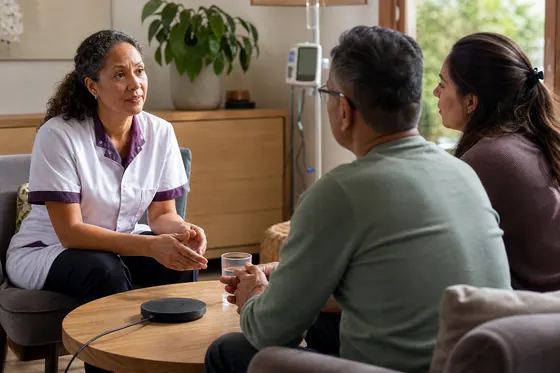
A structured report in your professional terminology
From care encounter to report
Hysio turns spoken information into a report. Choose the report format for the conversation you are documenting.
Document
Record the conversation and clearly state your own findings and agreed actions.
AI assistants
You stay in control of what gets saved.
In your workday
More attention for the conversation, less typing afterwards.
State relevant information, your own findings and agreed actions aloud so you can find them in your report.
The information appears under the headings of your chosen report format, so you can review each section.
Check names, facts and agreed actions. Edit the text where needed before using the report in your records.
Try it yourself
Try Hysio free for 14 days or schedule a personal demo.
For your team
Quick answer
Four documentation formats for conversations about wishes, symptoms at home and consultation with loved ones and team.
Here is a brief overview of how Hysio writes up palliative conversations and home visits. You read every report back, even when time is short.
For palliative care nursing, there are 4 documentation formats: Palliative Care Conversation, Advance Care Planning (ACP), Palliative Home Visit & Symptom Report and Palliative Family Meeting & MDT Meeting. The palliative care nurse chooses the format that fits the care moment and checks source, observation, agreements and follow-up before any text goes to the record. [3] [4] [5] [6] [1]
Palliative Care Conversation is intended for palliative care nursing. Within palliative care at home or in a care facility, Palliative Care Conversation helps you with values and agreements around advance care planning and values. Around the family meeting and MDT meeting, you read observation, assessment and follow-up each separately. For comfort, loved ones and agreed follow-up, the palliative care nurse reads back what Palliative Care Conversation records; your judgement remains decisive. This keeps advance care planning and values recognisable for the next colleague. [3]
Advance Care Planning (ACP) is one of the four documentation formats within palliative care nursing. For symptoms during a home visit, the format gives structure for values and agreements. Around comfort, loved ones and agreed follow-up, your observation, interpretation and next step do stay recognisable as separate parts. For the palliative care conversation, you set the contact alongside Advance Care Planning (ACP); comfort-focused palliative care remains dependent on your final professional judgement. In this way, for symptoms during a home visit, always compare what has already been established with what is still open. [4]
For palliative care nursing, Palliative Home Visit & Symptom Report links source and follow-up with the family meeting and MDT meeting in palliative care at home or in a care facility. For the palliative care conversation, you set fact, assessment and follow-up side by side. Around advance care planning and values, the palliative care nurse checks the text of Palliative Home Visit & Symptom Report; you decide what carries forward. This keeps the family meeting and MDT meeting linked to the right care moment. [5]
Around comfort, loved ones and agreed follow-up, Palliative Family Meeting & MDT Meeting makes room for input and agreements. Around advance care planning and values, you do not mix observation and professional interpretation. For symptoms during a home visit, the palliative care nurse checks whether Palliative Family Meeting & MDT Meeting reflects the care moment correctly; that interpretation remains your responsibility. This way the palliative care nurse can continue working in a focused way on comfort, loved ones and agreed follow-up. [6]
The Palliative Care Conversation format is for palliative care nursing. Within palliative care at home or in a care facility, Palliative Care Conversation connects the family meeting and MDT meeting with values and agreements. For the palliative care conversation, the next colleague can read back your observation. Around advance care planning and values, the palliative care nurse checks Palliative Care Conversation before saving; you keep deciding. This gives the family meeting and MDT meeting a clear place in the follow-up. [3]
Around values and agreements, Advance Care Planning (ACP) also keeps comfort, loved ones and agreed follow-up visible in palliative care at home or in a care facility. For advance care planning and values, you leave an open question in place until it has been discussed. For symptoms during a home visit, the palliative care nurse keeps the content of Advance Care Planning (ACP) next to the source; you determine the follow-up. This keeps the line around comfort, loved ones and agreed follow-up verifiable for you. [4]
The Palliative Home Visit & Symptom Report format gives palliative care nursing a place for source and follow-up in the palliative care conversation. Around symptoms during a home visit, the order of the care moment stays intact. For the family meeting and MDT meeting, the palliative care nurse asks follow-up questions about what Palliative Home Visit & Symptom Report describes; your interpretation remains necessary. This connects the palliative care conversation to the next step in care. [5]
For the palliative care nurse, Starter costs €20 per month, excl. VAT. Pro costs €40 and Unlimited €80. You pay the same for a care conversation, a home visit or an MDT meeting report. [7]
Conversations about dying, sedation or wishes around the end of life are extra sensitive. Agree with your organisation what you record and who may read the report. Only mention what is needed for the care. Loved ones being present does not mean everything may go into the report. [9]
For palliative care nursing, comfort-focused palliative care helps to interpret advance care planning and values properly. For symptoms during a home visit, you read the original source together with this information: Palliative sedation: indication: The physician is responsible for the indication for palliative sedation. Various healthcare professionals, including the nurse, provide important input for that indication, but do not make it independently. Around the family meeting and MDT meeting, you keep observation, interpretation and agreement recognisably separate. For advance care planning and values, the palliative care nurse retains professional responsibility. [17]
For the family meeting and MDT meeting, the comfort-focused palliative care of palliative care nursing comes together. For the palliative care conversation, you read the original source together with this information: Home care / community nursing: Community nursing falls under the Zorgverzekeringswet (Dutch Health Insurance Act); the community nurse plays a role in collaboration with the general practitioner, including through PaTz groups (256 groups active in the 2024 survey). For symptoms during a home visit, you record the open point alongside the outcome. [19]
This connects the palliative care conversation to comfort-focused palliative care for palliative care nursing. For the family meeting and MDT meeting, you read the original source together with this information: Primary care / network care: PaTz groups (general practitioner, community nurse, palliative care expert) numbered 256 groups in the 2024 survey, with an 84% response rate; participation by spiritual caregivers (58%), pharmacists (29%) and practice nurses (25%) is growing. For advance care planning and values, your own observation remains traceable in the report. [15] [17]
For palliative care nursing, comfort-focused palliative care is central for symptoms during a home visit. For advance care planning and values, you read the original source together with this information: Documentation as an ongoing part of every contact, not as a separate block. The generic documentation guideline states that documentation takes place in all phases of the nursing process, not only afterwards. Around the palliative care conversation, you note what you yourself saw, did and discussed. For symptoms during a home visit, the palliative care nurse checks date, meaning and professional context before saving. [13] [12] [14]
In palliative care at home or in a care facility, Palliative Family Meeting & MDT Meeting puts the emphasis on input and agreements for symptoms during a home visit. For comfort, loved ones and agreed follow-up, you first note what happened and then the follow-up. For the palliative care conversation, the palliative care nurse assesses what Palliative Family Meeting & MDT Meeting brings together; you stay in control. This keeps symptoms during a home visit readable at the next handover. [6]
For values and agreements, Palliative Care Conversation is intended for the family meeting and MDT meeting. For the palliative care conversation, it stays visible what you saw and what you decided. The palliative care nurse reads back Palliative Care Conversation around advance care planning and values; only substantiated text remains. This clearly records, for the family meeting and MDT meeting, what has been discussed. [3]
For comfort, loved ones and agreed follow-up, Advance Care Planning (ACP) helps to describe values and agreements clearly. Around advance care planning and values, you keep the fact separate from the agreement. For symptoms during a home visit, the palliative care nurse lets Advance Care Planning (ACP) match the contact; then you decide. This keeps comfort, loved ones and agreed follow-up available for the joint debrief. [4]
Within palliative care at home or in a care facility, Palliative Home Visit & Symptom Report connects the palliative care conversation with source and follow-up. For symptoms during a home visit, the next colleague can read back your observation. Around the family meeting and MDT meeting, the palliative care nurse checks Palliative Home Visit & Symptom Report before saving; you keep deciding. This gives the palliative care conversation a clear place in the follow-up. [5]
Writing yourself often happens at the end of the day, when the conversation was hours ago. With dictating, you record what was said shortly after the conversation, and Hysio organises it. Compare a few conversations on two points: how much you had to correct and how well a night shift colleague reads the report. [10]
The trial lasts 14 days and is free. Make up a case, for example a conversation about pain and breathlessness with a partner present. Record it and see whether wishes, symptoms and agreements stay properly separate. [8]
The practice of palliative care nursing calls for comfort-focused palliative care in advance care planning and values. For symptoms during a home visit, you read the original source together with this information: The Richtlijn Proactieve Zorgplanning (guideline on advance care planning) is a palliative-care-specific source on care planning. The guideline is published through Stichting PZNL with NHG as the lead organisation and was adopted on 20 June 2023. It helps to record values, wishes and agreements in the care conversation recognisably. Around the family meeting and MDT meeting, you note only what was established during this contact. [18]
Around the family meeting and MDT meeting, palliative care nursing holds on to the line of comfort-focused palliative care. For the palliative care conversation, you read the original source together with this information: The broader framework is the Kwaliteitskader Palliatieve Zorg Nederland (quality framework for palliative care in the Netherlands), drawn up by Stichting PZNL with IKNL and Palliactief as lead organisations, originally adopted on 14 September 2017 and maintained on Palliaweb since then. For symptoms during a home visit, you make visible which information still needs to be checked. Before saving, the palliative care nurse looks at completeness and origin for the family meeting and MDT meeting. [15]
In palliative care at home or in a care facility, the palliative care conversation stays connected with comfort-focused palliative care for palliative care nursing. For the family meeting and MDT meeting, you read the original source together with this information: Electronic documentation, use an individual care record for every client, and use unambiguous language through information standards such as eOverdracht. For advance care planning and values, you describe the contact as it took place. Around the palliative care conversation, the palliative care nurse decides what fits in the report after checking. [13]
For palliative care nursing, comfort-focused palliative care helps to interpret symptoms during a home visit properly. For advance care planning and values, you read the original source together with this information: The generic documentation guideline uses the nursing process as its organising principle: data collection, client problem, goal, intervention and evaluation. Electronic documentation also calls for an individual care record and unambiguous language through information standards such as eOverdracht. Around the palliative care conversation, you keep observation, interpretation and agreement recognisably separate. For symptoms during a home visit, the palliative care nurse retains professional responsibility. [12]
Palliative Family Meeting & MDT Meeting is for palliative care nursing. For palliative care nursing, Palliative Family Meeting & MDT Meeting links input and agreements with symptoms during a home visit in palliative care at home or in a care facility. For comfort, loved ones and agreed follow-up, you set fact, assessment and follow-up side by side. Around the palliative care conversation, the palliative care nurse checks the text of Palliative Family Meeting & MDT Meeting; you decide what carries forward. This keeps symptoms during a home visit linked to the right care moment. [6]
Around the family meeting and MDT meeting, Palliative Care Conversation makes room for values and agreements. Around the palliative care conversation, you do not mix observation and professional interpretation. For advance care planning and values, the palliative care nurse checks whether Palliative Care Conversation reflects the care moment correctly; that interpretation remains your responsibility. This way the palliative care nurse can continue working in a focused way on the family meeting and MDT meeting. [3]
In palliative care at home or in a care facility, Advance Care Planning (ACP) puts the emphasis on values and agreements for comfort, loved ones and agreed follow-up. For advance care planning and values, you first note what happened and then the follow-up. For symptoms during a home visit, the palliative care nurse assesses what Advance Care Planning (ACP) brings together; you stay in control. This keeps comfort, loved ones and agreed follow-up readable at the next handover. [4]
For source and follow-up, Palliative Home Visit & Symptom Report is intended for the palliative care conversation. For symptoms during a home visit, it stays visible what you saw and what you decided. The palliative care nurse reads back Palliative Home Visit & Symptom Report around the family meeting and MDT meeting; only substantiated text remains. This clearly records, for the palliative care conversation, what has been discussed. [5]
No. Hysio does not write in the client record and has no link with the system of the home care organisation or the hospice. You transfer the approved text. With voice-driven admin too, that stays your step. Make sure that agreements about sedation or resuscitation are exactly right. [11] [10]
In a family meeting, several people often speak. So check who said what and whether the client's wishes stand apart from those of loved ones. With voice-driven reporting, the judgement on what is right stays with you. Remove what was not discussed that way. [10]
For comfort-focused palliative care, advance care planning and values form an important starting point in palliative care nursing. For symptoms during a home visit, you read the original source together with this information: five clinimetric instruments for pain are the pain history and BAT for self-assessment, and REPOS, PACSLAC-D and PAINAD as observation instruments. Around the family meeting and MDT meeting, it stays clear what you heard, saw and did yourself. [15] [16] [17]
The Palliative Family Meeting & MDT Meeting format gives palliative care nursing a place for input and agreements for comfort, loved ones and agreed follow-up. Around advance care planning and values, the order of the care moment stays intact. For symptoms during a home visit, the palliative care nurse asks follow-up questions about what Palliative Family Meeting & MDT Meeting describes; your interpretation remains necessary. This connects comfort, loved ones and agreed follow-up to the next step in care. [6]
In palliative care at home or in a care facility, Palliative Care Conversation makes values and agreements in the palliative care conversation easier to follow. For symptoms during a home visit, observation, assessment and agreement each get room. For the family meeting and MDT meeting, the palliative care nurse checks that Palliative Care Conversation contains no assumption; you decide yourself. For the palliative care conversation, the healthcare professional determines what is needed next. [3]
In palliative care at home or in a care facility, Advance Care Planning (ACP) brings together values and agreements around advance care planning and values. For the family meeting and MDT meeting, you keep observation, assessment and follow-up apart. For comfort, loved ones and agreed follow-up, the palliative care nurse checks what Advance Care Planning (ACP) has recorded; you decide on the follow-up. Around advance care planning and values, there remains room for your professional judgement. [4]
Palliative Home Visit & Symptom Report fits a physical home visit for palliative care nursing. Within palliative care at home or in a care facility, Palliative Home Visit & Symptom Report helps you with source and follow-up around symptoms during a home visit. Around comfort, loved ones and agreed follow-up, you read observation, assessment and follow-up each separately. For the palliative care conversation, the palliative care nurse reads back what Palliative Home Visit & Symptom Report records; your judgement remains decisive. This keeps symptoms during a home visit recognisable for the next colleague. [5]
For the family meeting and MDT meeting, Palliative Family Meeting & MDT Meeting gives structure for input and agreements. For the palliative care conversation, your observation, interpretation and next step stay recognisable. The palliative care nurse compares Palliative Family Meeting & MDT Meeting with the contact for advance care planning and values; the final assessment is yours. This lets you see, for the family meeting and MDT meeting, what has been established and what is still open. [6]
For palliative care nursing, Palliative Care Conversation links values and agreements with comfort, loved ones and agreed follow-up in palliative care at home or in a care facility. For advance care planning and values, you set fact, assessment and follow-up side by side. Around symptoms during a home visit, the palliative care nurse checks the text of Palliative Care Conversation; you decide what carries forward. This keeps comfort, loved ones and agreed follow-up linked to the right care moment. [3]
Around the palliative care conversation, Advance Care Planning (ACP) makes room for values and agreements. Around symptoms during a home visit, you do not mix observation and professional interpretation. For the family meeting and MDT meeting, the palliative care nurse checks whether Advance Care Planning (ACP) reflects the care moment correctly; that interpretation remains your responsibility. This way the palliative care nurse can continue working in a focused way on the palliative care conversation. [4]
Go back to what the client actually said. Adjust the passage and check whether the change also affects the care plan or the handover. Admin with AI does not correct professional content by itself. The text is only ready after your check. [10]
Leave the gap visibly open and do not fill anything in by feel. Ask the colleague or the loved one who was there. With voice-driven reporting, a gap is better than a guess, especially with agreements about the end of life. [10]
For the family meeting and MDT meeting, Palliative Home Visit & Symptom Report helps to describe source and follow-up clearly. Around the palliative care conversation, you keep the fact separate from the agreement. For advance care planning and values, the palliative care nurse lets Palliative Home Visit & Symptom Report match the contact; then you decide. This keeps the family meeting and MDT meeting available for the joint debrief. [5]
Within palliative care at home or in a care facility, Palliative Family Meeting & MDT Meeting connects comfort, loved ones and agreed follow-up with input and agreements. For advance care planning and values, the next colleague can read back your observation. Around symptoms during a home visit, the palliative care nurse checks Palliative Family Meeting & MDT Meeting before saving; you keep deciding. This gives comfort, loved ones and agreed follow-up a clear place in the follow-up. [6]
Around values and agreements, Palliative Care Conversation also keeps the palliative care conversation visible in palliative care at home or in a care facility. For symptoms during a home visit, you leave an open question in place until it has been discussed. For the family meeting and MDT meeting, the palliative care nurse keeps the content of Palliative Care Conversation next to the source; you determine the follow-up. This keeps the line around the palliative care conversation verifiable for you. [3]
The Advance Care Planning (ACP) format gives palliative care nursing a place for values and agreements in advance care planning and values. Around the family meeting and MDT meeting, the order of the care moment stays intact. For comfort, loved ones and agreed follow-up, the palliative care nurse asks follow-up questions about what Advance Care Planning (ACP) describes; your interpretation remains necessary. This connects advance care planning and values to the next step in care. [4]
Palliative Home Visit & Symptom Report is intended for palliative care nursing. In palliative care at home or in a care facility, Palliative Home Visit & Symptom Report makes source and follow-up for symptoms during a home visit easier to follow. For comfort, loved ones and agreed follow-up, observation, assessment and agreement each get room. For the palliative care conversation, the palliative care nurse checks that Palliative Home Visit & Symptom Report contains no assumption; you decide yourself. For symptoms during a home visit, the healthcare professional determines what is needed next. [5]
In palliative care at home or in a care facility, Palliative Family Meeting & MDT Meeting brings together input and agreements around the family meeting and MDT meeting. For the palliative care conversation, you keep observation, assessment and follow-up apart. For advance care planning and values, the palliative care nurse checks what Palliative Family Meeting & MDT Meeting has recorded; you decide on the follow-up. Around the family meeting and MDT meeting, there remains room for your professional judgement. [6]
Yes, the palliative care conversation also fits when at home you mainly discuss pain, breathlessness or restlessness. You then record per symptom what the client and loved ones said, what you saw and which agreements on comfort followed. Your judgement remains decisive, and the next colleague can see what was agreed. [3]
The Advance Care Planning (ACP) format is intended for palliative care nursing. For the palliative care conversation, Advance Care Planning (ACP) gives structure for values and agreements. For symptoms during a home visit, your observation, interpretation and next step stay recognisable. The palliative care nurse compares Advance Care Planning (ACP) with the contact for the family meeting and MDT meeting; the final assessment is yours. This lets you see, for the palliative care conversation, what has been established and what is still open. [4]
First note how long writing up and reading back take now, for example after a home visit. Do the same after a week with dictating. Only count it as a gain if you have less to correct and the report is just as complete. [10]
Start with one type of conversation, for example the home visit. Agree who reads along with the reports in the first weeks. Then expand voice-driven reporting step by step. AI reporting does not take over the conversation with the client. [10] [9]
Hysio creates the report. You remain responsible for what you save in the record.