Document
Keep your attention on the care encounter.
Record the conversation and clearly state your own findings and agreed actions.
Hysio Operating Theatre Nursing
You say what happened in the holding area and during the procedure. Hysio organises it into an intake, procedure report or team handover.
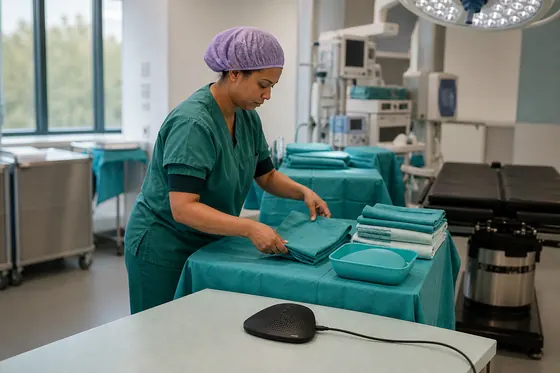
A structured report in your professional terminology
From care encounter to report
Hysio turns spoken information into a report. Choose the report format for the conversation you are documenting.
Document
Record the conversation and clearly state your own findings and agreed actions.
AI assistants
You stay in control of what gets saved.
In your workday
More attention for the conversation, less typing afterwards.
State relevant information, your own findings and agreed actions aloud so you can find them in your report.
The information appears under the headings of your chosen report format, so you can review each section.
Check names, facts and agreed actions. Edit the text where needed before using the report in your records.
Try it yourself
Try Hysio free for 14 days or schedule a personal demo.
For your team
Quick answer
Three documentation formats for the perioperative process: intake in the holding area, procedure report and team handover.
This is how Hysio records the work in the operating theatre. You read every report back before it goes into the client's record.
There are three formats. The Preoperative Nursing Intake is for the conversation in the holding area. The Nursing Procedure Report follows the procedure itself. The Team Handover is for the next setting, such as the recovery unit. With voice-driven reporting, you say after the moment what happened, and you read the text back. [3] [4] [5] [1]
The Intake turns one conversation in the holding area or a direct dictation in the operating theatre into a preoperative intake report. There are fixed sections: summary, context and sources, data collection, professional assessment, follow-up and additional information. What you did not check stays open. Hysio does not set an indication. [3]
The procedure report turns one dictation about the procedure into a report faithful to the source. Team roles, the time-out, your support, counts, materials, implants, specimens and the sign-out stay traceable per moment. Hysio does not count itself and does not check anything in your place. [4]
The Team Handover turns a verbal handover or short dictation into a report for the next setting. Procedure, side, sign-out, anaesthesia and measurement sources, wound, lines, deviations, open actions and the receipt status stay separate per source and reference time. [5]
With the client, you check identity, procedure and side, and ask about allergies, fasting and medication. You also mention what you find in the record. Hysio puts it under the right headings and keeps the source with every item. What still needs to be checked stays open. [3]
Name who had which role, when the time-out was and what was checked during it. Say which support you gave, which materials and implants were used and how the counts came out. Finish with the sign-out. Hysio puts it in the order of the procedure. [4]
Say what was done, on which side, and what the sign-out showed. Mention wound, drains and lines, and any deviations. Say what still needs to happen. You state the anaesthesia data with the anaesthesia nurse as the source. [5]
Say how you checked the identity and what the client said about the procedure and the side. Mention what is in the schedule or the record. If something does not match, both versions stay in. Hysio does not choose which one is correct. [3]
Starter is €20 per month, excl. VAT, for one healthcare professional. How many procedures you record makes no difference to the price. When comparing with typing yourself, also count the reading back. You decide which text you transfer. [6]
In the holding area, clients are often next to each other. So record where others cannot listen in. Only include what is needed for the care of this client. Your hospital decides who may read, edit and approve the report. [8]
No. Operating theatre assistant is not mentioned in the Wet BIG. So there is no title protection: in the Netherlands anyone may call themselves an operating theatre assistant. In your report, you keep observation, interpretation and agreement recognisably apart, and the responsibility stays with you. [18] [16] [17]
On 25 May 2021, Zorginstituut Nederland advised not to include the operating theatre assistant in article 3 of the Wet BIG. According to the advice, the request did not meet all the criteria for a statutory regulation to protect the client. For your report, that changes nothing about the care you take. [19]
A similar process took place for the anaesthesia nurse, with advice dated 10 March 2020. That did not lead to inclusion in the Wet BIG either. In your report, your own observation stays traceable. A conclusion you cannot substantiate, you leave out. [20]
Via the technical stream of the HBO-V nursing degree, called HBO-PV since 1 March 2026. You complete the full bachelor's in nursing and an additional CZO-recognised curriculum for operating theatre assistant or anaesthesia nurse. You then hold the nursing degree, with BIG registration as a nurse, and the CZO diploma for operating theatre assistant. [18] [27]
Whoever completes this bachelor's is a BIG-registered nurse and a qualified operating theatre assistant or anaesthesia nurse. In practice, you therefore work with two backgrounds. In your report, record what you saw and did yourself, with date and context. [27]
Yes. Part of the professional group, an estimated 5,000 operating theatre assistants in the Netherlands, came in through a four-year in-house hospital training, without a separate nursing degree. In your report, write down what really happened during the procedure, whatever your training route. [26]
The sign-out is a mandatory team check before the client leaves the operating theatre. Among other things, the team counts swabs, instruments and disposables, and checks the handling of specimens and the handover information. The report states what was actually checked and by whom. [14] [15]
The planning meeting is a separate process, step 3 of the guideline, in which the operating list is put together. Agreements from that meeting should appear recognisably alongside the other source information. Mention them in your intake with the meeting as the source. [13]
Typing in the operating theatre often happens between two procedures, under time pressure. When you dictate, you briefly say what happened and Hysio organises it in the chosen format. Reading back stays your task. See whether you need to correct less and whether the recovery unit understands the handover well. [9]
Make up a few procedures, for example a short day case and a procedure with an implant. Record them as you would after a real procedure. Check whether counts, materials and the sign-out come back correctly. [7]
On the WGBO, in book 7, section 5 of the Dutch Civil Code. Especially article 454 on the duty to keep a record and article 457 on professional confidentiality matter. For each procedure, only note what was established, and keep fact and assessment apart. [11]
They go back to the WHO Surgical Safety Checklist, with sign-in, time-out and sign-out. In the Netherlands it was adapted into its own structure of safety pauses. For team handovers, for example to the recovery unit, many hospitals use SBAR. Show which information still needs to be checked. [21]
You record the manufacturer, the product number and the lot number of an implant. That matters if there is a recall later. State the numbers as they appear on the packaging. Hysio does not fill in a number and does not check anything against a list. [12]
The current standard from 2024 is the Dutch standard for an information security management system in healthcare. Existing certificates must move to the new version before 20 February 2027. NEN 7513:2024 is about logging actions on personal data. These are requirements for organisations and systems, not for your report. [23]
For each count moment, state what was counted, by whom and what the result was. Hysio does not count itself and only adopts what you say. If a count does not add up, say so literally. That way the report stays honest and can be checked. [3]
For each item, state what is in place, where and in what condition. Also say what the next setting needs to check. Hysio adds nothing you did not mention. In the team handover it goes under current care. [5]
State what the client says and what you find in the record, each with its source. Say if something could not be verified. Hysio does not conclude whether someone has fasted. That judgement stays with the team. [3]
State the implant, the manufacturer, the product and lot number and the moment of placement. Say who passed it on. Hysio adopts the numbers as you state them. Then read them back extra carefully against the packaging or the sticker. [4]
No, there is no link with your hospital's record. After reading back, you transfer the text yourself. Then check that you have the right client and procedure. Otherwise follow the agreements of the operating theatre complex. [10] [9]
Read the report from top to bottom and compare it with the count, the stickers and your notes. Are roles, times and numbers right? Admin with AI takes over the typing, but this check stays with you. [9]
The nursing procedure text uses health and care information models (zibs) from Zibs 2024 and the Basisgegevensset Zorg, the national minimum client summary. They cover general data, but not every detail of a theatre procedure report. In your report, it stays clear what you heard, saw and did yourself. [24]
It shows whether the next setting has already received the handover. When recording, say to whom you handed over, on which ward and at what time. Hysio does not write that something was received if you do not mention it. If the handover has not yet taken place, it says so too. [5]
Note both, each with its source: what the client says and what the schedule shows. Hysio does not choose a version. Put the difference down as an open point, so that the team discusses it before the procedure starts. [3]
State when the time-out was, who was present and which points were checked. A point that was not discussed, you do not state as checked. Hysio does not complete the list. That way the time-out is represented honestly. [4]
For each value, state who or what the source is: the anaesthesia nurse, the monitor or your own measurement. Hysio keeps those sources apart. That way the recipient knows where each item comes from. [5]
Yes. The Intake can start from a conversation in the holding area or from a direct dictation in the operating theatre. Say which of the two it is, because that determines how a colleague reads the report. State what you checked with the client yourself and what comes from the record or the schedule. [3]
State who had which role and when someone changed over. At a changeover, also say what was handed over. Hysio puts the roles at the right moment. That way it can be traced afterwards who did what. [4]
Describe what deviated, when, and what was done. Name who assessed it. Hysio does not interpret the deviation. In the team handover it goes under deviations, with the open actions. [5]
First find out whether the error was in your dictation or in the organisation of the text. Only adjust that part. If it also appears in the team handover, correct it there too. Hysio never makes a substantive choice itself. [9]
Do not guess, certainly not with a count or a lot number. Check it with the circulating or scrub nurse who was there. Voice-driven admin works best with short dictations straight after each safety pause. A gap is safer than a guess. [9]
In client-facing professions, administration mainly consists of documenting care, accounting for about 19% of total working time. That is a sector figure and says nothing about your working day. Record your own observation and the follow-up, with the date. [25]
In a full list there is little room to learn a new tool, even if it saves time in the long run. Before a hospital allows speech or AI support in the operating theatre, preconditions apply, such as the current security standard, logging under NEN 7513 and a data processing agreement. Ask your organisation about those agreements. [22] [11]
Only state what was really agreed, such as an extra check or a question for the anaesthetist. An open question stays open. Hysio does not turn an idea into an agreement. Name who takes something up, if that is known. [3]
State which specimen was taken, how it was labelled and where it is going, for example to pathology. Say who checked it and when it left the operating theatre. Hysio does not add any label data. Read this part back extra carefully, because an error in a label is hard to put right. [4]
Only record what the next setting needs now: what was done, how the client is doing and what still needs to happen. The details are already in the procedure report. The Team Handover has fixed headings, so that nothing important is missing and the colleague in the recovery unit can start quickly. [5]
Name the ward as the source, for example the nurse who brought the client. What you check yourself, you state separately. Hysio does not turn their information into a check of your own. That way it stays clear what you have already checked. [3]
Say literally what did not add up, at which count moment, and what the team then did. Name who decided on the follow-up. Hysio does not fill anything in and does not make the count balance. Otherwise follow the procedure of your operating theatre complex. [4]
Say it in this order: the situation, the background, your assessment and what needs to happen. Hysio keeps that order in the fixed headings. An assessment you do not state, Hysio does not add. [5]
Keep track for a few days of how long reporting takes, including reading back. Then do the same with Hysio for comparable procedures. AI reporting is only a gain if the report stays at least as complete. So also look at counts and numbers. [9]
Start with one format, for example the team handover, and practise with made-up procedures. Agree with your organisation who approves reports and how you handle privacy. Evaluate after a few weeks. Then expand step by step. [9] [8]
Hysio creates the report. You remain responsible for what you save in the record.