Document
Keep your attention on the care encounter.
Record the conversation and clearly state your own findings and agreed actions.
Hysio Anaesthesia Nursing
After the screening or the procedure, you say what happened. Hysio organises it into an intake report, care documentation or handover to the recovery unit.
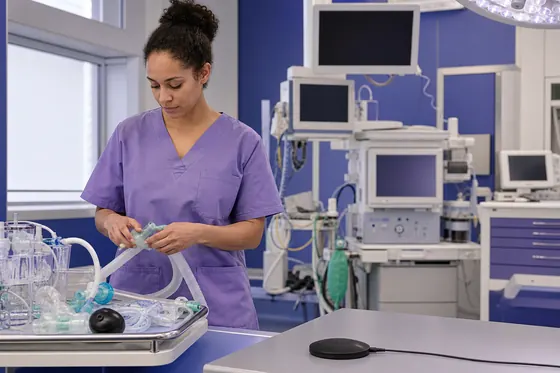
A structured report in your professional terminology
From care encounter to report
Hysio turns spoken information into a report. Choose the report format for the conversation you are documenting.
Document
Record the conversation and clearly state your own findings and agreed actions.
AI assistants
You stay in control of what gets saved.
In your workday
More attention for the conversation, less typing afterwards.
State relevant information, your own findings and agreed actions aloud so you can find them in your report.
The information appears under the headings of your chosen report format, so you can review each section.
Check names, facts and agreed actions. Edit the text where needed before using the report in your records.
Try it yourself
Try Hysio free for 14 days or schedule a personal demo.
For your team
Quick answer
Three documentation formats that follow the perioperative process: before the procedure, during anaesthesia and at the handover.
A short overview of what Hysio records around anaesthesia. You read every text back before it goes into the record.
There are three formats. The Screening organises the preoperative conversation into an intake report. The Care Documentation follows the anaesthetic from induction to emergence. The Perioperative Handover is for the recovery unit. With voice-driven reporting, you record the screening or handover and you read back what goes to the recovery unit. [3] [4] [5] [1]
The Screening turns one preoperative conversation or retrospective dictation into an intake report. It contains the context and sources, the data you collected, your professional assessment and the follow-up. What you did not ask stays open. Hysio does not set an indication or make a diagnosis. [3]
The Care Documentation organises one retrospective dictation from induction up to and including emergence. Airway, ventilation, monitoring, medication, fluids, the client's response and instructions each get a place. For each item, source, time and status stay visible: done, requested or still open. [4]
The Perioperative Handover organises what the operating theatre passes on to the recovery unit. You state the current care, the source information, open actions and the follow-up. That way the recovery unit sees quickly what is going on. Before the handover, you check that the text matches what happened. [5]
The Screening belongs to the conversation before the procedure. The Care Documentation belongs to what happens during anaesthesia. They have a different purpose and a different reader. Choose the format that fits the moment you are recording. [3]
For each phase, say what you did, what you saw and which values you measured. Also say what the anaesthetist asked and whether it has been carried out. Hysio puts it in time order and does not move anything to another phase. A phase you do not mention, Hysio does not fill in. [4]
Say how the client is now, what was given during the procedure and what is still open. Think of pain relief, fluids and agreements on checks. Hysio does not set a priority. That way the recovery unit reads straight away what you handed over. [5]
Yes. Record the conversation as soon as you can, and say that it is a retrospective dictation. State what the client said and what you checked yourself. What you are no longer sure about, you mark as uncertain. Hysio does not make it more definite than you said it. [3]
With Starter you pay €20 per month, excl. VAT. The price does not depend on the number of procedures or documentation formats. When comparing, also count the time for reading back and correcting. You decide what you transfer to the record. [6]
Agree with your hospital who may listen, read, edit and approve. Only record what is needed for the care of this client. Being present in the operating theatre does not give anyone a right of access. You decide what is kept or shared, following local agreements. [8]
Since 1 March 2026, the CZO awards the HBO-PV anaesthesia nurse qualification, instead of the earlier HBO-VT title. This does not create a new role of perioperative nurse. In your record, the professional responsibility stays with you. [14] [15] [16]
According to article 33 of the Wet BIG, it concerns observation, support, nursing and personal care. Procedures on instruction that follow on from the diagnostic or therapeutic work of an authorised professional also fall under it. For such a procedure, record who gave the instruction. [13]
The source of 24 July 2024 mentions, among other things, history taking, recognising health problems, the nursing plan, delivering care, evaluating and reporting. These belong to the five-yearly re-registration. A clear report shows what you observed and did yourself. [21]
A reserved procedure may only be carried out by someone who is authorised and competent. When it is carried out on instruction, the conditions of that instruction, the directions of the person giving it and the possibility of supervision or intervention also apply. Note what you did yourself and on whose instruction. [11] [12]
At emergence and sign-out, you bring the anaesthetic to an end and the team does a final check before the client leaves the operating theatre. Data on client, surgery and anaesthesia go to the recovery unit. Record your own observation and the agreed follow-up, with the time. [18]
Say what you did and what you saw, with the moment. If it concerns a setting, state the value as you read it. Hysio does not interpret the values. If you are unsure about a number, it stays an open point. [4]
Say what was administered, how much, when and on whose instruction. Requested but not yet given is a different status from administered. Hysio keeps those statuses apart. Check that dose and unit are right before you use the text. [5]
Name the anaesthetist as the source of an instruction. Then say whether you carried it out. Hysio does not turn an instruction into a completed action. That way the next colleague reads exactly who decided and did what. [3]
You often type in between or afterwards. When you dictate, you first say what happened and Hysio organises it afterwards. Admin with AI takes away the typing, but reading back remains. Compare how much you need to correct and whether the text is clear for the recovery unit. [9]
Choose a few fictional procedures, for example a short procedure under sedation and a longer one under general anaesthesia. Record them as you would after a real procedure. See whether instructions, administrations and responses stay properly apart. [7]
The NVA Leidraad Perioperatieve Zorg (perioperative care guidance) was published on 23 May 2024. It replaces three earlier documents: the 2019 NVA guideline on anaesthetic care in the perioperative process, the position statement on off-label use in anaesthesiology and the professional framework on informed consent. In your record, only note what was established at this contact. [16]
For procedural sedation outside the operating theatre, the module on discharge criteria after sedation and analgesia in adults in the Richtlijnendatabase applies, updated on 23 May 2024. Show in your report which information still needs to be checked before someone goes home. [19]
The preoperative phase follows the order of Step 2: medical history, medication, allergy, physical examination and additional tests. Record in that order, and the screening stays clear. Describe the conversation as it really went. [17] [20]
Leave the value empty and say that it is missing. Hysio does not choose a normal value and does not estimate anything. Look the value up on the monitor printout or ask. Only then do you add it yourself. [4]
Say what you saw and heard, and when. A response you did not observe, you do not mention. Hysio does not link a drug to a response if you do not say so. If you want to interpret it yourself, name it as your assessment. [5]
State what the client says and what you find in the record, each with its source. Also say if someone does not know. Hysio does not turn "no known allergy" into "no allergy". Read this part back extra carefully. [3]
State times at induction, important actions and emergence. If you do not know a time exactly, say that it is an estimate. Hysio does not move times. After recording, check whether the order is still logical. [4]
Everything that still needs to happen or be checked. Think of a check that is still running or an agreement on pain relief. Name who takes it up, if that has already been agreed. Hysio does not turn an open question into a decision. [5]
No. Hysio stays outside the electronic client record. You transfer the checked passage yourself, following the agreements of the theatre team. First check the client, the source and whether everything is complete. A documentation format is not a technical link. [10] [9]
Set the text against your own picture of the procedure. Pay attention to times, doses, units and who instructed what. Does the follow-up match what was agreed? Hysio organises, but you correct and approve. [9]
A reserved procedure may only be carried out by someone authorised and competent, possibly on instruction. Around anaesthesia, it often concerns procedures on the directions of the anaesthetist. In your record, it stays clear what you heard, saw and carried out yourself. [11] [12]
No. Hysio does not set an ASA class, indication or risk. If the anaesthetist states a class, it appears in the report with the anaesthetist as the source. That way it stays clear who made the assessment. [3]
Describe factually what happened, when, and what you did. Keep observation and interpretation apart. A report through your hospital's incident route is something other than a text in the record. Make that report separately. [4]
Say which points the team checked and what was agreed. If something was not discussed, you do not state it as checked. Hysio does not complete the list. That way the team check is represented honestly. [5]
Describe what you saw or did as concretely as possible. Name who assessed it. If you want it to stand out at a future procedure, agree that with your team. Hysio does not create a warning in another system. [3]
Use the Care Documentation and state the location, such as a treatment room. Record administration, monitoring and response as for a procedure in the operating theatre. At discharge, the agreements on discharge criteria apply. Hysio does not assess whether someone can go home. [4]
Note both, each with its source. Hysio does not choose a version. Put the difference down as an open point, so that the anaesthetist can discuss it. That is safer than silently keeping one version. [5]
Only record what the recovery unit needs now: condition, what was given, what is still open. The details are already in your care documentation. The handover follows fixed headings, so that nobody has to search. [3]
Go back to your source: what did you really say, measure or give? Only adjust the passage that is wrong. Check whether the same error also appears in the handover. Hysio does not change professional content without you. [9]
Mark it and do not guess. Listen back to the fragment or ask the anaesthetist what was said. A short dictation straight after the procedure usually works best. A visible gap is better than a guess. [9]
Usually after the procedure, as a retrospective dictation. During anaesthesia, your attention goes to the client. When recording, state the times you noted or read off. That way the report stays easy to follow afterwards. [4]
State the name or role of the colleague in the recovery unit and the time. Say what you handed over verbally. Hysio does not write that something was received if you do not mention it. [5]
Say what the original plan was, what changed and who decided it. State the moment. Hysio does not explain a reason you did not give. That way everyone can follow later why it went differently. [3]
Name the surgeon as the source. What you saw or did yourself, you say as your own observation. That way it stays clear which part of the record comes from whom. [4]
Say what the client indicated and what you saw, and what you gave for it. Only state a pain score if it was measured. Hysio does not make a score from a remark. What the recovery unit still needs to do goes under open actions. [5]
You decide that with the anaesthetist. Hysio shows which sections you have discussed and which are open. An empty section stays empty. That way you see at a glance what is still needed. [3]
Note what the client says about eating and drinking, with the times. Also say if you could not verify that. Hysio does not conclude whether someone has fasted. That judgement stays with the team. [4]
Yes, but you read each text back separately. The care documentation is for the anaesthesia record, the handover for the recovery unit. AI reporting helps you make both from the same account. Do check that the handover stays short enough. [5]
First measure how long recording, reading back and correcting take now. Then compare similar procedures with Hysio. Also look at completeness and clear professional language. A faster first text is only a gain if there is less to correct. [9]
Start with one type of procedure and a few practice cases. Agree who watches over source, privacy and approval. Check every text before saving. Only expand once it works well in the team. [9] [8]
Hysio creates the report. You remain responsible for what you save in the record.