Document
Keep your attention on the care encounter.
Record the conversation and clearly state your own findings and agreed actions.
Hysio Neonatal Nursing
You say what you saw in the newborn and what you discussed with the parents. Hysio organises it into an admission, care report, parent conversation or handover.
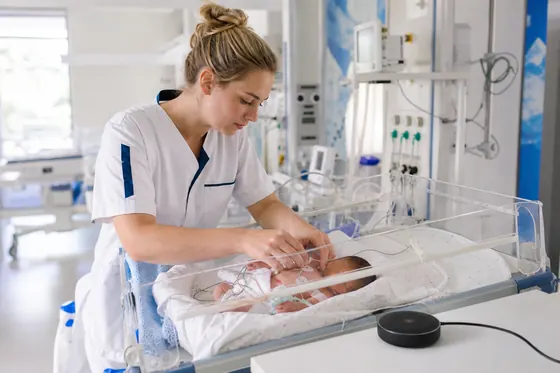
A structured report in your professional terminology
From care encounter to report
Hysio turns spoken information into a report. Choose the report format for the conversation you are documenting.
Document
Record the conversation and clearly state your own findings and agreed actions.
AI assistants
You stay in control of what gets saved.
In your workday
More attention for the conversation, less typing afterwards.
State relevant information, your own findings and agreed actions aloud so you can find them in your report.
The information appears under the headings of your chosen report format, so you can review each section.
Check names, facts and agreed actions. Edit the text where needed before using the report in your records.
Try it yourself
Try Hysio free for 14 days or schedule a personal demo.
For your team
Quick answer
Four documentation formats for neonatal care: admission, care and observation report, parent conversation and handover or discharge.
An overview of what Hysio records in neonatal care. You read every report back before it goes into the child's record.
There are four formats. The Admission records your first nursing assessment. The Care & Observation Report follows a care round, a shift or an event. The Parent Conversation keeps track of what was discussed with the parents. Handover & Discharge is for the next ward or going home. With voice-driven reporting, you say after the care what happened, and you read it back. [3] [4] [5] [6] [1]
The Admission turns your first nursing assessment into a traceable admission report. That happens after a medical admission decision by an authorised doctor. You see the handover information, your first observations, the care delivered and the follow-up. What you did not assess stays open. [3]
This report turns one care round, part of a shift or an event into a report in time order. Observations, care delivered, the child's response and the follow-up each get their own section. Hysio does not add an interpretation of its own. That way it stays visible what you really saw and did. [4]
The Parent Conversation turns one conversation with the parents into a compact report. You see who said what, what you explained and which agreements were made. The parents' perspective gets a place of its own. Hysio does not summarise their words into a judgement of its own. [5]
This format turns what you say and at most three relevant source files into a handover or discharge report. The course, the current condition, support, medication, nursing problems and the handover status stay separate. What the parents contribute stands apart from the clinical information. [6]
You say what you heard at the handover, what you saw yourself at the first assessment and which care you gave. Think of breathing, temperature, colour and the first feed. For each item, state the source and the time. Hysio does not fill in anything you did not mention. [3]
Briefly say what you did during the care round, what you saw and how the baby responded. State values with the time. Hysio puts it in fixed sections. You record a following care round separately, so that the shift stays easy to follow. [4]
Name who was at the conversation and what each person contributed. Say what you explained and how the parents reacted. You only state agreements if they were really made. That way a colleague can see later what the parents already know and what they still want to ask. [5]
You pay €20 per month for Starter, excl. VAT. That stays the same, however many care rounds or conversations you record. If you compare with typing, also count the time for reading back. You decide what goes into the record. [7]
On a neonatal ward, parents are often close by. Record where other parents cannot listen in. Only include what is needed for the care of this child. Your hospital decides who may read and approve the report. [9]
Briefly describe the course, how the child is doing now and which support and medication are running. State the nursing problems and what is still open. Also say what the parents already do themselves. Hysio puts it under fixed headings, so that the recipient quickly finds what is needed. [6]
At the admission, first state what you heard at the handover, with who said it. Then say what you saw yourself. Hysio puts those two in separate sections. That way a colleague reads straight away what was already known and what you established. [3]
Say when it happened, what you saw and which values the monitor showed. State what you did and how the baby responded. Hysio does not interpret the event. An assessment by the doctor, you state with the doctor as the source. [4]
Name the parent as the source, for example the mother or the father. Use their own words as much as possible. Hysio does not turn their experience into a clinical observation. What you see yourself, you state separately. [5]
Yes, at most three relevant source files alongside your own account. Choose what the recipient really needs. Hysio only takes over what fits the handover, with the source attached. Check that nothing from another child has slipped in. [6]
The Admission starts from a medical admission decision by an authorised doctor. If that is not yet clear, state what you do know and leave the decision open. Hysio does not fill it in. Check before you finalise the report. [3]
State what the baby received, how much, by which route and when. Also say whether the baby tolerated the feed well and what you saw. Hysio does not calculate a fluid balance. The values stay with the care round they belong to. [4]
State what you explained and how the parents put it back in their own words. Also say what was not yet clear. Hysio does not turn an explanation into understanding or agreement. That way a colleague knows where to continue. [5]
When you type, you often write at the end of a care round, with loose notes. When you dictate, you say straight away what happened and Hysio organises it. Reading back stays your task. After a few weeks, see whether you correct less and whether the text is clear for the next shift. [10]
Make up a few situations, such as the admission of a premature baby and a conversation with parents about feeding. Record them as you would after a real shift. Check whether observations, care and agreements stay properly apart. [8]
When the guideline was published, eOverdracht was the only available standard for this. SNOMED CT and health and care information models (zibs) are mentioned as tools against poor exchange between systems. In your report, only note what was established at this contact, and keep fact and assessment apart. [13]
For handover, an external format is relevant: eOverdracht. It works with health and care information models (zibs 2017) and FHIR as the technical structure, not with a free layout such as SOAP. A Hysio text is not an eOverdracht message. Do show which information still needs to be checked. [13]
The guideline names the risk that electronic records do not communicate well with each other because a common language is missing. SNOMED CT and health and care information models are mentioned as a direction for a solution. In your report, describe the contact as it really took place. [12]
eOverdracht is the quality standard for handover. The current version is 4.0.15, and 4.2.0-beta.4 is in development. Version 3.1 is explicitly marked as outdated. So do not use an older structure as the basis for a handover. [13] [16]
The stable version 4.0.15 is a minimal eOverdracht (MeO) with fourteen zibs. It was built on experience with implementation from 2021 to 2024. In your report, record the open point alongside the outcome, so that the handover is complete. [13]
The Perinataal Woordenboek en Dataset (PWD, the Dutch perinatal dictionary and dataset) supports the maternity care chain. Current releases mentioned are PWD 2.3 Geboortezorg 2.3.10, 2.3.9 and PWD 3.2.4 Geboortezorg/Perinatologie. Version 3.1 is not the current release. In your report, your own observation stays traceable, without a conclusion you cannot substantiate. [17]
The difference between eOverdracht 3.1, which is outdated, and 4.0.15, the current release, matters functionally. So do not use an outdated structure as the current basis. Note yourself what you saw, did and discussed, with date and context. [13]
According to the applicable V&VN/NVK protocol from 2017, the auscultation method may no longer be used to determine the position of a nasogastric tube. Record in your report how you actually checked the position. Hysio does not present an outdated method as valid. [18]
No. Hysio has no access to your hospital's record. After reading back, you transfer the text yourself. Then check carefully that you have the right child, especially with twins or triplets. Otherwise follow your ward's agreements. [11] [10]
Read the whole report and compare it with what you saw and measured. Are times, values and amounts right? Is what parents said shown with the parents? Voice-driven admin saves typing, but you always do this check yourself. [10]
For example RDS (respiratory distress syndrome), BPD (bronchopulmonary dysplasia), apnoea, bradycardia, desaturation, CPAP, NIPPV, HFOV, FiO2, surfactant and oxygen saturation. Hysio adopts these terms as you say them. In your report, it stays clear what you heard, saw and did yourself. [19]
Among others enteral and parenteral feeding, feeding intolerance, NG and OG tubes, tube feeding, fluid balance, breast milk and donor milk. Record which information was actually mentioned about this child. Also name which question is still open, so that the next shift knows what to do. [18]
Among others NIDCAP, kangaroo care and skin-to-skin contact, bonding, parent participation, teach-back, shared decision-making, comfort care and palliative care. The report shows what was discussed and agreed with parents. Ask further if a date, role or meaning is not clear. [15]
There is no fixed universal target value. The source advises against a target of 85 to 89% at a gestational age between 24 and 28 weeks, because of increased mortality. Hyperoxia above 95% must be avoided. In your report, only note the values and agreements that belong to this child. [14] [19]
Name the parents as the source for everything they contribute, such as how things are arranged at home. Clinical information stands apart. Hysio does not mix the two. That way the recipient reads straight away what comes from the parents and what from the team. [6]
Describe what you saw and measured at the first assessment, with the time. State the baby's breathing, circulation, temperature and behaviour. You state an assessment as your assessment. Hysio does not add a diagnosis. [3]
Say what you did and what you saw afterwards, such as changes in colour, breathing or restlessness. State the time. Hysio sets care and response side by side, but does not draw a link you do not mention. [4]
State what was agreed with the parents: when, how long and what they do themselves. Also say how the baby responded if it has already happened. Hysio does not turn a wish into an agreement. What still needs to be discussed stays open. [5]
First check whether the error was in your dictation or in the organisation of the text. Only adjust that part. If it also appears in a handover, correct it there too. Hysio never makes a professional change itself. [10]
Do not guess, certainly not with a value or an amount. Check with the colleague from the previous shift or look at the monitor data. Leave it open until you know for sure. With such small babies, a gap is much better than a guess. [10]
Describe in broad lines how the baby has developed since admission. State important events with the date. Hysio turns it into a short course, separate from the current condition. Details are already in the earlier care reports. [6]
State what you did, such as connecting to the monitor, regulating temperature or giving a first feed. Say when and on whose instruction, where applicable. Hysio does not add an action you did not mention. [3]
Use the care and observation report for that one event. Say what happened, what you did and how the baby responded, with times. Name whom you consulted. That way a colleague quickly finds the event. [4]
In the parent conversation, state what the parents said, in their own words. Say what you explained and what was agreed, for example a conversation with the doctor. Hysio does not take sides. The difference stays visible. [5]
State what still needs to happen, who takes it up and when, as far as known. Think of check-ups or contact with community nursing. Hysio does not turn an open question into an agreement. In the discharge report they go under open actions. [6]
State the baby's temperature and the incubator setting, each with the time. Say what you adjusted and why, if that is known. Hysio does not adjust anything and does not set a target value. [3]
Say what was given, how much, how and when, and on whose instruction. Requested but not given is a different status. Hysio keeps those statuses apart. Read dose and unit back extra carefully. [4]
Name who was present and what the parents said and asked. Say what was explained and what was agreed. Use calm, factual language. Hysio does not add a judgement. What still needs to be discussed stays open. [5]
Keep track for a few shifts of how long reporting takes, including reading back. Then do the same with Hysio. That way you see on your own ward what AI documentation delivers. Also check whether your reports become more complete, not just faster. [10]
Choose one format, for example the care and observation report, and practise with made-up situations. Make agreements on privacy and on who approves reports. Evaluate with your team after a few weeks. Then add the other formats. [10] [9]
Hysio creates the report. You remain responsible for what you save in the record.