Document
Keep your attention on the care encounter.
Record the conversation and clearly state your own findings and agreed actions.
Hysio Ambulance Nursing
After the call-out, you say what you saw, measured and did. Hysio organises it into a call-out report, a report of your assessment or a handover for the receiving team.
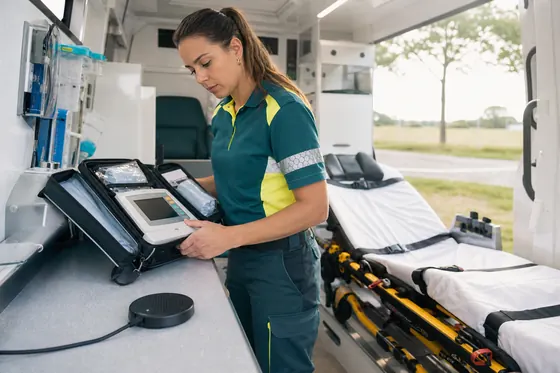
A structured report in your professional terminology
From care encounter to report
Hysio turns spoken information into a report. Choose the report format for the conversation you are documenting.
Document
Record the conversation and clearly state your own findings and agreed actions.
AI assistants
You stay in control of what gets saved.
In your workday
More attention for the conversation, less typing afterwards.
State relevant information, your own findings and agreed actions aloud so you can find them in your report.
The information appears under the headings of your chosen report format, so you can review each section.
Check names, facts and agreed actions. Edit the text where needed before using the report in your records.
Try it yourself
Try Hysio free for 14 days or schedule a personal demo.
For your team
Quick answer
Three documentation formats that follow the call-out: from dispatch and on-scene assessment to the handover to the emergency department.
Here is a brief overview of how Hysio records the call-out. You read every report back and decide what goes into the ambulance record.
For ambulance nursing, there are 3 documentation formats: Ambulance Care Report, Ambulance Prehospital Assessment and Ambulance Acute Handover. The care report follows the whole call-out. The assessment records what you found on scene. The handover is short and meant for the receiving team. With voice-driven reporting, you record what you saw and did after the call-out; you check the text before the handover. [3] [4] [5] [1]
The Ambulance Care Report turns one call-out into a short, chronological report. Dispatch and dispatch centre information, what the client says, your measurements, your assessment, the care, the response to it and the transport each get their own place. Open points stay open. Hysio does not fill in a value or time that you did not mention. [3]
The Ambulance Prehospital Assessment describes one on-scene assessment. You state the course of the complaint, what you saw and measured, and your own professional assessment. Then come the intervention, the response and the choice of transport. What you do not know yet is included as open information. Hysio does not turn your assessment into a diagnosis. [4]
You use the Ambulance Acute Handover on arrival, for the team that takes over the client. It is a short text with the current condition, the medical history, values, procedures and open actions. Each item shows its source and time. Before handing over, you check that everything is right and who gave the information. [5]
Choose the care report if you want to record the whole call-out, from dispatch to transport. It also fits a call-out without a handover to a hospital. Tell it in the order in which it happened. Hysio keeps that order and does not put your measurements between other people's reports. [3]
Record both moments, each with a time. Say what you saw first and what was different afterwards. The Prehospital Assessment sets these out as two source moments, one below the other. Hysio draws no conclusion from them about cause or urgency; that judgement stays with you. [4]
The call-out report is for the record of the call-out. The acute handover is for the recipient, for example the emergency department. They want to know quickly how the client is doing now and what is still open. You can make both from the same dictation, but you read each text back separately. [5]
Name the dispatch centre as the source of the dispatch call. What you see on scene, you say as your own observation. That way the next colleague reads straight away what was known beforehand and what you established. If the dispatch call does not match what you found, both stay in. [3]
For €20 per month, excl. VAT, you use Starter. You do not pay per call-out or per documentation format. When comparing, also count the time you spend reading back and correcting. You decide which text you transfer to the ambulance record. [6]
Agree with your regional ambulance service who may listen, read, edit and approve. Only record what is needed for the care of this client. Bystanders sometimes hear a lot, but that does not give them a right of access. You decide what is kept or shared, following your organisation's agreements. [8]
As a nurse, you have an article 3 profession under the Wet BIG. You are listed in the BIG register with name, BIG number and profession, and those details are public. In your call-out report, the professional responsibility stays with you. Hysio organises what you say, but does not assess anything in your place. [15]
The Kwaliteitskader Ambulancezorg 2.0 (quality framework for ambulance care) is a separate source on quality. It describes 23 quality indicators, an implementation plan and a maintenance plan. The framework was presented on a tripartite basis in July 2024 and included in the Register of Zorginstituut Nederland on 2 October 2024. A clear call-out report makes it easier to look back on that later. [13]
The ambulance nurse works prehospitally and on the move. The emergency nurse works in the hospital, after the handover. So in terms of content, your report ends at arrival or handover. Do not write down a conclusion you could not substantiate on scene; that belongs with whoever takes over the care. [11] [12] [13]
Say who told you, for example a neighbour or a partner. Hysio then puts it in the assessment as a report from that person, separate from your observation. That way a bystander's account does not quietly turn into an established fact. [4]
Leave the value open and say that it is missing. Hysio does not fill in a normal value and does not estimate anything. In the acute handover it appears as an open action, so that the receiving team knows what still needs to be measured or checked. [5]
First say what you did and when. Then say what you saw or measured after that action. The care report sets intervention and response side by side in this way. Hysio does not draw a causal link that you did not state yourself. [3]
Record each measurement with the moment you took it. Hysio puts them in time order and does not calculate a trend. If you want to name a course yourself, say it as your assessment. Then the difference between measurement and interpretation stays visible. [4]
Say what you handed over, to whom and when. What has not yet been discussed stays an open action. Hysio does not write that something was taken over if you did not say so. That way the status of the handover is still right afterwards. [5]
When you type, you write the record text straight away. When you dictate, you first tell the call-out and Hysio organises it afterwards. So voice-driven admin shifts the work to reading back. Compare how often you need to correct something and whether the text is clear for the next colleague. [9]
The trial period lasts 14 days. Take a few fictional call-outs, for example a fall at home and a breathless client. Record them as you would after a real call-out. See whether dispatch information, measurements and transport stay properly apart and how much you need to correct. [7]
The guideline was not written specifically for ambulance care. It applies to documentation of care or support for all client groups, care settings and organisations where nurses and carers work. Use it as a basis, alongside the agreements of your regional ambulance service. Only note what was established during this call-out. [11] [12] [13]
Besides the general guideline, ambulance care has its own frameworks. The LPA family (LPA-HC, LPA-MC, LPA-LC) and the SPART model for clinical reasoning mainly guide what you do, and to a lesser extent the documentation. Hysio does not apply any protocol. You leave visibly open what still needs to be checked. [11] [12] [13]
SPART is ambulance care's own framework for structuring clinical reasoning. It was introduced in 2019 for highly complex care. Since the extension with LPA-MC and LPA-LC in 2025, it is also meant for medium and low complexity care. In your report, you describe the call-out as it really went. [11] [12] [13]
The framework has 23 quality indicators, with an implementation and maintenance plan. It was presented on a tripartite basis in July 2024 and has been included in the public Register of Zorginstituut Nederland since 2 October 2024. For you, this means: observation, interpretation and agreement recognisably apart, so that quality can be followed later. [13]
Among others, the Wkkgz, the Wazv, the Nota Goede Ambulancezorg, the Kwaliteitskader Ambulancezorg and the LPA. They concern quality, organisation and practice. For your call-out report, this mainly means: alongside the outcome, also record what is still open. [12]
NEN 7512 is about exchanging data, NEN 7513 about logging who views a record. For your report, this means: note which source and which responsible person belong to an item. Link measured values and interventions to a time. [11] [12] [13]
An acute handover connects ambulance care with the next organisation. State the reason, the main observations, the care delivered and what is still open, with source and time. Keep the steps of the nursing process recognisable. Only name what the call-out actually showed. [11] [12] [13]
Say where you transported the client and who made that choice. Also mention the condition during transport if it changed. The care report puts this under follow-up. Hysio does not choose a destination and does not add a reason that you did not mention. [3]
No. Hysio does not write directly to an electronic client record. You transfer the checked text yourself, following the agreements of your regional ambulance service. Check the client, the recipient and whether everything is complete beforehand. A documentation format is not a technical link. [10] [9]
Read the whole report and set it against your memory of the call-out. Pay attention to times, values, professional terms and who said what. Is the agreed next step right? Hysio organises the text, but you correct and approve it. [9]
SNOMED CT is a shared clinical language. The Dutch edition is active and is revised regularly. V&VN, VWS and other national bodies name it as the basis for unambiguous communication, and so does the V&VN documentation guideline. In your call-out report, it makes clear what you heard, saw and did. [15]
eOverdracht contains administrative data, the general context of the client, the medical context and the nursing context. The latter includes the care plan and the description of the state of health. A Hysio text is not an eOverdracht message. You do use the content as a basis for what you hand over. [14] [15]
Professionally, factually and matter-of-factly. The eOverdracht standard organises this into fixed categories, not into a form of address. Give facts and agreed next steps each their own place. If a date, role or meaning is unclear, ask before you hand over. [14]
No. Hysio does not determine urgency, priority, indication or instruction. If you state an urgency yourself, it appears in the report as your assessment. If the category comes from the dispatch centre, the dispatch centre is shown as the source. [4]
Say who you heard the medical history from and what period it relates to. The acute handover sets medical history and current condition one below the other, not mixed together. That way the emergency department does not accidentally read an old complaint as something from today. [5]
Record per section what you found, with the value and the time. For a section you did not assess, say so too. Hysio does not fill in an empty step. The report then shows what you actually checked. [3]
It goes into the report as your professional assessment. Hysio does not turn it into an established diagnosis and does not tone it down either. If needed, say what your assessment rests on, such as a measurement or an observation. [4]
State times for dispatch, arrival, interventions and departure. Hysio puts them in the order you give and does not move anything. A time you estimate, you name as an estimate. Before the handover, read back whether the order is still right. [5]
Start from your own source: what did you really say or measure? Only adjust the passage that is wrong. Then check whether the error also appears in the summary or the handover. Hysio does not change the professional content without you. [9]
Mark what you cannot understand and do not guess. Listen again or check with your colleague on the call-out. Voice-driven reporting works best with a short dictation straight after the call-out. A clear gap is better than a silent assumption. [9]
Under the Wazv, the regional ambulance service (RAV) is authorised and obliged to provide ambulance care, or have it provided, in its own region. So it is a regional structure regulated under public law and not a free market of separate providers. Working agreements on your report therefore come from your own regional ambulance service. [11] [12] [13]
The Kwaliteitskader Ambulancezorg 2.0 asks Regionale Ambulancevoorzieningen (regional ambulance services) to submit quality information according to the 23 quality indicators. The framework has been in the Register of Zorginstituut Nederland since 2 October 2024. How often and in what form you submit is not set out precisely. In your report, write down what really happened during the call-out. [13]
Use the care report and say clearly that there was no transport. State what you assessed, which care you gave and which advice you left. Hysio does not make up a reason for not transporting that you did not mention. The follow-up stays separate. [3]
Leave the dispatch call as it came in, with the dispatch centre as the source. Then add what you found yourself. Hysio does not delete the original dispatch call and does not choose a version. The difference stays visible for whoever reads the report later. [4]
Only record what the receiving team needs now: condition, values, procedures and open actions. The rest is already in your care report. The handover follows fixed headings, so that the emergency department quickly finds what it is looking for. [5]
Only what was really agreed or handed over. A plan you still need to discuss, you name as an open point. Hysio does not turn an idea into an agreement. For an agreement, name who takes it up, if that is known. [3]
Describe factually what the client said, which information you gave and who was present. Also state your own assessment, if it comes from you. Hysio does not assess mental capacity and does not add a conclusion. Otherwise follow the agreements of your regional ambulance service. [4]
When recording, say who saw or did what. Hysio keeps those sources apart and does not choose which version is right. Read back together whether the handover has one clear line. If in doubt, it stays an open point. [5]
First measure how long recording, reading back and correcting take now. Then compare similar call-outs with Hysio. Look not only at time, but also at completeness and clear professional language. A faster first text is only a gain if there is less to correct. [9]
Start small, with one type of call-out and a few practice cases. Agree who watches over source, privacy and approval. Check every text before saving. Only expand once the way of working proves reliable in your team. [9] [8]
Hysio creates the report. You remain responsible for what you save in the record.