Document
Keep your attention on the care encounter.
Record the conversation and clearly state your own findings and agreed actions.
Hysio Emergency Department Nursing
Hysio organises triage and the initial assessment, the acute care encounter and the agreed follow-up, using the ABCDE approach.
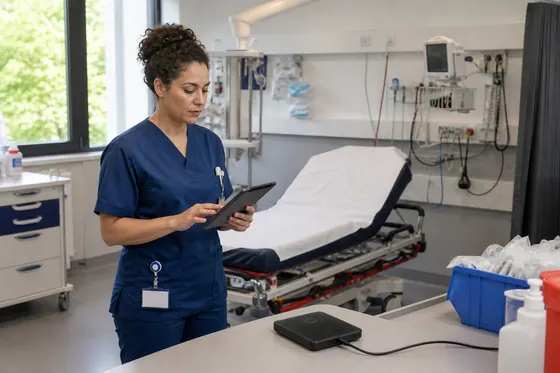
A structured report in your professional terminology
From care encounter to report
Hysio turns spoken information into a report. Choose the report format for the conversation you are documenting.
Document
Record the conversation and clearly state your own findings and agreed actions.
AI assistants
You stay in control of what gets saved.
In your workday
More attention for the conversation, less typing afterwards.
State relevant information, your own findings and agreed actions aloud so you can find them in your report.
The information appears under the headings of your chosen report format, so you can review each section.
Check names, facts and agreed actions. Edit the text where needed before using the report in your records.
Try it yourself
Try Hysio free for 14 days or schedule a personal demo.
For your team
Quick answer
Three documentation formats for triage and intake, the acute care encounter and the handover or discharge.
Here is a brief overview of how Hysio writes up an emergency contact. You read every report back before it goes into the record, even when the waiting room is full.
For emergency department nursing, there are three documentation formats: ED Triage & Intake, ED Acute Care Encounter Report and ED Handover & Discharge. They follow the course of an emergency encounter, so that the initial assessment, the acute care moment itself and the agreed follow-up stay clearly separate. As an emergency department nurse, you choose which format fits the moment. [3] [4] [5] [1]
ED Triage & Intake organises the initial intake around an acute care encounter for ABCDE observations and measurements. In handover or discharge, you always record observation, assessment and follow-up separately from each other. The emergency department nurse reviews what this format records about the information from the client and companion, and your judgement within triage, ABCDE and acute care remains decisive. This keeps an acute care encounter recognisable for the next colleague. [3]
In handover or discharge, ED Acute Care Encounter Report organises the ABCDE observations and measurements into a point of reference for the care moment and response. Your own observation, interpretation and next step regarding the information from the client and companion stay clearly separate within it. The emergency department nurse compares the text with what happened during triage and the initial assessment, and that final assessment remains yours. This way you can see at a glance what is already established and what is still open. [4]
ED Handover & Discharge links condition and follow-up to the information from the client and companion. During handover or discharge from the ED, you already place fact, assessment and follow-up side by side in it. The emergency department nurse checks the text in an acute care encounter, and within triage, ABCDE and acute care you decide what happens next. This keeps handover or discharge from the ED linked to the correct care moment. [5]
The format helps you describe the initial intake around ABCDE observations and measurements clearly, keeping fact and agreement about the information from the client and companion separate. The emergency department nurse makes the text match the actual contact within acute care in the ED, and the decision on it always remains yours. This keeps everything available for the joint debrief. [3]
In an acute care encounter, ED Acute Care Encounter Report organises the care moment and response, in line with what happens around handover or discharge. The next colleague can find your observation later, with its source, time and status recognisable. The emergency department nurse checks the text before saving, and within triage, ABCDE and acute care the decision stays with the healthcare professional. This gives handover or discharge a clear place in the follow-up pathway. [4]
In handover or discharge from the ED, the format also keeps the information from the client and companion visible side by side. In an acute care encounter, you simply leave an open question in place until it has actually been discussed. The emergency department nurse always checks the content against the source, so that ABCDE observations and measurements continue to determine the follow-up and the whole thread stays verifiable for you. [5]
The format gives triage and the initial assessment a fixed place for the initial intake. Around ABCDE observations and measurements, the sequence of the care moment stays intact. In handover or discharge, the emergency department nurse asks follow-up questions about what the text describes, because your interpretation remains necessary within triage, ABCDE and acute care. This way the initial assessment connects to the next step in care. [3]
For the emergency nurse, Starter costs €20 per month, Pro €40 and Unlimited €80, excl. VAT. The price is the same for triage, an acute care encounter or the handover. When comparing, also count the time you now spend on reporting after your shift. [6]
For the information from the client and companion, you first determine exactly what purpose that care serves. You then record which information is needed and who gets access to it, for example around triage and the initial assessment. For ABCDE observations and measurements, you check who may listen, read, edit and approve. Never use more than the established care purpose requires, not even when more happens to be available. The emergency department nurse decides in an acute care encounter what may be kept or shared; simply being present is not consent. [8]
Triage, ABCDE and acute care require an acute care encounter that you can interpret correctly, and authorisation plays a part in this. For ABCDE observations and measurements, the source text states: ‘Nurse’ is an article 3 profession under the Wet BIG (Dutch Individual Healthcare Professions Act): BIG registration is mandatory to use the title and to practise the profession independently. The BIG register page lists eleven article 3 professions. You also keep observation, interpretation and agreement around handover or discharge clearly separate. The emergency department nurse carries professional responsibility for an acute care encounter. [11]
Article 3 professions partly determine how triage, ABCDE and acute care are regulated within emergency department nursing. The source text says: Article 3 of the Wet BIG lists, among others, pharmacist, doctor, physiotherapist, healthcare psychologist, clinical technologist, generalist remedial educationalist (orthopedagoog-generalist), physician assistant, psychotherapist, dentist, nurse and midwife as article 3 professions. The emergency department nurse therefore falls under the nursing article 3 profession. Alongside the outcome of ABCDE observations and measurements, you therefore also record the open point. [13] [15]
Registration affects how triage and the initial assessment are structured for emergency department nursing. This is how the original source puts it: emergency department nursing is not a separate BIG article 3 title. It is a specialist post-registration programme and an area of expertise on top of the basic nurse registration. The training requirements are set by the College Zorgopleidingen (CZO) and apply to the post-registration programme to become an emergency department nurse (spoedeisendehulpverpleegkundige), classified at NLQF level 6. Your own observation in an acute care encounter also remains traceable in the report. [15]
Consistent language is part of how emergency department nursing records ABCDE observations and measurements. The sources differ: the triage standard refers to patient, the training document to care recipient, and the nursing documentation guideline uses client as a sector-wide term. Choose the term your own organisation uses and keep it the same within one report. Around triage and the initial assessment, you note what you yourself saw, did and discussed. [15]
Demand for emergency department nurses also affects how you record the information from the client and companion every day. The original source states: the demographic scenario predicts annual growth in demand for emergency department nurses of 0.9% per year. The expert scenario also takes into account the rise in falls among older people, more complex injuries partly due to e-bikes, a decrease in the number of ED locations and the growing deployment of other healthcare professionals for low-complexity care needs. For triage and the initial assessment, this changes nothing about what you yourself may and must record. [12]
Training capacity partly determines how much room there will be for a careful approach to an acute care encounter. Taken literally from the source: based on the expert scenario, the Capaciteitsorgaan (the Dutch capacity planning body for healthcare training) advises an intake of 374 training places per year for the post-registration programme to become an emergency department nurse. The demographic scenario arrives at 340 places per year. Around handover or discharge from the ED, you write down what actually happened during the care moment. The emergency department nurse assesses before saving what an acute care encounter means for this care situation. [13]
What a care encounter after triage involves determines how you note ABCDE observations and measurements. This is what the source says: after triage, the care encounter includes observing, measuring and interpreting vital signs, carrying out nursing interventions, supporting examination and treatment, and communicating with the client and relatives. This often happens under time pressure and is short and cyclical in nature. Within acute care in the ED, always keep your own observation separate from your professional assessment. [15]
Peak moments in the ED also influence how you approach handover or discharge from the ED. The source this is based on reports: the Capaciteitsorgaan explicitly names several factors that increase the pressure on the emergency department nurse, such as an increase in the number of older people who end up in the ED after a fall, a growing number of cycling accidents (especially with e-bikes) with more complex injuries that require more time and effort, and a decrease in the number of ED locations, two fewer than in 2023. Around an acute care encounter, it nevertheless stays clear what you heard, saw and carried out yourself. [13]
Writing yourself puts the pen directly in your hands, including in handover or discharge from the ED. Dictating first records the conversation with the client and companion, after which Hysio organises the chosen source into text. The professional assessment always stays with you, never with the documentation format itself. Around an acute care encounter, compare faithfulness to the source, correction time and readability. The emergency department nurse checks before saving whether the text reflects the contact correctly, and in triage, ABCDE and acute care you choose the route with the least correction work. [9]
You can try Hysio for 14 days without paying. Make up a case, for example someone with chest pain who comes in with a companion. Record triage and ABCDE and see whether measured values, complaint and assessment stay separate. [7]
A profession-specific documentation guideline partly guides how emergency department nursing documents an acute care encounter. According to the source, this shows: this guideline is not ED-specific; it applies to all nursing and caring professionals who document care for individual clients in the care record. A separate, ED-specific documentation guideline from V&VN does not currently exist. Around handover or discharge from the ED, you therefore note only what has actually been established in this contact. In an acute care encounter, the emergency department nurse safeguards the distinction between fact and assessment. [15]
Discussing documentation with the client is part of how emergency department nursing keeps the thread of triage, ABCDE and acute care. The underlying source states: discuss the documentation with the client in all phases of the nursing process, and in case of mental incapacity with the legal representative. Involve family members or informal carers where this fits the client's wishes. For ABCDE observations and measurements, you make visible which information still needs to be checked. The emergency department nurse looks at completeness and origin before saving. [15]
Requirements for electronic documentation directly affect how triage and the initial assessment are recorded for emergency department nursing. This is how the source phrases it: choose an electronic record, make sure you have influence on the choice or development of an easy-to-use and efficient record, use a relevant format such as Gordon's functional health patterns, and use unambiguous, interoperable language via the available information standards. In an acute care encounter, you always describe the contact as it actually took place. [14] [15]
Evaluating and monitoring quality helps you interpret ABCDE observations and measurements correctly within emergency department nursing. The source explains this as follows: evaluate and monitor the quality of documentation by checking whether the client or representative has been involved, whether the documentation reflects all phases of the nursing process, and whether eOverdracht (the Dutch electronic nursing handover) has been used. This way you keep observation, interpretation and agreement around triage and the initial assessment clearly separate. The emergency department nurse carries professional responsibility for this. [14] [15]
Training requirements are reviewed periodically, and that also affects how you record the information from the client and companion. In support, Hysio quotes the source: evaluation of the training requirements takes place periodically; for the renewed post-registration nursing programmes, this was planned for 2023. Alongside the outcome, you therefore also record the open point, and you check whether the text reflects the care moment correctly. [15]
Evaluating the documentation itself is a recurring step within triage, ABCDE and acute care for emergency department nursing. The source this refers to says: quality evaluation of the documentation itself, according to the V&VN guideline, checks whether the client was involved, whether all phases of the nursing process have been recorded, and whether eOverdracht has been used. In handover or discharge from the ED, your own observation remains traceable in the report. In an acute care encounter, the emergency department nurse leaves out any conclusion that is not supported. [14] [15]
The Kwaliteitskader Spoedzorgketen (quality framework for the emergency care chain) forms the wider context in which emergency department nursing arranges handover or discharge from the ED. Directly from the consulted source: the Kwaliteitskader Spoedzorgketen is a national, chain-wide quality framework for emergency care, adopted on 19 February 2020 by the Zorginstituut after a development process with eleven parties, including ambulance services, hospitals, general practitioners, nurses and client representatives. Around ABCDE observations and measurements, you note what you yourself saw, did and discussed. The emergency department nurse checks date, meaning and professional context before saving. [16]
You use the format in a completed acute care encounter for the care moment and response. What you saw and what you decided stays visible within triage, ABCDE and acute care. The emergency department nurse reviews the text around handover or discharge from the ED, and only supported text remains in the end. [4]
No. Hysio is not linked to the hospital's record system. You transfer the approved text yourself, following the ED's agreements. Admin with AI does not take that step off your hands. Check times, measured values and who takes over the client. [10] [9]
Read the report back as soon as possible after the contact. Pay attention to times, measured values, medication and who said what. With voice-driven reporting, reading back is your last step of the contact. Remove any conclusion you did not state that way. [9]
Classification systems partly determine how you record client problems in an acute care encounter for emergency department nursing. The source describes it like this: for client problems within eOverdracht, the SNOMED CT core set is used in the first instance. The nursing reference set from Nictiz aligns with this as a common language for nursing handover. Use only a classification in the record that your organisation and the source support. Around handover or discharge from the ED, it stays clear what you heard, saw and carried out yourself. [14]
Besides SNOMED CT, there are more mapping options, relevant to handover or discharge from the ED within emergency department nursing. What the source records about this: NANDA-I, Omaha and ICF are named within eOverdracht as mapping options when an organisation works with those classifications. The chosen classification follows the organisation's set-up and must not appear in the report as an automatic clinical judgement. For ABCDE observations and measurements, you also always state which question is still open. [14]
In handover or discharge from the ED, the format makes condition and follow-up around triage and the initial assessment traceable. Observation, assessment and agreement each get their own space within it, including for ABCDE observations and measurements. The emergency department nurse checks that the text contains no assumption, and within triage, ABCDE and acute care you decide yourself what is needed. [5]
The format brings the initial intake around an acute care encounter together with the information from the client and companion. In handover or discharge, you keep observation, assessment and follow-up apart within triage, ABCDE and acute care. The emergency department nurse checks what this format has recorded, and you decide yourself on the follow-up within triage, ABCDE and acute care. Around an acute care encounter, there remains room for your own professional judgement. [3]
The format helps you with the care moment and response around ABCDE observations and measurements. You keep the information from the client and companion separate within it, with observation, assessment and follow-up each in their own place. In a completed acute care encounter, the emergency department nurse reviews what has been noted, and your judgement remains decisive. This keeps ABCDE observations and measurements recognisable for the next colleague. [4]
In handover or discharge from the ED, the format gives a point of reference for condition and follow-up. Your own observation, interpretation and next step regarding triage and the initial assessment stay recognisable. The emergency department nurse compares the text with what happened during an acute care encounter, and the final assessment lies with you. This way you immediately see what is already established and what is still open. [5]
The format links the initial intake to the information from the client and companion in acute care in the ED. In an acute care encounter, you place fact, assessment and follow-up side by side in it. Around ABCDE observations and measurements, the emergency department nurse checks the text, and for triage, ABCDE and acute care you decide yourself what happens next. This keeps the information from the client and companion linked to the correct care moment. [3]
Around a completed acute care encounter, the format makes room for the care moment and response within acute care in the ED. You deliberately keep observation and professional interpretation separate, including around ABCDE observations and measurements. In handover or discharge from the ED, the emergency department nurse assesses whether the text reflects the care moment correctly, and that responsibility stays with them. This allows the healthcare professional to continue working in a focused way in a completed acute care encounter. [4]
A correction always starts with the original source. First open the passage that is incorrect, for example around handover or discharge from the ED. Then check whether the change affects observation, agreement or handover regarding the information from the client and companion. The emergency department nurse keeps only what can actually be supported in an acute care encounter. In triage and the initial assessment, Hysio does not independently adopt a professional correction, and the amended text is not usable until you have checked it. [9]
Leave the gap open and do not fill in a measured value or time by feel. Check it in the measured values or ask the colleague who was there. With voice-driven reporting, a visible gap is safer than a guess. [9]
Workload in the ED also affects how you record an acute care encounter within emergency department nursing. The original source indicates: the strongest indirect signal comes from the Capaciteitsorgaan report. The pressure on emergency department nurses is increasing due to more complex injuries that require more time and effort, a falling number of ED locations that concentrates demand, and slow outflow of clients to other departments due to capacity problems elsewhere. In handover or discharge from the ED, you therefore record your own observation and the follow-up all the more carefully. [13]
Yes. The handover shows ABCDE findings and measured values with time and source, so that the next colleague can find them. What the client or companion said stays separate. You check the handover before saving, and decisions on triage and acute care stay with the healthcare professional. [5]
Around the initial intake, the format also keeps triage and the initial assessment visible side by side. For ABCDE observations and measurements, you simply leave an open question in place until it has been discussed. The emergency department nurse checks the content against the source, so that triage, ABCDE and acute care continue to determine the follow-up. This keeps the thread around handover or discharge from the ED verifiable for you. [3]
In an acute care encounter, the format gives a fixed place for the care moment and response. Around handover or discharge, the sequence of the care moment stays intact within triage, ABCDE and acute care. For the information from the client and companion, the emergency department nurse asks follow-up questions about what the text describes, and your interpretation remains necessary. This way an acute care encounter connects to the next step in care. [4]
In acute care in the ED, the format makes condition and follow-up for ABCDE observations and measurements easier to trace. Observation, assessment and agreement each get their own space within it, including for the information from the client and companion. In handover or discharge from the ED, the emergency department nurse checks that the text contains no assumption, and within triage, ABCDE and acute care you decide yourself. [5]
The format brings the initial intake together with what happens around handover or discharge from the ED. In triage and the initial assessment, you keep observation, assessment and follow-up apart within triage, ABCDE and acute care. In an acute care encounter, the emergency department nurse checks what this format has recorded, and you decide yourself on the follow-up. Around handover or discharge from the ED, there remains room for your professional judgement. [3]
ED Acute Care Encounter Report is a profession-specific format within emergency department nursing. It helps with the care moment and response around the information from the client and companion. In an acute care encounter, you read observation, assessment and follow-up each separately within triage, ABCDE and acute care. For ABCDE observations and measurements, the emergency department nurse reviews what has been noted, and your judgement remains decisive. This keeps the information from the client and companion recognisable for the next colleague. [4]
In handover or discharge from the ED, the format gives a point of reference for condition and follow-up within acute care in the ED. Your observation, interpretation and next step around ABCDE observations and measurements stay recognisable. The emergency department nurse compares the text with what happened during handover or discharge from the ED, and that final assessment lies with you. This way, in handover or discharge from the ED, you immediately see what is already established and what is still open. [5]
Measure for a few shifts how long reporting takes now. Then do the same with dictating. Only less correction work counts as a real gain. AI reporting is only useful if the handover stays just as complete. [9]
Start with one type of contact, for example the handover to the ward. Agree with the team who reads along with the first reports. Then expand voice-driven reporting to triage and acute care encounters. [9] [8]
Hysio creates the report. You remain responsible for what you save in the record.