Document
Keep your attention on the care encounter.
Record the conversation and clearly state your own findings and agreed actions.
Hysio Registerpodologie
Hysio organises registerpodologie care around the request for help, foot observation, gait examination, ICF and the agreed follow-up.
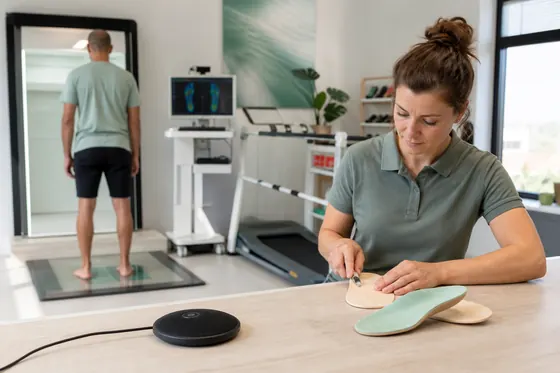
A structured report in your professional terminology
From care encounter to report
Hysio turns spoken information into a report. Choose the report format for the conversation you are documenting.
Document
Record the conversation and clearly state your own findings and agreed actions.
AI assistants
You stay in control of what gets saved.
In your workday
More attention for the conversation, less typing afterwards.
State relevant information, your own findings and agreed actions aloud so you can find them in your report.
The information appears under the headings of your chosen report format, so you can review each section.
Check names, facts and agreed actions. Edit the text where needed before using the report in your records.
Try it yourself
Try Hysio free for 14 days or schedule a personal demo.
For your team
Quick answer
Hysio draws a clear line between registerpodologie and podiatry or medical pedicure care. The request for help, foot observation, gait examination, any clinimetrics, ICF organisation and agreements stay separately traceable. The podologist determines the professional meaning. Hysio makes no claim of BIG or podiatric authority.
Here you can see, for each contact, what Hysio records about foot observation, gait examination and PSK, and what you assess as a registered podologist.
For the foot function record, Hysio Registerpodologie Consultation remains a format for a registerpodologie consultation with a goal, foot observation, gait pattern, intervention and follow-up. This applies to an encounter with foot and gait analysis. The request for help, foot observation, gait pattern, ICF and professional conclusion each keep their own origin at the registration and the direct access screening in the foot function record. At the registration and the direct access screening, check foot posture, gait pattern and ICF organisation without attributing any podiatric authority to them. [1] [3]
For the registerpodologie intake with the request for help, screening, expectations and relevant history, Hysio Registerpodologie Intake is intended for the foot function record. This format fits an encounter with foot and gait analysis. In the foot function record, the podologist links "Summary" to the first source of information. "Registration and follow-up" stays separately readable for an encounter with foot and gait analysis. A missing footprint, gait finding or PSK score (the Dutch Patient-Specific Complaints measure) is not calculated from other information if information about the request for help and expectations is missing. For the request for help and expectations, check foot posture, gait pattern and ICF organisation without attributing any podiatric authority to them. [1] [4]
Hysio Registerpodologie Examination is for foot and gait examination with any clinimetrics, ICF organisation and a podological conclusion in the foot function record. In an encounter with foot and gait analysis, the podologist keeps the request for help, foot observation, gait examination and any clinimetrics separately recognisable. The foot, the gait phase, PSK or N(P)RS and the date of the examination make clinimetrics traceable when the foot observation is documented. The podologist determines the ICF organisation, the podological conclusion and the chosen aid for the interpretation of the foot observation. [1] [5]
For a registerpodologie evaluation with goal attainment, functioning, PROM or PREM and closure, Hysio Registerpodologie Evaluation is intended for the foot function record. The design keeps "Summary" apart from "Evaluation framework" and leaves an outcome that has not been established open. A podological analysis must not sound like a podiatric diagnosis or a claim of statutory authority when the gait and movement examination is worded. For the gait and movement examination, check foot posture, gait pattern and ICF organisation without attributing any podiatric authority to them. [1] [6]
Organise foot observation, gait pattern and professional conclusion as separate sources of information. A missing footprint or PSK score stays open; the documentation format does not calculate anything from other information. The podologist personally assesses the ICF organisation, the podological conclusion and the meaning of an N(P)RS or other outcome measure that was actually administered. Document each source and measurement date separately. With voice-driven reporting, only what was actually measured counts for the podologist. [1] [2] [3]
For an encounter with foot and gait analysis, the report design for foot and gait analysis remains a profession-focused structure and does not make a podiatric diagnosis, a claim of BIG authority or a treatment choice. If the ICF organisation is missing, the podologist leaves that place in the foot function record open. A podological analysis must not sound like a podiatric diagnosis or a claim of statutory authority when the ICF organisation is worded. Only the podologist can add a conclusion or choice to the foot function record. [1] [2] [3]
In the foot function record, the podologist separates the request for help, foot observation, gait examination, any clinimetrics, ICF organisation and podological conclusion based on their actual origin. What the client reports about pain, load or footwear stays separate from what you observed during the gait examination. Professional interpretation gets its own origin and assessment. [1] [2] [3]
Before saving to the foot function record, the podologist checks the foot, the gait phase, PSK or N(P)RS, the footprint and the date of the examination against the original note. For the therapeutic insole advice or an exercise agreement, check foot posture, gait pattern and ICF organisation without attributing any podiatric authority to them. Later, the podologist only keeps a version of the foot function record whose origin and terminology are correct. [1] [2] [3]
The foot function record is not automatically linked to every medical record system. When the foot function record is handed over, the podologist specifically reviews the foot, side, footprint, gait pattern, ICF organisation and an explicitly administered PSK or N(P)RS. The practice's way of working for the foot function record determines the format within a foot function care practice. Access and version control stay linked to the foot function record. The report design for foot and gait analysis does not prove any technical integration for the foot function record; the handover remains human work. [1] [2] [6]
For the foot function record, the podologist chooses between consultation, intake, foot and gait examination and evaluation based on the actual purpose of contact. The intake organises the request for help and screening, the examination organises foot and gait findings with ICF, the consultation describes ongoing care and the evaluation documents functioning and closure. In the foot function record, the podologist always makes the final choice between these four formats. [1] [2] [6]
Document registration and direct access screening in the foot function record as two traceable steps. The podologist notes the request for help, the answers given and the follow-up actually chosen without filling in missing screening information. ICF organisation and the podological conclusion only follow after the appropriate examination. Within Hysio Registerpodologie Intake, these two steps stay recognisable as separate sources, even when a screening question is answered later. [2] [4]
The request for help and expectations are kept in the foot function record as client information. Foot observation, gait examination, a footprint and a PSK or N(P)RS score each get their own source data and moment of measurement. The podologist then adds the ICF organisation and the podological conclusion separately. In doing so, the intake format does not confuse an expectation with a measured examination outcome. [2] [4]
Within the five steps of methodical practice and documentation, you document the foot observation in the phase where this part belongs. In an encounter with foot and gait analysis, assess that place in relation to the request for help, the examination, the professional conclusion and the plan. The documentation format Hysio Registerpodologie Examination keeps that order without deriving a cause or choice from the foot observation itself. For the foot observation, the methodical choice stays with the podologist; that person approves the text. [2] [5]
Link a gait finding to the examined foot, side, test condition, any footprint and the date of the examination. A client score and an observed gait pattern stay separate sources. Where records differ, the podologist compares the original notes before the ICF organisation is adjusted. The documentation format does not choose a podological conclusion or aid. [2] [5]
In the foot function record, the registered podologist gives PSK or N(P)RS the same certainty as the original source. Put the professional term next to the goal of the foot and gait analysis. Within Hysio Registerpodologie Examination, a score stays a recorded value with a scale and date. It is not a statement about recovery or effect. What the score means is for you to assess. [2] [5]
For ICF organisation, you need the request for help, the limited activity, the environmental factor and the personal factor, each as the client or the examination provided them. Note the source and the moment for each item. The podologist determines which context is relevant to the goal and checks the text before saving. [2] [3]
Only link a podological conclusion in the foot function record to a measurement or observation that was actually carried out in an encounter with foot and gait analysis. The podologist notes the known method, location or side, outcome and date as far as the source shows them. Suitable examples are PSK, N(P)RS, footprint, gait observation or other clinimetrics when you actually administer them, but only an observation or measure that was actually used belongs in the report. The professional meaning remains for the podologist to assess. [2] [3]
Connect a therapeutic insole or exercise agreement in the foot function record to the established goal, the foot and gait findings and the client's consent. The podologist states who carries out the follow-up action and when PSK, N(P)RS or functioning will be discussed again. This documentation format does not choose an aid itself. The podological conclusion remains professional work. [2] [3]
For an evaluation and a PREM or PROM, Hysio Registerpodologie Evaluation is the documentation format that fits an encounter with foot and gait analysis most closely. In the foot function record, the podologist compares the required set of sources and layout with the actual moment of reporting. The report design for foot and gait analysis does not select anything independently. The podologist determines the ICF organisation, the podological conclusion and the chosen aid for the interpretation of an evaluation and a PREM or PROM. [2] [6]
At closure, the foot function record separately names the result for the request for help, the gait pattern, a PROM or PREM that was actually administered and any remaining agreements. The podologist keeps uncertain or missing outcomes open and states which follow-up was discussed with the client. The podologist carries out the final assessment and ensures secure storage. [2] [6]
The LOOP guideline and KABIZ information are private quality sources; the Dutch title registerpodoloog has no statutory Article 3 title protection. The foot function record names the LOOP guideline for methodical practice and documentation in podology (Richtlijn methodisch handelen en verslaglegging podologie) with its publisher, date and type of source. In an encounter with foot and gait analysis, the foot function record shows the legal status. A foot function care practice separates professional standards from government rules. [10] [7] [8] [12]
The LOOP guideline from 2020 organises registration, foot observation, gait examination, clinimetrics, ICF, conclusion and evaluation in the foot function record. For the request for help and expectations, the podologist only uses the applicable part of the LOOP guideline for methodical practice and documentation in podology. The foot function record keeps the document version and scope. In an encounter with foot and gait analysis, a local agreement stays recognisable as local. [10] [9] [11]
The Dutch name registerpodoloog and its trademark protection are private; they do not give BIG status and must not be equated with podiatry. The legal position of the podologist is recorded in the foot function record separately from a second care role. The podologist only states a verifiable status for an encounter with foot and gait analysis. Any other capacity is assessed separately for the foot function record. [12]
In the case of a complaint, the registerpodologie practice keeps Wkkgz obligations, register rules and any disputes route legally separate. After an encounter with foot and gait analysis, a report in the foot function record gets facts, a date and follow-up. A foot function care practice chooses the applicable complaints procedure. The foot function record contains facts and no independent legal judgement. [14]
The retention period is linked to the specific care relationship and applicable law, not solely to LOOP or KABIZ documents. For the foot function record, the podologist documents which care relationship, law and policy version support the retention period. LOOP or KABIZ documents are read as their own type of source and, without that context, do not provide an independent general period. [10] [9] [11] [13]
KABIZ registration supports private quality assurance and is mentioned with its validity date without suggesting statutory authority. The podologist states KABIZ, the applicable criteria period and the date of the register check. The foot function record makes clear that this private quality assurance does not grant BIG status or authority as a podiatrist. Validity is verified again when the criteria period changes. [7] [8] [12]
In a foot examination, you document the question asked and the answer; a discussed recording or handover gets a separate, traceable entry. In a foot and gait examination, the question asked, the answer and the date of the examination are documented as one traceable contact item. A discussed recording or handover also gets a specific purpose and a verified recipient. The podologist does not treat silence or routine as consent. [4] [10] [9] [11]
Only share a registerpodologie report for a specific purpose, with relevant foot and gait data and a verified recipient. For a handover from the foot function record, the podologist checks the care goal, recipient and scope of data. In an encounter with foot and gait analysis, the foot function record keeps the client's own words apart from the request for help, foot observation, gait examination, any clinimetrics, ICF organisation and podological conclusion. A foot function care practice uses the verified destination and the local method of sending. [6] [10] [9] [11] [13]
The podologist determines the ICF organisation and the podological conclusion; Hysio does not turn them into a podiatric diagnosis. In the foot function record, the layout can separate the request for help, foot observation, gait examination, any clinimetrics, ICF organisation and podological conclusion. For an encounter with foot and gait analysis, the podologist personally determines the interpretation. The follow-up in the foot function record and the saved version remain professional work. [2] [3]
Check new LOOP and KABIZ versions for date, target group and changed requirements before updating record claims. The podologist compares the LOOP guideline and professional code with the applicable KABIZ criteria for version and target group. The foot function record only adopts a change once the effective date and the consequences for documentation have been established. [10] [9] [7] [8]
Only document a PSK, N(P)RS, footprint or gait observation when the method used and the examination contact are evident from the source. For a score, state the scale, value and date; link a footprint to the correct foot and the appropriate moment of measurement. The documentation format does not calculate a missing outcome. The podologist determines how the finding is organised within ICF and what podological meaning it gets. [2] [5] [10]
In an encounter with foot and gait analysis, the podologist only uses professionally documented terminology for the request for help and expectations. A technical term stays linked to the source that said it and to the moment that happened. The practitioner assesses necessity, precision and readability before saving. [2] [3] [10] [9] [11]
The podologist leaves the relevant part of the foot function record empty if, after an encounter with foot and gait analysis, the source contains no information about the foot observation. A detail that was not mentioned about the foot, the gait phase, PSK or N(P)RS, the footprint and the date of the examination stays unknown. The podologist asks a targeted question or states in the foot function record that information about the foot observation is missing. [2] [3]
Where there are contradictions about the gait and movement examination, the podologist keeps the source, moment and wording separately in the foot function record. During an encounter with foot and gait analysis, the podologist compares the relevant parts of the request for help, foot observation, gait examination, any clinimetrics, ICF organisation and podological conclusion. When the gait and movement examination is corrected, a gait finding is corrected from the examination note or recorded print. [2] [5]
The boundary around PSK or N(P)RS is that the report design for foot and gait analysis does not make a podiatric diagnosis, a claim of BIG authority or a treatment choice. The request for help, foot observation, gait pattern, ICF and professional conclusion each keep their own origin with PSK or N(P)RS in the foot function record. Convincing wording for an encounter with foot and gait analysis does not replace a missing source. The podologist determines the ICF organisation, the podological conclusion and the chosen aid for the interpretation of a PSK or N(P)RS measurement. [2] [3]
Use ICF to distinguish the foot or gait finding from its consequences for activities and participation. Keep something the client reports apart from your own observation and note the foot, side, examination condition and contact date when they are known. A worrying signal stays recognisable, together with the follow-up that was actually discussed. Hysio does not determine a diagnosis, urgency or referral; you make that judgement yourself within the limits of your expertise. [2] [3] [18]
In a registerpodologie examination, a client score such as PSK or N(P)RS stays distinct from foot observation, gait pattern and footprint. The registered podologist records the foot, side, test condition and date of the examination with the finding. ICF organisation and the podological conclusion only come after that. Voice-driven admin does not turn this data into a podiatric diagnosis or evidence for the aid either. [5]
ICF organisation, PSK and N(P)RS are only mentioned when the podologist actually chose or administered that classification or scale. Value, foot, side, method and date stay linked to the examination source. The documentation format does not calculate anything from a gait observation or footprint. The podological conclusion and the choice of an aid remain professional work. [2] [3] [10]
The result for the request for help, the gait observation and a PROM or PREM remain different evaluation sources. For an evaluation and a PREM or PROM, the podologist keeps to the level of certainty of the request for help, foot observation, gait examination, any clinimetrics, ICF organisation and podological conclusion in the foot function record. During an encounter with foot and gait analysis, a reported change stays separate from the foot, the gait phase, PSK or N(P)RS, the footprint and the date of the examination and from the assessment by the podologist. For a foot function care practice, the report design for foot and gait analysis provides no proof of efficacy or causal relationship. [2] [6]
Before saving to the foot function record, compare the foot, the gait phase, PSK or N(P)RS, the footprint and the date of the examination with the request for help, foot observation, gait examination, any clinimetrics, ICF organisation and podological conclusion. If information about the closure is missing, that part stays open. The podologist removes from the report text for the foot function record any autonomous podiatric diagnosis, claim of BIG authority or treatment choice. At closure, check foot posture, gait pattern and ICF organisation without attributing any podiatric authority to them. [2] [6]
A registered podologist can check the general Hysio price on the pricing page; Starter starts from €20 per month, excl. VAT. That plan also includes the registerpodologie intake, consultation, examination and evaluation formats. There is no separate rate for voice-driven reporting in registerpodologie. [15]
Foot, gait and client score data in the foot function record are limited to what the purpose of examination or treatment requires. Under the GDPR, the registerpodologie practice determines who has access and which data may go to a verified recipient. The podologist checks the foot, side and origin. The documentation formats do not select any data for handover themselves. [16] [17]
For the foot function record, the podologist compares writing by hand with dictation. In an encounter with foot and gait analysis, the Hysio format for the foot function record is a third option. Within a foot function care practice, every way of working requires assessment of the request for help, foot observation, gait examination, any clinimetrics, ICF organisation and podological conclusion. A general chatbot does not automatically know the foot, the gait phase, PSK or N(P)RS, the footprint and the date of the examination. For a foot function care practice, the Hysio format therefore remains an extra, generic choice alongside the existing ways of working. [2]
A registerpodologie practice assesses Hysio for 14 days. The formats for screening, gait examination and ICF are part of that trial. A first test could start with one encounter in which foot examination, gait pattern and ICF organisation come together. The podologist defines checkpoints in advance for the foot, side, PSK or N(P)RS, source comparison, podological conclusion and time for corrections. [15]
Carry over a PSK or N(P)RS score as a client score with its moment of measurement and the scale used. That outcome is not the same as an objective gait result and does not produce a podiatric diagnosis. The podologist assesses foot observation, gait, clinimetrics and ICF organisation separately. The documentation format does not calculate a score and does not choose an aid. [2]
The podologist checks the request for help, foot and gait findings, client score and ICF organisation against the examination sources. The podological conclusion and the choice of an aid remain their professional decisions. The practice designates who may save the reviewed version. The documentation format does not calculate a score and does not make a podiatric diagnosis from separate pieces of data. [2] [3]
Do not correct a podological conclusion by silently changing the original ICF organisation, gait finding or client score. The podologist corrects the specific part from the correct source and checks the foot, side and moment of measurement again. The foot function record keeps the previous entry, the reviewer and the version that applies afterwards traceable. [2] [3]
If an agreement about a therapeutic insole or exercise is missing, the podologist consults the plan or client section of the same encounter. A footprint, gait finding or podological conclusion does not in itself constitute consent. Without a confirming source, a targeted question follows or the follow-up stays open. The documentation format does not choose an aid and does not fill in an agreement. [2] [3]
A registerpodologie time measurement compares similar evaluations with, for example, PSK, N(P)RS, PREM or PROM. Record the time for preparation, dictation, checking foot and gait data, ICF organisation, corrections and transfer. No time advantage has been measured for the registerpodologie formats. Only your own baseline measurement shows what admin with AI brings your practice. [2]
A registerpodologie practice starts with one chosen type of encounter and one fixed professional reviewer who reads everything. The foot, side, gait pattern, client score, ICF organisation, conclusion and storage get concrete checkpoints in advance. The introduction is only widened once a small series of records proves correct, traceable and transferable locally within the practice. [2]
Hysio creates the report. You remain responsible for what you save in the record.