Document
Keep your attention on the care encounter.
Record the conversation and clearly state your own findings and agreed actions.
Hysio Allied Medical Care Professional
Hysio organises client-reported information, ABCDE data, interventions, professional assessments and handover in a time-stamped care report.
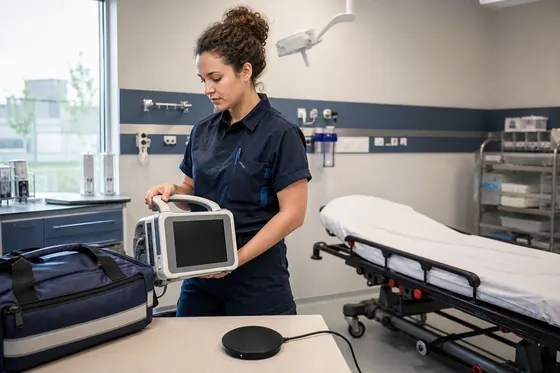
A structured report in your professional terminology
From care encounter to report
Hysio turns spoken information into a report. Choose the report format for the conversation you are documenting.
Document
Record the conversation and clearly state your own findings and agreed actions.
AI assistants
You stay in control of what gets saved.
In your workday
More attention for the conversation, less typing afterwards.
State relevant information, your own findings and agreed actions aloud so you can find them in your report.
The information appears under the headings of your chosen report format, so you can review each section.
Check names, facts and agreed actions. Edit the text where needed before using the report in your records.
Try it yourself
Try Hysio free for 14 days or schedule a personal demo.
For your team
Quick answer
The three formats fit acute assessment, care encounters and handover.
Acute assessment, care contact and handover each have a format of their own, with the time at every step. Client report, examination, measured value, intervention, assessment and follow-up stay separately recognisable.
This documentation format is intended for a time-critical acute assessment, covering ABCDE domains, exact values, interventions and follow-up. For the acute or procedural intervention, record how you organise only explicitly examined domains, measurement data and the assessment that was stated. Link the acute assessment to the client, the moment, the step performed and the responsible healthcare professional. With voice-driven reporting, you dictate the ABCDE findings and values after the procedure; Hysio organises them in chronological order and you check them. [2] [8] [3]
This documentation format is intended for a chronological care encounter with reported information, examination, exact values, care, response and follow-up. Make the clinical course traceable by describing how you record timeline, examination, performance and response separately. In the care report, the allied medical care professional checks measurement, observation, intervention and reaction separately. [2] [6] [4]
This documentation format is intended for an SBAR-organised handover with condition, assessment, request, actions and receipt status. Write up the encounter source so it is clear how you do not write condition, assessment, request and receipt status as one handover fact. In the acute handover, leave an intervention not performed or a missing outcome recognisably open. [2] [11] [5]
An acute client encounter needs a timeline and explicit examination before a handover or conclusion is described, and it fits Hysio Allied Medical Care Acute Assessment. For a safe handover, note how you organise reported information, examination and follow-up as an encounter line. For an acute client encounter, check identity, source of urgency, intervention, effect and open follow-up action before saving. [2] [7] [3]
A client report, such as chest pain for an hour, is what the client says and not yet a medical conclusion. Note the report with the moment and the step of care it belongs to. Your own examination and measurements are kept separately. [2] [6]
Time-stamped reporting makes clear when reported information, measurement, intervention and assessment took place. Make the clinical course traceable by describing how you preserve the order and the moment of each source fact. For time-stamped reporting, the allied medical care professional checks measurement, observation, intervention and reaction separately. [2] [8]
An acute signal or measured value is not the same as an urgency determined by Hysio: Hysio does not determine urgency or triage itself. Write up the encounter source so it is clear how you keep the source fact and professional triage apart. Leave an intervention not performed or a missing outcome recognisably open. [2] [7]
An instruction is source information with a purpose and a status and does not automatically grant independent authority. For a safe handover, note how you do not merge instruction, competence and performance. For a care instruction, check identity, source of urgency, intervention, effect and open follow-up action before saving. [2] [10]
An open action remains an action with an owner or status when that is known from the encounter. Around the acute or procedural intervention, record how you do not mix up planned, performed and confirmed. Link an open acute care action to the client, the moment, the step performed and the responsible healthcare professional. [2] [11]
A handover can be ready without the recipient having received or confirmed it yet. Make the clinical course traceable by describing how you note sent, received and followed up as separate statuses. [2] [11] [5]
An acute assessment can contain the complaint, timeline, explicitly examined ABCDE domains, exact measured values, interventions and the assessment that was stated. Write up the encounter source so it is clear how you include only the parts that were examined and stated. In an acute assessment, leave an intervention not performed or a missing outcome recognisably open. [2] [8]
The airway only belongs in the report when it has been explicitly assessed and the source describes the finding. For a safe handover, note how you do not fill in a domain that was not examined as normal. [2] [8]
A breathing finding needs source, moment, measured value or observation and any intervention, when these have been mentioned. Around the acute or procedural intervention, record how you document observation, value and intervention separately. Link breathing in ABCDE to the client, the moment, the step performed and the responsible healthcare professional. Compare the note on breathing in ABCDE with the original source and note which part is still missing. [2] [8]
Circulation data can include pulse, blood pressure, perfusion or other explicitly mentioned findings. Make the clinical course traceable by describing how you keep value, unit, moment and method together. For circulation data, the allied medical care professional checks measurement, observation, intervention and reaction separately. Compare the note on circulation data with the original source and note which part is still missing. [2] [8]
Disability is an acute assessment category for which the concrete observation and source must be recorded. Write up the encounter source so it is clear how you do not turn the category into a diagnosis or score interpretation. For Disability in acute care, leave an intervention not performed or a missing outcome recognisably open. [2] [8]
Exposure can cover the explicitly examined context, skin, injury or environment within the chosen acute method. For a safe handover, note how you organise only the findings that were actually described. [2] [8]
An exact vital sign value needs the value, unit, moment, measurement method and client context. Around the acute or procedural intervention, record how you add no norm, trend or deviation that was not stated. Link an exact vital sign value to the client, the moment, the step performed and the responsible healthcare professional. [2] [6]
The allied medical care professional assesses measurement, observation, intervention and reaction separately before a NEWS or GCS outcome gains meaning. Note the source, the moment and the method for every value. Hysio does not interpret a score and leaves the professional assessment with the authorised healthcare professional. [2] [7]
Response to an intervention is a time-bound observation or report after that intervention. Write up the contact source so it is clear how you note intervention, response and assessment separately. With a response to an intervention, leave an intervention that was not carried out or a missing outcome recognisably open. With voice-driven admin, you dictate the time of the response straight away. [2] [6]
A domain that was not examined is unknown and must not be filled in as a normal finding. For a safe handover, note how you leave the missing examination visible. [2] [8]
For every intervention, note who performed it and under whose responsibility, so that the question of authority can be traced later. Record the source, the moment and the actual performance separately. The allied medical care professional and the responsible healthcare professional decide together which assessment and which follow-up go into the record. [2] [9]
Working under instruction requires an appropriate instruction, competence, supervision or intervention according to the applicable context. Make the clinical course traceable by describing how you keep instruction and independent authority apart. [2] [10]
You describe a reserved procedure only as you or the source names it, with the time and who carried it out. Hysio does not assess whether you were authorised. If a procedure was not carried out or the outcome is missing, it stays visible as an open point. [2] [10]
The national education profile describes the programme and the professional role and is not proof of an individual's current authority. For a safe handover, note how you do not present the education context as registration. [2] [6]
A care record can contain reported information, examination, care, communication, response and follow-up with source and timeline. Around the acute or procedural intervention, record how you document only necessary and traceable information. [2] [12]
Client data require a purposeful choice, appropriate access and a verifiable handover. Make the clinical course traceable by describing how you link only relevant data to the recipient. [2] [12]
An instruction states what was requested, whereas an assessment can be a professional interpretation of findings. Write up the encounter source so it is clear how you visibly separate both source roles. [2] [10]
A consultation with a physician is an encounter source with question, answer, participant and the status of the next step. For a safe handover, note how you do not rewrite the consultation as your own decision. For a consultation with a physician, check identity, source of urgency, intervention, effect and open follow-up action before saving. [2] [12]
A proposed or discussed destination is not the same as a confirmed destination. Around the acute or procedural intervention, record how you note proposal, decision and confirmation separately. Link a destination that is not confirmed to the client, the moment, the step performed and the responsible healthcare professional. [2] [7]
The professional boundary names which decision stays with the authorised source and which facts you have recorded. Make the clinical course traceable by describing how you do not merge source fact, instruction and decision. [2] [10]
ABCDE is a structure for acute assessment in which only explicitly examined domains and findings are recorded. Write up the encounter source so it is clear how you use the order without filling in missing parts. For ABCDE in an acute note, leave an intervention not performed or a missing outcome recognisably open. [2] [8]
SBAR can organise a handover around situation, background, assessment and recommendation or request. For a safe handover, note how you fill the headings with source facts and no missing conclusion. For SBAR in a handover, check identity, source of urgency, intervention, effect and open follow-up action before saving. [2] [11]
Nictiz describes information standards for acute care and their data exchange within the care chain. Around the acute or procedural intervention, record how you do not present a standard as proof of a local integration. [2] [11]
A measurement method makes clear how a value came about and under which circumstances. Make the clinical course traceable by describing how you keep method, value and moment together. For a measurement method in acute care, the allied medical care professional checks measurement, observation, intervention and reaction separately. [2] [8]
Source provenance shows who reported, measured, performed or assessed a piece of information. Write up the encounter source so it is clear how you keep each source role with the fact. [2] [6]
Do not silently replace a value; keep both the original and the corrected measurement visible. Note who made the correction, at what moment and on the basis of which source. The allied medical care professional checks the handover and keeps the professional assessment recognisable alongside the measurement data. [2] [8]
An acute observation describes what was observed at a certain moment and is not a diagnosis. Around the acute or procedural intervention, record how you label observation and assessment separately. Link an acute observation to the client, the moment, the step performed and the responsible healthcare professional. [2] [7]
An intervention performed can be recorded without claiming an effect that was not measured or discussed. Make the clinical course traceable by describing how you note performance and response separately. For an intervention without an effect claim, the allied medical care professional checks measurement, observation, intervention and reaction separately. [2] [6]
A triage category or urgency requires a current professional assessment and is not an automatic text result. Write up the encounter source so it is clear how you describe the source route without adding a category of your own. [2] [7]
Hysio organises acute source information but does not interpret a score, makes no diagnosis and does not determine a route or destination. For a safe handover, note how you leave the allied medical care professional in place as the deciding source. [2] [9]
In acute care, Hysio Starter costs €20 per month excl. VAT. The rate belongs to the plan and not to one profession or AI assistant for allied medical care professionals. The allied medical care professional remains responsible for checking and final saving. [13]
There are three formats: acute assessment using ABCDE, care contact and handover. Each format has its own structure, with time and source for every value you mention. You check the record text before you save it, also after a handover. [16]
In acute care, you can try Hysio free for fourteen days. During that period you get to know Hysio; this page describes which documentation formats are intended for allied medical care professionals. The allied medical care professional then chooses what is useful and checks the text against source, context, record purpose and professional agreements. [14]
For the allied medical care professional, human review of source origin, professional content, missing information and the final record choice remains necessary. For a safe handover, note how you compare the text with the original encounter and the designated source. [16]
For the allied medical care professional, Hysio does not write directly to an electronic record; the allied medical care professional reviews the text and transfers it themselves. Around the acute or procedural intervention, record how you review the text yourself and transfer it manually to the right place. [17]
For the allied medical care professional, time can be saved by organising a conversation or dictation, but review and safe transfer remain part of the work. Make the clinical course traceable by describing how you include time for review and safe transfer. [2] [6]
Start with one clearly defined acute or procedural encounter and choose the AI assistant that fits that purpose. Compare the text with the original source. Check timeline, explicitly examined domains, values, units, interventions, reactions, professional assessment and follow-up. The allied medical care professional only transfers the reviewed text themselves. [16]
For the allied medical care professional, Hysio does not fill in any missing measurement, consent, assessment, intervention or agreement. For a safe handover, note how you do not fill empty parts with acute assumptions. For missing acute information, check identity, source of urgency, intervention, effect and open follow-up action before saving. [2] [10]
For every measurement and intervention, note the time as precisely as known: arrival, first ABCDE, administration and handover. You mark an estimated time as estimated. The final check of the report lies with you, not with Hysio. [16]
The allied medical care professional remains responsible for source choice, professional assessment, correction and final saving. Make the clinical course traceable by describing how you do not hand the final assessment over to the text. [16]
Hysio creates the report. You remain responsible for what you save in the record.