Document
Keep your attention on the care encounter.
Record the conversation and clearly state your own findings and agreed actions.
Hysio Oncology Nursing
Hysio organises what you hear and see in an oncology contact: what is reported, observation, care provided and the agreed follow-up.
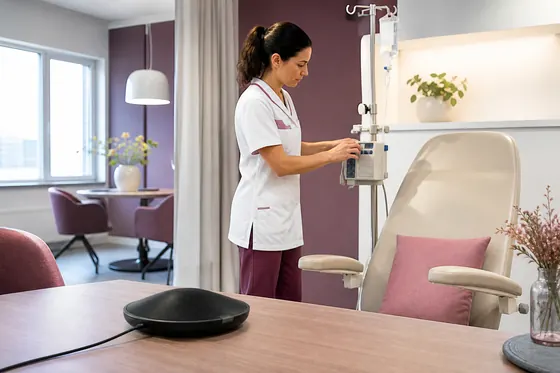
A structured report in your professional terminology
From care encounter to report
Hysio turns spoken information into a report. Choose the report format for the conversation you are documenting.
Document
Record the conversation and clearly state your own findings and agreed actions.
AI assistants
You stay in control of what gets saved.
In your workday
More attention for the conversation, less typing afterwards.
State relevant information, your own findings and agreed actions aloud so you can find them in your report.
The information appears under the headings of your chosen report format, so you can review each section.
Check names, facts and agreed actions. Edit the text where needed before using the report in your records.
Try it yourself
Try Hysio free for 14 days or schedule a personal demo.
For your team
Quick answer
Four documentation formats for consultations, side effect contacts, psychosocial follow-up and handover.
Here is a brief overview of how Hysio writes up an oncology contact. You decide what goes into the record after reading it.
Oncology nursing has 4 documentation formats: Oncology Nursing Consultation, Oncology Treatment & Side Effects Contact, Oncology Psychosocial Follow-up and Oncology Evaluation & Handover. The structure is aligned with oncological treatment and coping capacity and keeps an oncology consultation, treatment and side effects, and the agreed follow-up recognisably together. The oncology nurse chooses the appropriate care moment. [3] [4] [5] [6] [1]
The Oncology Nursing Consultation belongs to oncology nursing. Within oncology care, the Oncology Nursing Consultation helps you with source and follow-up around treatment and side effects. Around the evaluation and handover, you read observation, assessment and follow-up each separately. For the client's concerns and questions, the oncology nurse reads back what the Oncology Nursing Consultation records; your judgement remains decisive. This keeps treatment and side effects recognisable for the next colleague. [3]
The Oncology Treatment & Side Effects Contact is the format for oncology nursing. For psychosocial signals and coping capacity, the Oncology Treatment & Side Effects Contact gives you a firm basis within oncology care for source and follow-up. For the client's concerns and questions, your observation, interpretation and next step stay recognisable. For an oncology consultation, the oncology nurse compares the Oncology Treatment & Side Effects Contact with the contact; the final assessment is yours. That way, for psychosocial signals, you see at once what is already settled and what is still open. [4]
For oncology nursing, the Oncology Psychosocial Follow-up links source and follow-up with the evaluation and handover in oncology care. For an oncology consultation, you set fact, assessment and follow-up side by side. Around treatment and side effects, the oncology nurse checks the text of the Oncology Psychosocial Follow-up; you decide what goes forward. That is why the evaluation and handover stays connected to the right care moment. [5]
Around the client's concerns and questions, the Oncology Evaluation & Handover makes room within oncology care for condition and follow-up. Around treatment and side effects, you do not mix observation and professional interpretation. For psychosocial signals and coping capacity, the oncology nurse checks whether the Oncology Evaluation & Handover reflects the care moment correctly; that interpretation remains your responsibility. That way the oncology nurse can continue working in a focused way on the client's concerns and questions. [6]
The Oncology Nursing Consultation fits oncology nursing. Within oncology care, the Oncology Nursing Consultation connects to source and follow-up for the evaluation and handover. For an oncology consultation, the next colleague can read back your observation. Around treatment and side effects, the oncology nurse checks the Oncology Nursing Consultation before saving; you continue to decide. That way the evaluation and handover gets a clear place in the follow-up. [3]
The source description lists the reported complaint, objective values, your assessment, the explanation given with safety-net advice and the agreed follow-up action. Around source and follow-up, the Oncology Treatment & Side Effects Contact also keeps the client's concerns and questions visible in oncology care. For treatment and side effects, you leave an open question in place until it has been discussed. For psychosocial signals and coping capacity, the oncology nurse checks the content of the Oncology Treatment & Side Effects Contact against the source; you determine the follow-up. This keeps the line around the client's concerns and questions verifiable for you. [4]
The Oncology Psychosocial Follow-up format gives oncology nursing a place for source and follow-up in an oncology consultation. Around psychosocial signals and coping capacity, the order of the care moment stays intact. For the evaluation and handover, the oncology nurse asks further about what the Oncology Psychosocial Follow-up describes; your interpretation remains necessary. That way an oncology consultation connects to the next step in care. [5]
For the oncology nurse, Starter costs €20 per month, Pro €40 and Unlimited €80, excl. VAT. The price is the same for a consultation, a side effect contact or a handover. When comparing, also count the time you now spend writing up after the clinic. [7]
Agree with your organisation which data you record and who may read the report. In oncology it is often about diagnosis, treatment schedule and worries at home. Only mention what is needed for the care goal. A loved one listening in is not yet consent to record everything. [9]
For oncology nursing, oncological treatment and coping capacity helps you interpret treatment and side effects properly. For psychosocial signals and coping capacity, you read the original source together with this information: A telephone side effects clinic is a recurring point of contact between treatment cycles, with a signalling and assessment role for the nurse. Record the reported symptoms, the observation and the agreed follow-up separately. Around the evaluation and handover, within oncology care, you keep observation, interpretation and agreement clearly apart. For treatment and side effects within oncology care, the oncology nurse retains professional responsibility. That way the core stays readable within oncology care for the next colleague dealing with treatment and side effects. [12] [15] [19]
At the evaluation and handover, the oncological treatment and coping capacity of oncology nursing comes together within oncology care. For an oncology consultation, you read the original source together with this information: Psychosocial screening can be carried out as a recurring point of contact using a validated instrument. Discuss the outcome with the client and keep the instrument, the reported concerns and the professional assessment clearly apart. For psychosocial signals and coping capacity, within oncology care you record the open point alongside the outcome. For the evaluation and handover, the oncology nurse checks within oncology care whether the text reflects the care moment correctly. [16]
For oncology nursing, the Oncology Evaluation & Handover links condition and follow-up with an oncology consultation in oncology care. For psychosocial signals and coping capacity, you set fact, assessment and follow-up side by side. Around the evaluation and handover, the oncology nurse checks the text of the Oncology Evaluation & Handover; you decide what goes forward. That is why an oncology consultation stays connected to the right care moment. [6]
The Oncology Nursing Consultation is the format within oncology nursing. Around treatment and side effects, the Oncology Nursing Consultation makes room within oncology care for source and follow-up. Around the evaluation and handover, you do not mix observation and professional interpretation. For the client's concerns and questions, the oncology nurse checks whether the Oncology Nursing Consultation reflects the care moment correctly; that interpretation remains your responsibility. That way the oncology nurse can continue working in a focused way on treatment and side effects. [3]
In oncology care, the Oncology Treatment & Side Effects Contact puts the emphasis on source and follow-up for psychosocial signals and coping capacity. For the client's concerns and questions, you first note what happened and then the follow-up. For an oncology consultation, the oncology nurse assesses what the Oncology Treatment & Side Effects Contact brings together; you stay in control. This keeps psychosocial signals and coping capacity readable at the next handover. [4]
For source and follow-up, the Oncology Psychosocial Follow-up is intended for the evaluation and handover within oncology care. For an oncology consultation, it stays visible what you saw and what you decided. The oncology nurse reads back the Oncology Psychosocial Follow-up around treatment and side effects; only substantiated text remains. That way, for the evaluation and handover, it is clearly recorded what was discussed. [5]
For the client's concerns and questions, the Oncology Evaluation & Handover helps you describe condition and follow-up clearly within oncology care. Around treatment and side effects, you keep the fact separate from the agreement. For psychosocial signals and coping capacity, the oncology nurse lets the Oncology Evaluation & Handover connect to the contact; then you decide. That is why the client's concerns and questions remain available for the joint debrief. [6]
Within oncology care, the Oncology Nursing Consultation connects to source and follow-up for an oncology consultation. For psychosocial signals and coping capacity, the next colleague can read back your observation. Around the evaluation and handover, the oncology nurse checks the Oncology Nursing Consultation before saving; you continue to decide. That way an oncology consultation gets a clear place in the follow-up. [3]
When you type yourself, you write the report during or after the conversation. When you dictate, you first record what was discussed, and Hysio then organises it. That is voice-driven admin. Compare on a few consultations how much you need to correct and how well a colleague reads it. [10]
You can use Hysio free for 14 days. Take a made-up case, for example a client who calls about fever after the treatment cycle. Record the conversation and see whether complaint, measurement and advice stay separate. Note what you had to adjust. [8]
The practice of oncology nursing calls for oncological treatment and coping capacity in treatment and side effects. For psychosocial signals and coping capacity, you read the original source together with this information: Observations and measurements, with value, unit, time, method and source: Aligns with the Nictiz kernset observaties (core set of observations), which links nursing observations to SNOMED CT reference sets and the Probleem (Problem) health and care information building block. Around the evaluation and handover, within oncology care, you only record what was established during this contact. For treatment and side effects, the oncology nurse safeguards the distinction between fact and assessment within oncology care. That is why this information stays connected within oncology care to the care moment for treatment and side effects. [21] [19]
The profession-specific format Oncology Treatment & Side Effects Contact is for oncology nursing. In oncology care, the Oncology Treatment & Side Effects Contact brings together source and follow-up around the client's concerns and questions. For treatment and side effects, you keep observation, assessment and follow-up apart. For psychosocial signals and coping capacity, the oncology nurse checks what the Oncology Treatment & Side Effects Contact has recorded; you decide on the follow-up. Around the client's concerns and questions, there remains room for your professional judgement. [4]
The Oncology Psychosocial Follow-up is intended for oncology nursing. Within oncology care, the Oncology Psychosocial Follow-up helps you with source and follow-up around an oncology consultation. Around psychosocial signals and coping capacity, you read observation, assessment and follow-up each separately. For the evaluation and handover, the oncology nurse reads back what the Oncology Psychosocial Follow-up records; your judgement remains decisive. This keeps an oncology consultation recognisable for the next colleague. [5]
The Oncology Evaluation & Handover belongs to oncology nursing. For treatment and side effects, the Oncology Evaluation & Handover gives you a firm basis within oncology care for condition and follow-up. For the evaluation and handover, your observation, interpretation and next step stay recognisable. For the client's concerns and questions, the oncology nurse compares the Oncology Evaluation & Handover with the contact; the final assessment is yours. That way, for treatment and side effects, you see what is settled and what is still open. [6]
The Oncology Nursing Consultation belongs to this care moment. For oncology nursing, the Oncology Nursing Consultation links source and follow-up with psychosocial signals and coping capacity in oncology care. For the client's concerns and questions, you set fact, assessment and follow-up side by side. Around an oncology consultation, the oncology nurse checks the text of the Oncology Nursing Consultation; you decide what goes forward. That is why psychosocial signals and coping capacity stay connected to the right care moment. [3]
The source description lists the reported complaint, objective values, your assessment, the explanation given with safety-net advice and the agreed follow-up action. Around the evaluation and handover, the Oncology Treatment & Side Effects Contact makes room within oncology care for source and follow-up. Around an oncology consultation, you do not mix observation and professional interpretation. For treatment and side effects, the oncology nurse checks whether the Oncology Treatment & Side Effects Contact reflects the care moment correctly; that interpretation remains your responsibility. That way the oncology nurse can continue working in a focused way on the evaluation and handover. [4]
In oncology care, the Oncology Psychosocial Follow-up puts the emphasis on source and follow-up for the client's concerns and questions. For treatment and side effects, you first note what happened and then the follow-up. For psychosocial signals and coping capacity, the oncology nurse assesses what the Oncology Psychosocial Follow-up brings together; you stay in control. This keeps the client's concerns and questions readable at the next handover. [5]
For condition and follow-up, the Oncology Evaluation & Handover is intended for an oncology consultation within oncology care. For psychosocial signals and coping capacity, it stays visible what you saw and what you decided. The oncology nurse reads back the Oncology Evaluation & Handover around the evaluation and handover; only substantiated text remains. That way, for an oncology consultation, it is clearly recorded what was discussed. [6]
No. There is no link between Hysio and the hospital record. You transfer the approved text yourself, following your department's agreements. Check in advance that recipient, date and treatment cycle data are right. [11] [10]
Read the report alongside what you remember of the conversation. Pay attention to who said something, to doses, grades and times. With voice-driven reporting, the check stays with you: Hysio organises, you approve. If a next step appears that was not agreed, remove it. [10]
For oncological treatment and coping capacity, treatment and side effects form an important starting point in oncology nursing. For psychosocial signals and coping capacity, you read the original source together with this information: Observation or finding: an objective observation, linked to the Probleem (Problem) health and care information building block in the nationale kernset (national core set). Around the evaluation and handover, within oncology care, it stays clear what you heard, saw and did yourself. For treatment and side effects, the oncology nurse checks the source and the agreed follow-up within oncology care. That way the information fits daily work within oncology care around treatment and side effects. [21]
Within oncology care, the evaluation and handover belongs to the oncological treatment and coping capacity of oncology nursing. For an oncology consultation, you read the original source together with this information: Performance status: the client's level of functioning and self-reliance, measured with ECOG, for example. For psychosocial signals and coping capacity, within oncology care, you also name which question is still open. For the evaluation and handover, the oncology nurse determines within oncology care which interpretation is professionally justifiable. This keeps the explanation usable for the next contact within oncology care at the evaluation and handover. [18]
In oncology nursing, you read an oncology consultation from the profession's perspective of oncological treatment and coping capacity. For the evaluation and handover, you read the original source together with this information: ICD-O (International Classification of Diseases for Oncology): Coding of tumour site (topography) and tissue type (morphology), plus behaviour and grade. For treatment and side effects, within oncology care, you give facts and agreed next steps each their own place. For an oncology consultation, the oncology nurse asks further within oncology care if date, role or meaning are not clear. That way you can calmly check the meaning within oncology care around an oncology consultation. [17]
In oncology care, the Oncology Nursing Consultation brings together source and follow-up around treatment and side effects. For the evaluation and handover, you keep observation, assessment and follow-up apart. For the client's concerns and questions, the oncology nurse checks what the Oncology Nursing Consultation has recorded; you decide on the follow-up. Around treatment and side effects, there remains room for your professional judgement. [3]
The Oncology Treatment & Side Effects Contact is the format for oncology nursing in this contact. Within oncology care, the Oncology Treatment & Side Effects Contact helps you with source and follow-up around psychosocial signals and coping capacity. Around the client's concerns and questions, you read observation, assessment and follow-up each separately. For an oncology consultation, the oncology nurse reads back what the Oncology Treatment & Side Effects Contact records; your judgement remains decisive. This keeps psychosocial signals and coping capacity recognisable for the next colleague. [4]
For the evaluation and handover, the Oncology Psychosocial Follow-up gives you a firm basis within oncology care for source and follow-up. For an oncology consultation, your observation, interpretation and next step stay recognisable. For treatment and side effects, the oncology nurse compares the Oncology Psychosocial Follow-up with the contact; the final assessment is yours. That way, for the evaluation and handover, you see what is settled and what is still open. [5]
For oncology nursing, the Oncology Evaluation & Handover links condition and follow-up with the client's concerns and questions in oncology care. For treatment and side effects, you set fact, assessment and follow-up side by side. Around psychosocial signals and coping capacity, the oncology nurse checks the text of the Oncology Evaluation & Handover; you decide what goes forward. That is why the client's concerns and questions stay connected to the right care moment. [6]
Around an oncology consultation, the Oncology Nursing Consultation makes room within oncology care for source and follow-up. Around psychosocial signals and coping capacity, you do not mix observation and professional interpretation. For the evaluation and handover, the oncology nurse checks whether the Oncology Nursing Consultation reflects the care moment correctly; that interpretation remains your responsibility. That way the oncology nurse can continue working in a focused way on an oncology consultation. [3]
Go back to what was actually said. Adjust the passage and check whether the change also affects the advice or the handover. Hysio does not correct the professional content itself. The text is only ready for the record after your check. [10]
Leave the gap open and do not fill anything in by feel. Ask the client or the colleague who was there. With voice-driven reporting, a visible gap is better than a guess. Then you decide whether the report is complete enough. [10]
In oncology nursing, oncological treatment and coping capacity begins with attention to treatment and side effects. For psychosocial signals and coping capacity, you read the original source together with this information: eOverdracht is a national standard that enables structured data transfer. It is not primarily an accountability instrument, but it does contribute indirectly to a consistent and reusable documentation base. At the evaluation and handover, you record your own observation and the follow-up within oncology care. For treatment and side effects, the oncology nurse checks within oncology care whether date and meaning fit the contact. This lets you use this information carefully within oncology care for treatment and side effects. [19] [20]
Around the evaluation and handover, oncological treatment and coping capacity takes on a concrete meaning for oncology nursing. For an oncology consultation, you read the original source together with this information: A large healthcare organisation may require its own assessment by the ICT department and information security before a new application is admitted. The source mentions this in connection with safe digital care; Hysio does not claim any link with or admission by a hospital. For psychosocial signals and coping capacity, you write down what actually happened during the care moment within oncology care. Before saving, the oncology nurse assesses within oncology care what the evaluation and handover means for this care situation. [13] [14]
Around source and follow-up, the Oncology Treatment & Side Effects Contact also keeps an oncology consultation visible in oncology care. For psychosocial signals and coping capacity, you leave an open question in place until it has been discussed. For the evaluation and handover, the oncology nurse checks the content of the Oncology Treatment & Side Effects Contact against the source; you determine the follow-up. This keeps the line around an oncology consultation verifiable for you. [4]
The Oncology Psychosocial Follow-up format gives oncology nursing a place for source and follow-up in treatment and side effects. Around the evaluation and handover, the order of the care moment stays intact. For the client's concerns and questions, the oncology nurse asks further about what the Oncology Psychosocial Follow-up describes; your interpretation remains necessary. That way treatment and side effects connect to the next step in care. [5]
The Oncology Evaluation & Handover is the format for oncology nursing. In oncology care, the Oncology Evaluation & Handover makes condition and follow-up easier to trace for psychosocial signals and coping capacity. For the client's concerns and questions, observation, assessment and agreement each get room. For an oncology consultation, the oncology nurse checks that the Oncology Evaluation & Handover contains no assumption; you decide yourself. For psychosocial signals and coping capacity, the healthcare professional determines what is needed next. [6]
In oncology care, the Oncology Nursing Consultation brings together source and follow-up around the evaluation and handover. For an oncology consultation, you keep observation, assessment and follow-up apart. For treatment and side effects, the oncology nurse checks what the Oncology Nursing Consultation has recorded; you decide on the follow-up. Around the evaluation and handover, there remains room for your professional judgement. [3]
The source description lists the reported complaint, objective values, your assessment, the explanation given with safety-net advice and the agreed follow-up action. The Oncology Treatment & Side Effects Contact organises information for oncology nursing at this care moment. Within oncology care, the Oncology Treatment & Side Effects Contact helps you with source and follow-up around the client's concerns and questions. Around treatment and side effects, you read observation, assessment and follow-up each separately. For psychosocial signals and coping capacity, the oncology nurse reads back what the Oncology Treatment & Side Effects Contact records; your judgement remains decisive. This keeps the client's concerns and questions recognisable for the next colleague. [4]
The Oncology Psychosocial Follow-up fits the daily practice of oncology nursing. For an oncology consultation, the Oncology Psychosocial Follow-up gives you a firm basis within oncology care for source and follow-up. For psychosocial signals and coping capacity, your observation, interpretation and next step stay recognisable. For the evaluation and handover, the oncology nurse compares the Oncology Psychosocial Follow-up with the contact; the final assessment is yours. That way, for an oncology consultation, you see what is settled and what is still open. [5]
Measure it first without Hysio: how long do writing up, reading back and correcting take after a clinic? Then do the same with dictating. Only count time saved if you have less to correct. Also check whether a colleague understands the report the next day. [10]
Choose one type of contact to start with, for example the telephone side effect clinic. Practise with a few cases and agree who does the final check. Only expand voice-driven reporting once it works well. AI reporting does not replace your professional judgement. [10] [9]
Hysio creates the report. You remain responsible for what you save in the record.