Document
Keep your attention on the care encounter.
Record the conversation and clearly state your own findings and agreed actions.
Hysio Rehabilitation Medicine
Hysio organises a rehabilitation medicine consultation, intake or evaluation around body functions, activities and participation, and shows clearly who contributed what.
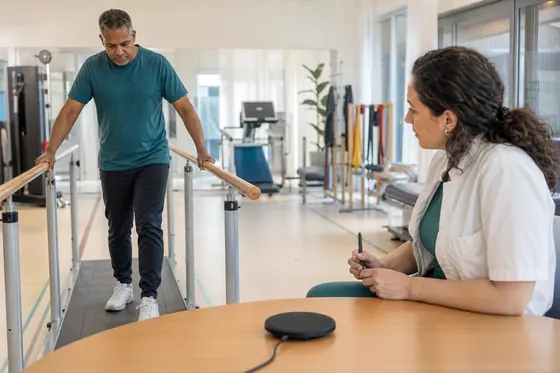
A structured report in your professional terminology
From care encounter to report
Hysio turns spoken information into a report. Choose the report format for the conversation you are documenting.
Document
Record the conversation and clearly state your own findings and agreed actions.
AI assistants
You stay in control of what gets saved.
In your workday
More attention for the conversation, less typing afterwards.
State relevant information, your own findings and agreed actions aloud so you can find them in your report.
The information appears under the headings of your chosen report format, so you can review each section.
Check names, facts and agreed actions. Edit the text where needed before using the report in your records.
Try it yourself
Try Hysio free for 14 days or schedule a personal demo.
For your team
Quick answer
A profession-specific structure for functioning, activities and participation after illness or injury, with room for history, examination, conclusion and plan.
Read how Hysio organises a rehabilitation consultation, intake, evaluation or team meeting. You can read about the structure of the report, about source roles and measurement data, and about what the rehabilitation physician decides themselves.
For an outpatient encounter centred on the request for help, the Rehabilitation Medicine Consultation fits: that format follows the reason for the visit, medical history, specific history, current level of functioning, examination, conclusion and plan. If it is the first team-wide encounter, the Multidisciplinary Rehabilitation Medicine Intake is a better fit, and for a planned review the Progress Evaluation. Hysio organises what you have said. Which format suits this encounter is your own decision. [2] [3] [4] [5] [1] [11]
Activities and participation each get their own label under current level of functioning, alongside body functions and structures, personal factors and environmental factors. Hysio fills only the labels that the source provided actually supports, with source role, date, value, unit, side, measurement condition and assistive device. No code, qualifier or severity grade is added. That interpretation, and how the components relate to each other, is yours to state as the rehabilitation physician. [2] [1] [10]
You note an assistive device as it came up in the encounter: which device, for which activity, according to which source and on which date. If the patient reports walking for ten minutes with a walking stick and the physiotherapist noted eight minutes, both reports stay side by side with their own origin and measurement condition. Hysio does not average those values and does not turn them into a course. That judgement is yours to make. [10] [1] [2]
Limit what you record about work, education, relationships and social life to what this encounter needs, and leave the rest out of the report. If a relative or an employer provides something, note who provided it and what you use it for. You record consent for sharing it separately. Hysio never assumes consent and does not infer it from who was present during the conversation. [8] [19] [1]
Hysio has three monthly plans: Starter €20, Pro €40 and Unlimited €80 per month, excl. VAT. If you pay yearly, you get two months free. The current terms for each plan are on the pricing page. The plan you choose does not change the content boundaries: even on the most extensive plan, Hysio does not make a rehabilitation diagnosis, does not assign a goal status, and the final review of the report stays with you. [6] [7]
If your department already works with a fixed heading structure for the outpatient report that everyone knows and that lands well in the record, that template may fit better than a new layout. In that case, compare what Hysio produces with your own headings, and check whether source role, date and measurement condition remain equally traceable in both. This is a choice for your own team. [1] [10] [11]
Read the report alongside your own dictation and the selected sources, and pay particular attention to value, unit, side, date and measurement condition. Check that a patient's report has not been written down as a professional measurement, and that a statement from the physiotherapist or occupational therapist is still attributed to that role. A fixed format does not make the content correct by itself, so this check is needed again for every report. [1] [11] [9]
During the consultation your attention goes to the patient and not to the screen: you listen to what someone tells you about daily activities, work and their own goals, instead of typing along. Hysio then organises that conversation into the fixed sections, with the patient's words remaining recognisable as the patient's report. Only afterwards do you read the report, add what you established yourself and save it. [1] [2] [10]
A general dictation solution produces running text. Hysio organises the same recording into the sections of a rehabilitation medicine report and keeps visible who said what, so that a report from the patient, a contribution from the occupational therapist and your own findings stay separate. What the platform deliberately does not do counts just as much: no calculating differences, no interpreting trends and no ticking off a goal that nobody stated. [1] [2] [10]
You follow the standards of your own profession and tell your client or patient that you use Hysio; audio is stored securely in the EU. [20]
A defined assessment of the report structure covers an encounter type you have often, for example the outpatient follow-up consultation, with your own report alongside it for the first few weeks. Agree who reads the report before it goes into the record, and collect what goes wrong structurally in source role, date or unit. Assessment of intake, evaluation and team report follows only once that first structure proves to work reliably in your practice. [7] [8] [1]
This format is intended for the outpatient rehabilitation medicine consultation. The sections follow the structure you use yourself: summary, reason for the visit or referral, medical history, specific history, current level of functioning, physical examination, additional investigations, conclusion, considerations and plan. Each section is filled only with what is in the source provided. If a part is missing, it stays visibly empty instead of being filled in. [2] [1] [11]
The intake belongs to the first, team-wide encounter. In addition to the sections of the consultation, the intake has its own place for the request for help and expectations, a summary of the level of functioning and the multidisciplinary contributions. What the physiotherapist, occupational therapist or psychologist contributes therefore stays recognisable as that discipline's contribution and is not merged into a single team text. Hysio never decides on its own who is the lead clinician or co-treating clinician. [3] [1] [11]
This format is intended for the planned evaluation of an ongoing programme. The sections run from the reason and evaluation period, via previous goals and agreements, current functioning and measured values, to the comparison with the previous situation, the result per goal and the adjusted plan. Two values may stand side by side with their date and measurement condition. The platform does not calculate a difference and does not state a goal status itself. [4] [1] [11]
This format organises a short encounter in four parts: subjective, objective, assessment and plan. If your department or care partner works with that layout, the report fits it. For the extensive outpatient report, Consultation, Intake and Progress Evaluation are the formats that follow the rehabilitation medicine structure with current level of functioning. With voice-driven reporting too, only what was said in the encounter goes into the report. [5] [1] [11]
The choice follows the encounter and not the topic. A first team-wide encounter calls for the intake, with the request for help, expectations and discipline contributions. A regular outpatient consultation fits the Consultation. A planned review of goals and course belongs in the Progress Evaluation. A short encounter that you want to record in four parts fits the SOAP Note. If in doubt, choose the format with the sections you would write yourself. [1] [2] [11]
Choose the intake when you record the starting point: request for help, expectations, medical history, the level of functioning at that moment and what each discipline contributes. At a follow-up encounter you already have that starting point, and the focus is on what has been discussed and measured since. If the course relative to previously agreed goals is central, the Progress Evaluation is the format with its own section for the result per goal. [1] [2] [11]
You record a procedure as you stated it: what you did, on which side, for what reason and what you agreed afterwards. If you mention a medicine or a dose, Hysio copies that verbatim into the section where you mentioned it and does not turn it into a medication list. The platform does not propose an indication, dose or next step itself and does not add customary steps. [1] [2] [11]
Feedback to the GP or referrer should include the reason for the visit, what you established about functioning, your conclusion and the plan you stated. What another discipline contributed stays recognisable as that discipline's contribution. Before you send it, check that the purpose of the feedback and the patient's consent are clear. Hysio does not assess that and does not send anything itself. [1] [2] [11]
Each line gets the role that belongs to it: what the patient reports, what a relative says, what the physiotherapist or occupational therapist noted and what you examined yourself. Hysio keeps those roles separate and does not merge them into one flowing paragraph. That way the record keeps showing that a reported walking distance is something other than a measured walking distance, also for whoever reads the report later. [1] [2] [11]
Only set values side by side when both are in the selected source, each with source, date and measurement condition. A walking speed from last month and one from today may stand side by side when they were measured the same way, with the same assistive device. Hysio calculates no difference, no percentage and no rate, and does not call anything an improvement or a deterioration. That statement is for you to make, or for the discipline that took the measurement. [1] [2] [11]
The specific history contains what the patient tells you about symptoms, course and daily life, in their own words and recognisable as the patient's report. What comes up about activities and participation, such as walking, self-care, household tasks, work or social contacts, goes under current level of functioning. If a topic did not come up, it stays empty. Hysio does not add customary history questions. [1] [11]
For each goal, note who stated it: the patient, a relative, a discipline from the team or you as the rehabilitation physician. A patient's goal therefore does not become a team goal, and a team goal does not become a treatment decision. Hysio keeps that origin as it was provided and does not change the role, not even when the same wording was attributed to someone else in an earlier report. [1] [19] [11]
Note the name of the instrument, the value, the unit, the side, the measurement condition, the date and who took the measurement. With Goal Attainment Scaling, the level that was stated also belongs there, exactly as it was recorded. Hysio copies such a score verbatim and calculates nothing: no sum, no conversion, no rounding and no comparison with a norm value. What the outcome means is yours to state. [1] [11]
A result goes into the additional investigations section, with type of investigation, source, date and the conclusion that the radiologist, the neurophysiologist or the laboratory stated themselves. That conclusion stays within that investigation report and does not become the conclusion of your report. What the result means for functioning, you write yourself under conclusion or considerations. A planned or requested investigation belongs in the plan. [1] [11] [19]
No. Hysio copies a supplied report of, for example, an MRI or a neurophysiological investigation verbatim, with source, date and the assessor's conclusion, but does not look at images or raw signals itself. The platform also does not make a link between an image and the reported limitations. It is exactly that link between finding and functioning that is your work as the rehabilitation physician. [10] [9] [11]
Hysio keeps to the language you use and the terms that belong to this profession: body functions and structures, activities, participation, personal and environmental factors, and roles such as lead clinician, co-treating clinician or consulting clinician. A term from a neighbouring field only comes along when a source uses it literally, with that role attached. Abbreviations stay as you say them and are not written out for you. [1] [11]
Information from a partner, parent or representative is explicitly given that role in the report, separate from what the patient says. The same applies to the referral letter: it remains a statement by the referrer. With cognitive problems after brain injury, those accounts may differ, and then they stand side by side. Whether someone may take part in decisions or receive information is for you to assess, not the platform. [1] [19] [11]
Record per discipline what was contributed and who picks up which follow-up, so that the team does not have to guess. In the intake, this has its own section for multidisciplinary contributions. Hysio does not write a joint conclusion where the meeting did not state one, and does not infer consensus, a team goal or a division of tasks. What was not said is not there, and in a meeting with many participants that is often the most important thing. [1] [2] [19]
Take a follow-up consultation after a stroke. The patient reports being able to walk for about ten minutes with a walking stick, while an earlier physiotherapy source noted eight minutes, with date and measurement condition. Both are listed under activities, each with its source. Under participation it says that work is on hold and that return to work was named as a goal. You write the conclusion, considerations and plan yourself. Hysio does not turn those two values into progress. [1] [11] [2]
Limit the handover to what the recipient needs in order to continue: the reason, current functioning, ongoing agreements and who can be contacted for what. The rest stays in the record, where it is traceable. Short does not mean vaguer: value, unit, date and source role also stay in a summarising line. Hysio only summarises what is there and does not add a conclusion that was never stated. [10] [8] [19] [11]
No. Hysio organises what you said and adopts your conclusion as you phrase it. The platform does not make a rehabilitation diagnosis, does not assign a diagnosis group or code, and does not confirm an indication for medical specialist rehabilitation. Nor does it add a differential diagnosis, prognosis or urgency. If there is no conclusion in the source, that section stays empty instead of the platform filling one in itself. [9] [1] [11]
You are, as the treating physician. Hysio provides a report. You read it, correct what is not right and decide what gets saved. That responsibility does not shift because the platform organised the text, and it changes nothing about your record-keeping duty and your professional confidentiality. If you work with a nurse practitioner or a physician assistant, the agreement about who reviews and approves remains an agreement of your own department. [1] [9] [19]
Then that section stays explicitly empty, with a fixed line stating that the part is not in the source provided. Hysio does not fill in a date, value or normal finding and does not turn a goal that was not discussed into an open goal. With partial information, the platform writes down the usable part and names what is missing. That way you see straight away, when reviewing, where you still need to add something yourself. [1] [9] [11]
Not for the assessment itself. Hysio does not triage, does not determine urgency and does not advise on what needs to happen now. Act first, according to your own judgement and your department's agreements. Afterwards you can record the encounter: what you saw, what you decided and at what moment. Even then, the platform only includes what you said and does not add any explanation afterwards. [9] [8] [11]
You assess consent yourself, per recipient and per purpose, and you record what was agreed. Hysio never assumes consent, not even when a relative was present during the conversation or a referrer sent information earlier. If there is doubt about decision-making capacity, for example after brain injury, that doubt belongs explicitly in the record. The platform does not send anything itself and does not share anything outside your own record. [8] [19] [1]
No. The plan in the report is what you stated, not what the platform considers appropriate. Hysio does not propose a treatment, treatment duration, team composition or follow-up appointment, and does not infer a goal from a measurement or from what is customary for a condition. It does make sure that the plan you do mention ends up in the report complete and traceable, with the agreements you made alongside it. [9] [10] [11]
Doubt stays as you express it. If you say a finding is unclear or that you are awaiting an investigation, that wording goes into the report with that reservation and not as a finding of fact. Hysio never makes a statement firmer than the source and does not soften it either. With voice-driven admin too, an open question to a colleague stays recognisable, instead of disappearing into a smoothly flowing summary. [1] [11] [9]
Then both accounts stay side by side, each with source, role and date. A patient who reports walking for ten minutes and a physiotherapy source that noted eight minutes produce two lines and not one average. Hysio does not choose which source is right, does not align measurement conditions and does not turn the difference into a course. Which account you adopt in your conclusion, and why, is for you to decide when reviewing. [1] [19] [11]
Medication that was discussed only appears verbatim in the section where you mentioned it, for example in the history or in the plan. Hysio does not turn it into a medication list, does not normalise a name or dose and never proposes a start, stop or change. A decision about medication goes into the report when you stated it yourself. Fixed record blocks such as allergies or active medication stay completely outside the report. [1] [11] [9]
Before saving, check three things. Is there nothing in it that you did not say, such as a normal finding, a goal status or a link between a result and a symptom? Are the source roles right, so that a report has not become a measurement? And are date, value, unit and side there as they were mentioned? What you change remains your text, and the saved record remains your responsibility. [1] [8] [9] [19]
In a handover between colleagues, what matters most is that the recipient knows what is going on and who is doing what. Agree who reads the report before it is circulated, and keep the follow-up separate from the findings, so that agreements do not disappear into the running text. What a discipline contributed stays attributed by name. Hysio does not write a summarising judgement about how things are going. That stays with whoever knows the patient. [10] [8] [19] [2]
Record three things: which format you use for which encounter type, how you write frequently used terms and abbreviations, and who reads and approves a report before it goes into the record. Also agree what happens to a report you do not finish. That way colleagues read each other's reports without surprises. Hysio does not enforce those agreements and follows the format and language you choose. [1] [2] [10]
Choose one encounter type and one period of, for example, two weeks, and agree in advance what you will look at: are the source roles right, is the measurement data complete, and how much do you still change before saving. Collect the corrections in one place instead of forgetting them per report. Afterwards, discuss with the team what went wrong structurally, and adjust your agreements before you expand voice-driven reporting. [7] [8] [1]
Compare the sections of the chosen format with the headings your department uses, and decide per section where the text ends up in the record. Individual sections can be copied separately, which helps when parts belong in different fields. If your department deviates somewhere, record that once instead of working it out again for every report. Authorisation for saving remains your own arrangement. [10] [1] [11]
Ask the question as you would ask it in the consulting room, with a word from your own profession in it: which format suits an outpatient follow-up consultation, how does a measurement get into the report, or what happens if a goal was not discussed. A broad question about documentation in healthcare gives a general answer. This page is specifically about rehabilitation medicine documentation. [1] [11] [2]
Measure over several weeks and for the same encounter type, otherwise you mainly end up comparing random fluctuations in workload. Note how long you spend per report, how much you still change and how often a report comes back during review. Also count the indirect hours, such as the time around a team meeting, because they are noticeable in your schedule. Quality comes before speed: a report you have to correct twice gains you nothing. [1] [10] [7]
You can try Hysio for fourteen days without a credit card, and after that the subscription can be cancelled monthly. The current terms are on the pricing page. Use that period in a focused way: take one encounter type, read every report and check whether source roles, measurement data and plan are right within your way of working. The same boundaries apply during that period, so you remain the one who checks and saves the report. [7] [6] [8]
Pricing is on the pricing page, the processing of data in the privacy policy, the product boundaries in the disclaimer and the terms under legal information. Those pages apply to all healthcare fields and take precedence over what you read here. What is not there is a professional standard: Hysio does not prescribe what a rehabilitation medicine report should look like. That standard comes from your own profession and your own department. [6] [8] [9]
Hysio leaves an abbreviation as you say it and does not write it out for you. That is exactly why it helps to agree within your team which spelling you use and which abbreviations you write out in full once. Think of terms that are read differently outside your department, or of your own name for an assistive device. What you agree also applies to whoever reads the record later. [1] [10] [11]
Work per source and per encounter instead of everything at once. Select which earlier reports, measurements and discipline contributions you include, so that it stays clear what this report is built from. Under current level of functioning, the individual lines stand side by side with their role and date. You write how those lines relate under conclusion and considerations yourself, because Hysio does not turn many separate findings into an overall picture. [1] [11] [2] [9]
Hysio creates the report. You remain responsible for what you save in the record.