Document
Keep your attention on the care encounter.
Record the conversation and clearly state your own findings and agreed actions.
Hysio Neurology
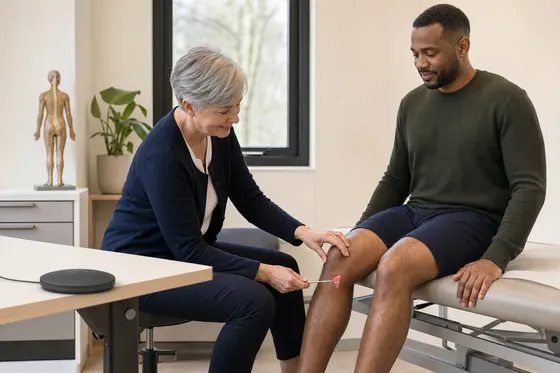
After a neurological consultation, you dictate the course of the complaints and the examination. Hysio puts strength, sensation and EEG result each in their place; localisation and conclusion stay yours.
A structured report in your professional terminology
From care encounter to report
Hysio turns spoken information into a report. Choose the report format for the conversation you are documenting.
Document
Record the conversation and clearly state your own findings and agreed actions.
AI assistants
You stay in control of what gets saved.
In your workday
More attention for the conversation, less typing afterwards.
State relevant information, your own findings and agreed actions aloud so you can find them in your report.
The information appears under the headings of your chosen report format, so you can review each section.
Check names, facts and agreed actions. Edit the text where needed before using the report in your records.
Try it yourself
Try Hysio free for 14 days or schedule a personal demo.
For your team
Quick answer
For neurological complaints, seizures and deficits, with a dedicated place for examination, EEG and the impact on daily life.
Read how Hysio works in a neurological consultation, examination or follow-up contact. Each answer belongs to a documentation format from the catalogue and to the sources of neurology.
For a request for help involving strength and sensation, the appropriate report structure follows what was actually reported during that contact. An extensive first assessment belongs in the Neurological Intake, a focused outpatient contact in the Neurological Consultation. Hysio places the reported seizure semiology and lateralisation side by side with their origin and includes an EEG result only when the source contains it. The localisation itself remains your judgement. [2] [3] [4] [5] [6] [1] [12]
In the record, a fixed layout works best: put strength and sensation and the EEG result under their own headings, so the neurological history and lateralisation are quick to find. Hysio keeps the origin with each part and keeps seizure semiology separate from your own assessment. That way it stays clear which information comes from which source and what you have added to it. [2] [1] [11]
An EEG result belongs in the section for additional investigations, with the type of investigation, the source role and the date, and with the assessor's conclusion recognisable as the source's conclusion. Your own conclusion stands apart from it, even when both say the same thing. Hysio provides that text with its origin; check the seizure semiology and the source before you save. You decide its final place in the record. [11] [1] [2]
When making the privacy choice, you limit the note on lateralisation to what the contact actually needs. You record consent for sharing strength and sensation separately, apart from the assessment of seizure semiology and the EEG result. That way the reported symptoms stay traceable without more being shared than necessary. [9] [14] [1]
As a neurologist, you pay the rate on Hysio's central pricing page, regardless of whether it concerns seizure semiology, lateralisation or strength and sensation. The pricing model does not change anything about the boundaries around neurological localisation: symptoms and the EEG result remain your assessment. Choosing a plan and responsibility for the content are therefore separate from each other. [7] [8]
Your own template for strength and sensation can sometimes fit better than the standard layout, for example when your department already uses fixed headings for lateralisation and seizure semiology. Compare such a template with what Hysio produces and keep the EEG result traceable to the source. As long as symptoms within neurological localisation stay tied to the source, you can choose which route to follow. [1] [11] [12]
During the source check, you place the text of the neurological history alongside the dictation and the lateralisation to see whether everything matches. A fixed format does not in itself guarantee accuracy within neurological localisation: you check whether strength and sensation and the EEG result match what the source actually says. Only after that check do you save the seizure semiology. [1] [12] [10]
During the client contact, your attention goes to the client first and only then to writing up the EEG result. Record lateralisation and strength and sensation with the available origin and check the seizure semiology before you finalise the note. You do not fill in afterwards what was not discussed during the contact. [1] [2] [11]
The difference lies in the division of roles: Hysio organises lateralisation, the EEG result and seizure semiology and links each part to the source it comes from. You then assess strength and sensation and the symptoms and decide for yourself what is usable. Where the origin is not kept for each part, it is precisely that information that gets lost when it is transferred. [1] [2] [11]
When you start working with this, begin with one recognisable contact involving seizure semiology, so you can see how strength and sensation and the EEG result are presented. Agree within your department who checks the lateralisation before Hysio is used more widely. What is not in the source should not appear in the report either. [8] [9] [1]
The Neurological Consultation fits a focused outpatient, telephone or digital contact in which the question, the course of symptoms with lateralisation, the examination findings and the stated follow-up come together. Hysio records seizure semiology and the EEG result with the available origin and does not pass judgement on them itself. Saving to the record always waits for your check before it becomes final. [2] [1] [12]
The Neurological Intake is the extensive first assessment: the referral question, onset and course of symptoms, lateralisation, medical history, family and social context, expectations and examination come together here. Strength and sensation and the reported symptoms stay tied to the source, and information from the referrer remains an attributed source rather than a confirmed diagnosis. You include an EEG result only as the source states it; you save only after your own check. [3] [1] [12]
The Neurological Examination is the dictation of a clinical neurological examination that was actually performed: what was examined, which findings were established and which follow-up was stated. Strength and sensation, reflexes, coordination and gait appear here with source-faithful lateralisation and notation. Additional investigations such as an EEG do not belong in this format; you record that result in the consultation or follow-up format. [4] [1] [12]
The Neurological Follow-up Consultation is the format for a results or follow-up contact: the interval course since the previous contact, the investigation results already assessed and the agreed review come together here. Hysio links the EEG result and seizure semiology to their source, without passing judgement itself. That is how voice-driven reporting also works in a results discussion: a result that has not yet been authorised remains a pending investigation. You record the outcome for neurological localisation only after your own check. [5] [1] [12]
The Neurological SOAP Note is the journal entry for a short follow-up contact or a ward round during admission, not the outpatient letter. It organises the contact as Subjective, Objective, Assessment and Plan, so that course, lateralisation and examination values stay separate from your current judgement and plan. You also save this format within neurological localisation only after you have checked it. [6] [1] [12]
Which format best suits seizure semiology depends on the contact itself: with a mixed source containing both strength and sensation and an EEG result, a report structure that does justice to both parts is appropriate. Lateralisation and symptoms are recorded with their origin, not merged into a single stand-alone conclusion. That way it stays traceable why you chose that particular format. [1] [2] [12]
You choose an intake when the findings on strength and sensation describe the starting point of care, so at the first contact. For a subsequent contact, in which an EEG result shows the change compared with earlier, a follow-up format fits better. In both cases, seizure semiology and lateralisation are recorded in a source-bound way. [1] [2] [12]
After a results appointment, the history covers what has changed since the previous contact and how the result was discussed with the client. The result itself remains a separate, source-bound part with the type of investigation, date and source role, alongside the seizure semiology. Do not add details that do not come from the source itself. You link strength and sensation to this results appointment only when that information was actually discussed within neurological localisation. [1] [2] [12]
In a handover, the EEG result should always show who the source is, who receives it and which agreement was made about it. Check consent before you share information about neurological localisation, and limit the note to what the recipient needs. You include seizure semiology and symptoms only when relevant. [1] [2] [12]
You keep lateralisation separate from other sources by labelling the client's account, your own observation and the professional assessment separately. Record the source role explicitly for each part, so that the EEG result and seizure semiology stay traceable. During the final check before saving, you verify whether strength and sensation and symptoms still belong to the right source within neurological localisation. [1] [2] [12]
In the history, you describe lateralisation as the source gives it: which side is affected, when it began and what the course is, in the source's own words. Add this part only when it was actually discussed during a consultation, examination or follow-up contact. The EEG result and strength and sensation stay separate, each with its own origin within neurological localisation. [1] [12]
Record explicitly under the source role who provided the information about the seizure semiology, whether that is the client, a relative or a referrer. Keep that separate from your own observation, so that lateralisation stays traceable within neurological localisation. An observation by a relative remains an observation by a relative, even when it is clinically useful. [1] [14] [12]
For a measured value in strength and sensation, you record the instrument, unit and time of measurement, so the information is traceable on its own. You copy an MRC grading as the source states it; Hysio does not convert any score, adds nothing and does not classify. Lateralisation and the EEG result are kept separate, each with its own source. You determine the professional meaning of the measurement. [1] [12]
For an investigation result, always link the neurological history to the type of investigation, the date and its source. Your own assessment of the lateralisation gets a separate place, apart from what the EEG result and strength and sensation literally state. That way it stays clear what is fact and what is interpretation within neurological localisation. [1] [12] [14]
Hysio includes a provided EEG result as the source describes it and does not itself assess any images, signals or raw measurement data. That professional assessment stays with you, as does the link with seizure semiology, lateralisation and the findings on strength and sensation. The source therefore remains decisive for everything recorded within neurological localisation. [11] [10] [12]
For the professional term for lateralisation, you stick to what the source states: left or right, and where applicable terms such as radicular, dermatome or paresis. Hysio does not turn that into a synonym, abbreviation or its own classification. Check whether colleagues read the same term unambiguously, especially when the EEG result and strength and sensation refer to it. Seizure semiology follows the same agreement within neurological localisation. [1] [12]
When a relative provides information about the seizure semiology, you state explicitly that this is the source: client, relative or referrer. Record consent for sharing lateralisation separately, before you pass anything on. Strength and sensation and the EEG result are left untouched in that case, unless the relative also reports something about them. [1] [14] [12]
For a team meeting, it matters most to make visible which discipline assessed strength and sensation and who takes on the follow-up. Keep the EEG result understandable for colleagues outside your own specialty, without abbreviations that are not explained. You link lateralisation and seizure semiology to the same source within neurological localisation. [1] [2] [14]
A good example case shows the actual contact, the neurological history and the follow-up, without inventing details that were not discussed. You add the EEG result and strength and sensation only if the source actually contains them. A diagnosis or localisation belongs in it only when the neurologist stated it in the source. [1] [12] [2]
Limit a handover about the EEG result to the source and the purpose of sharing. Let the recipient trace the seizure semiology themselves using the lateralisation and strength and sensation, instead of summarising everything. You include symptoms only when that is needed for the handover within neurological localisation. [11] [9] [14] [12]
Hysio does not make a diagnosis based on an EEG result and does not establish an indication either. The platform organises lateralisation, strength and sensation and seizure semiology with their origin; you, as the neurologist, determine their medical meaning yourself. Hysio also does not independently derive the localisation, the root level or the nerve involved. [10] [1] [12]
Professional responsibility for lateralisation lies entirely with you: you choose what goes into the record and assess the text before it is saved. Hysio provides the EEG result and seizure semiology tied to the source, but never takes over that decision. Strength and sensation and symptoms follow the same rule within neurological localisation. [1] [10] [14]
If the seizure semiology is missing, you mark it explicitly as missing or not discussed, instead of inventing something. Do not add any date, value or conclusion that does not come from the source. In that case, strength and sensation and the EEG result also stay empty until the information is available within neurological localisation. [1] [10] [12]
Hysio is not intended for an acute situation: do not use the platform for triage involving strength and sensation, because that assessment requires immediate clinical evaluation. Record the EEG result tied to the source only after the acute assessment has taken place and the contact has ended. Seizure semiology and lateralisation follow the same order within neurological localisation, even in urgent cases. [10] [9] [12]
Before you share the neurological history, you check the purpose of sharing, the client's consent and exactly who the recipient is. Record only what was actually agreed, no more, even if extra context sometimes seems useful. The EEG result and strength and sensation follow the same consent boundary within neurological localisation, whoever asks the question. [9] [14] [1]
For the plan, Hysio puts the EEG result under its own heading, but does not itself choose a treatment, nor any medication. A medication decision appears only as you stated it; Hysio does not create a medication list and does not normalise any name or dosage. Lateralisation and strength and sensation are provided only tied to the source, never interpreted or supplemented with a conclusion of its own. [10] [11] [12]
You leave doubt about the lateralisation visible instead of silently writing it away or replacing it with an assumption. Do not make strength and sensation more definite than the source allows, and record an open question explicitly as an open question. The EEG result and seizure semiology follow the same restraint within neurological localisation until the uncertainty is resolved. [1] [12] [10]
If sources differ on the seizure semiology, keep both accounts side by side instead of choosing one as the truth yourself. Record the origin of each account before you add your own assessment to the record. Strength and sensation and the EEG result get the same treatment within neurological localisation as soon as sources differ there too. [1] [14] [12]
You copy medication and measured values verbatim, including source, dosage and unit, without your own interpretation. Hysio does not create its own medication overview from them and does not normalise any name or dosage. The same rule applies to figures in the EEG result. Their medical assessment stays with you as the neurologist, as does the link to seizure semiology within neurological localisation. [1] [12] [10]
During the final check, you read the text on the neurological history back once more alongside the source and its date, before you continue. If the lateralisation is not right, you correct it straight away. Admin with AI takes over the typing, not your final check. The EEG result and strength and sensation go through the same final check within neurological localisation. [1] [9] [10] [14]
For a team handover, you agree in advance who reads through the neurological history before it is shared. Decide which information about strength and sensation the recipient actually needs and set the follow-up pathway apart, separate from the lateralisation. You include the EEG result and seizure semiology only when relevant within neurological localisation. [11] [9] [14] [2]
For shared team use, it works well to agree fixed headings for the EEG result and to use shared terminology for seizure semiology, so that everyone reads the same language. Also record who within the team approves the final text on neurological localisation. Lateralisation and strength and sensation follow that same team agreement. [1] [2] [11]
When you start working with this, keep a first round small: one clearly defined contact, so you can quickly see how the text turns out. Collect corrections on strength and sensation and apply them before you continue. Only expand once the EEG result and seizure semiology are consistently correct as well. That way voice-driven reporting grows along with your clinic. [8] [9] [1]
To adapt a report on the seizure semiology to local agreements, you first check it against the headings your department already uses. You also check lateralisation against the applicable authorisations. Have the designated colleague review it before strength and sensation and the EEG result become final within neurological localisation. [11] [1] [12]
For each limb, state the strength on the MRC scale and where sensation is abnormal, with left and right separately. Hysio records those values as you say them and puts them with the neurological examination. An EEG result or the description of a seizure gets its own place. Anything you did not examine stays empty. [1] [12] [2]
If you want to measure the time saved on the neurological history, do so together with your team: record the time for drafting, checking and any corrections separately. Always give the accuracy of neurological localisation priority over a percentage promised in advance. You measure lateralisation and strength and sensation in the same way. [1] [11] [8]
The conditions for the free trial around an EEG result are on the central trial conditions page, separate from the content choices you make. Those conditions apply to Hysio as a whole and not per documentation format. You assess lateralisation and strength and sensation in the same way within neurological localisation. [8] [7] [9]
Current rates for Hysio are on the pricing page; the legal pages describe data use and responsibilities. Lateralisation, strength and sensation are part of the content of a neurological report and have no separate subscription rate. When assessing the platform, look at both the subscription terms and the information on processing health data. The choice of which neurological information belongs in the record remains your assessment. [7] [9] [10]
Record agreements on your own terminology for seizure semiology in writing and appoint someone to manage the list, so that new colleagues use the same spelling. Keep the text on neurological localisation understandable for every colleague who reads the record later. The EEG result and lateralisation follow the same agreed spelling throughout the record. [1] [11] [12]
For a complex case, you first break strength and sensation down into the separate contacts and their sources. Then organise the EEG result, findings and next steps without adding an extra conclusion of your own. Seizure semiology and lateralisation each get their own source-bound place within neurological localisation. [1] [12] [2] [10]
Hysio creates the report. You remain responsible for what you save in the record.