Document
Keep your attention on the care encounter.
Record the conversation and clearly state your own findings and agreed actions.
Hysio ENT
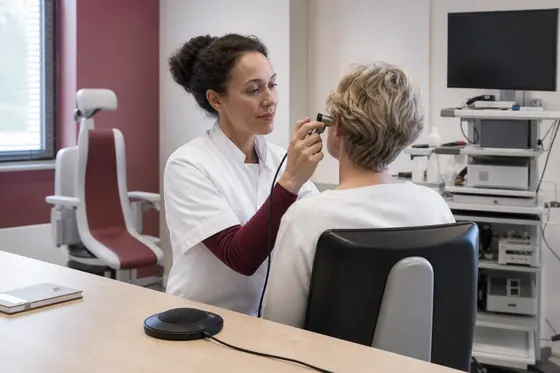
After an ENT consultation or examination, you say what you heard and saw. Hysio puts audiometry, endoscopy and the agreed follow-up each in their place.
A structured report in your professional terminology
From care encounter to report
Hysio turns spoken information into a report. Choose the report format for the conversation you are documenting.
Document
Record the conversation and clearly state your own findings and agreed actions.
AI assistants
You stay in control of what gets saved.
In your workday
More attention for the conversation, less typing afterwards.
State relevant information, your own findings and agreed actions aloud so you can find them in your report.
The information appears under the headings of your chosen report format, so you can review each section.
Check names, facts and agreed actions. Edit the text where needed before using the report in your records.
Try it yourself
Try Hysio free for 14 days or schedule a personal demo.
For your team
Quick answer
For ear, nose, throat, voice, swallowing and balance, with a dedicated place for audiometry, endoscopy and daily functioning.
Read how Hysio works in an ENT consultation, an examination or a follow-up contact.
When the request for help is discussed, what matters is the format that fits the moment at which audiometry comes up: usually the ENT Consultation or the ENT Intake, depending on whether it concerns a first contact or a follow-up appointment. Within that format, hearing, nasal patency and swallowing problems each get their own place next to the source of every result. That way hoarseness stays clearly linked to what you actually established, instead of being mixed with what the patient reports. [2] [3] [4] [5] [6] [1] [12]
Nasal patency and swallowing problems each get their own heading in the report, with the source stated directly after it. That way you see at a glance whether a finding comes from your own examination or from what the patient told you. Audiometry and hoarseness sit separately alongside them, so you do not accidentally link them to the wrong symptom. That separation makes the record quicker to search at the next contact. [2] [1] [11]
Document hoarseness as the patient or the source describes it, without adding a severity or cause yourself. Link the report to the moment it arose and to any triggering factors that were mentioned. Audiometry, nasal patency and swallowing problems stay in their own section of the record, so that hoarseness does not get mixed up with other symptoms. In the end, you assess for yourself what the report actually means. [11] [1] [2]
When making privacy choices, you describe swallowing problems in the words of the source, without extra details that were not shared. Audiometry and hoarseness belong in separate sections, so you can decide for each item who may see it. You only record nasal patency after you have assessed that item yourself. That way you, not Hysio, decide which information is shared and with whom. [9] [12] [1]
The price of Hysio does not depend on the topic of a contact: hearing, audiometry or hoarseness make no difference to the plan. The current rates per plan are on the central pricing page, including how many sessions an ENT specialist gets within each plan. Nasal patency and swallowing problems change nothing about that; the boundaries of what Hysio does and does not record stay the same for every plan. [7] [8]
Your own template for audiometry may be a better fit when your practice already uses a fixed, approved layout that does not correspond one to one with the Hysio format. In that case, first compare the two structures, and keep hoarseness, nasal patency and swallowing problems traceable to their source before you switch. In both situations, hearing stays linked to what you actually established yourself. [1] [11] [12]
During the source check, always compare your own dictation or note with what the source states about nasal patency, and adjust the text as soon as a difference appears. You check audiometry and swallowing problems in the same way: a fixed documentation format does not automatically guarantee that the content is correct. Hoarseness remains a separate checkpoint, because only the source determines whether an earlier note still holds. [1] [12] [10]
When hoarseness is reported, first focus on what the patient tells you about its course, before you bring in audiometry or other findings. Write down only what the source actually states, without adding your own estimate of severity. Keep nasal patency and swallowing problems in their own section, so that the note on hoarseness does not overshadow the patient's perspective with other symptoms. [1] [2] [11]
With swallowing problems, Hysio organises the source and links every item to where it comes from, instead of summarising everything in running text. You then assess audiometry yourself and decide what is useful for a clear handover. Hoarseness and nasal patency stay separate from hearing, so you see at a glance exactly which item belongs to which symptom. [1] [2] [11]
At the introduction stage, start with one recognisable contact around hearing, for example a single intake conversation, before you document audiometry and hoarseness more broadly. Agree within your team who checks nasal patency and who reads through the first reports. During the free trial you can still adjust those agreements, without swallowing problems or other parts already being fixed in a definitive way of working. [8] [9] [1]
The ENT Consultation fits a regular consultation, examination or follow-up contact: the format sets out reason for visit and referral, medical history, specific history, physical examination, additional investigations, conclusion, considerations and management plan as separate headings. The ENT specialist checks the source and determines the medical assessment. [2] [1] [12]
The ENT Intake fits a first contact and sets out reason for visit, active diagnoses, social history, medical history, expectations, examination and the agreed management plan as separate headings. The ENT specialist determines which context and professional assessment belong in the record; Hysio does not fill in missing professional content. [3] [1] [12]
The ENT Examination Report fits when the examination itself is central and sets out reason for visit, examination context and method, findings and measurements, additional investigations, conclusion, considerations and management plan as separate headings. The ENT specialist checks the examination source and determines the professional conclusion. [4] [1] [12]
For an intervention or procedure, the ENT Procedure Report is the intended format: it organises reason, procedure, findings and aftercare under Reason, Procedure, Findings and Follow-up. Effects on hearing and communication after the intervention, such as changed hearing, belong under Findings or Follow-up, depending on the moment at which they were established. The medical interpretation still stays with you. [5] [1] [12]
The ENT SOAP Note follows the classic structure of Subjective, Objective, Assessment and Plan, and therefore fits a regular follow-up contact. What the patient reports about hearing and communication goes under Subjective; what you measure or observe, such as a hearing test, goes under Objective. Assessment and Plan always remain your own consideration, even when the result is already noted under Objective. [6] [1] [12]
For a report about hearing during a regular consultation, the ENT Consultation usually fits best, because Findings there gives room for a result alongside the conversation itself. If it is purely an examination moment, the Examination Report fits better; for an evaluative follow-up contact, the SOAP Note fits. Audiometry, nasal patency, swallowing problems and hoarseness follow the same rule in every format: only the source determines what you note. [1] [2] [12]
The ENT Intake is intended for situations in which audiometry has not been discussed before and you first map out the patient's request for help, medical history and context. If there is already a record with earlier hearing tests, follow-up formats such as the Consultation or the SOAP Note are intended for that, so you do not start from scratch again. You only include nasal patency and hoarseness in the intake when the patient or the source mentions them. [1] [2] [12]
After a results moment, what belongs with nasal patency is mainly what was measured or observed, with the source of that measurement and the moment it took place. Do not add any interpretation that was not explicitly stated during the contact. Audiometry and swallowing problems stay in their own section of the record, so that a result on nasal patency does not get mixed up with other findings from the same contact. [1] [2] [12]
In a handover, you include the following about hoarseness: since when the symptom has been present, who reported it, and which findings have already been established, each with its source. Leave room for what is not yet clear, instead of filling it in yourself. Audiometry and nasal patency only belong in it when they relate directly to the reason for the handover, so that the receiving colleague immediately knows what has already been examined. [1] [2] [12]
Put swallowing problems in a section of the record of their own, separate from hearing, nasal patency or hoarseness, so that each symptom keeps its own source and time. If information comes from the patient, from a referrer or from your own examination, state that separately each time. That way you prevent an observation about swallowing problems from accidentally being read as coming from audiometry or another part of the contact. [1] [2] [12]
Describe swallowing problems in the history as the patient puts them: since when, with which kind of food and how often. Do not add your own interpretation of the cause before examination confirms it. Note hearing and hoarseness separately, so that a swallowing symptom does not get mixed up with other reports. Audiometry only comes later in the record, as a separate result with its own source. [1] [12]
For every report about hearing, state who the source was: the patient, a relative, a referring doctor or your own examination. That distinction determines how much weight an item carries in your assessment. If the source is unclear, state that explicitly in the text instead of noting an assumption. That way audiometry also stays traceable to whoever originally supplied the information. [1] [12]
Always link an audiometry result to the exact time of measurement: the date and, if known, the time and the method used. Without that time of measurement, a hearing value is hard to compare with an earlier or later test. Also state who carried out the measurement, especially when that was not you. Nasal patency and swallowing problems follow the same rule: a value without a time of measurement stays incomplete in the record. [1] [12]
Place the result on nasal patency directly next to the finding it belongs to, with the source and the moment of examination stated. That way it stays clear whether a value comes from imaging, a physical examination or your own estimate. Do not leave a result standing on its own in the record without that link, because that makes a related symptom harder for a colleague to find later. [1] [12]
No. Hysio does not read imaging and therefore does not draw any conclusion about hoarseness from it. Hysio does include what you dictate or type yourself about an imaging study, as source-bound text. The medical interpretation of a scan or image, and its translation into a symptom such as hoarseness, stays entirely with you and your local team. [11] [10] [12]
Use the technical term you are used to, such as dysphagia, as long as it matches what was actually established. Hysio does not automatically replace a term you chose yourself with another one. If you are unsure between a description of the symptom and a technical term, choose the term that stays closest to the source. That way the text on swallowing problems matches how colleagues and referrers are used to reading. [1] [12]
If a relative reports something about the patient's hearing, state explicitly that the information comes from that relative, with name or relationship if known. Record the observation as it was given, without equating it with a finding from your own examination. If you have doubts about the reliability of the report, note that as well, so it stays clear which part rests on your own examination. [1] [12]
For a team meeting, your colleague mainly needs the audiometry result, the time of measurement and the next step that has already been agreed. Also state what is still open, so that nobody picks up an action twice. Leave out details that have nothing to do with the question discussed: an overloaded report makes it harder for a colleague to find the core quickly. [1] [2] [12]
A case around nasal patency usually shows how a symptom, an examination finding and a next step connect logically: from the first report to the result and the plan discussed. Such examples serve to illustrate the structure, not as a template for an individual patient. Every case in practice still depends on its own source and the actual course of that contact. [1] [12] [2]
In a handover about hoarseness, briefly describe the course, the main findings and what has already been discussed with the patient, each with its source. Leave room for what is not yet clear, instead of filling it in yourself. State who receives the handover and which action you expect from them, so that the next healthcare professional immediately knows what still needs to happen. [11] [9] [12]
No, Hysio does not make a diagnosis for hoarseness or any other symptom. The platform organises what you dictate or type yourself about examination, findings and conversation, but does not draw a medical conclusion from it. The diagnosis, the severity and the further course of care remain entirely your professional judgement as an ENT specialist. At most, Hysio makes visible which source belongs to which item, so you can make that judgement more quickly. [10] [1] [12]
You always check the text on swallowing problems yourself before it is saved. Read the text for accuracy and completeness, and adjust anything that does not match what was actually discussed or established. Only after your approval does the text end up in the record for good, just like any other part of the report. [1] [10] [12]
If information about hearing is missing, leave the section open or mark it as not yet discussed, instead of filling in an assumption. Ask about it explicitly at the next contact, or consult the patient or a colleague when that gives clarity sooner. Hysio never fills in a missing item itself with an expected value, not even when an earlier measurement seems to point to it. [1] [10] [12]
No, do not use Hysio in an acute situation: there is no real-time assessment and no emergency function. With an acute symptom around hearing, nasal patency or hoarseness, you first contact the right healthcare professional or emergency line yourself. Hysio can only help afterwards with documenting what was discussed during that acute contact, not with the assessment in the moment itself. [10] [9] [12]
Only the healthcare professionals and organisations you designate as recipients yourself get to see information about nasal patency; Hysio shares nothing automatically with third parties. For each handover, state who the recipient is, together with the reason that person needs the information for their own contact. If you are unsure what may be shared, limit the text to what is relevant for that specific contact, in line with the consent given earlier. [9] [12] [1]
No, Hysio does not draw up a treatment plan for hoarseness or any other symptom. Hysio records what you state or type yourself as a next step in a source-bound way, but the platform does not devise that plan itself, nor does it check whether it is medically sound to carry out. Every follow-up that ends up in the record therefore remains a choice that you make and justify yourself as an ENT specialist. [10] [11] [12]
Write down uncertainty about swallowing problems literally as uncertainty, for example by stating that a finding has not yet been confirmed or that the patient is unsure about the course. Avoid a firm wording when it is not supported. That way it stays clear to a colleague who reads the record later which part of the text is established and which part still needs assessment or further examination. [1] [12] [10]
For hearing, handle each source separately: a test result, a report from the patient and an observation from a colleague do not simply belong together in one sentence. For each item, state where it comes from and when it was collected. With contradictory information, for example when a patient reports something different from what an earlier test showed, keep that difference visible instead of silently resolving it. [1] [12]
Note medication that may affect audiometry separately from the result itself, with the name, the use and the source of that information. That way, when assessing a hearing test later, you can weigh up whether medication may have played a role. With voice-driven admin, Hysio does not make that link itself: that medical judgement stays with you as the ENT surgeon. [1] [12] [10]
Read the text on nasal patency for factual accuracy before you save: are the time of measurement, the source and the description of the finding correct? Adjust anything that differs from what was actually discussed or established, and do not add anything that was not mentioned. Only after that check does the text end up in the record for good, with your approval as the last step in the process. [1] [9] [10] [12]
For a handover about nasal patency, first gather what has been established, with the source and moment of each finding, and state what is still open without presenting it as an established fact. Then decide who receives the handover and which action you expect from that person. You judge whether the text is complete enough to share; Hysio organises the source data, but does not take that decision out of your hands. [11] [9] [12] [2]
Agree within your team who assesses a report of hoarseness first, and at which moment a colleague is brought in. Also record who approves the final text in the record before it is shared. Without such an agreement it can remain unclear who is responsible for the final check, while Hysio itself plays no role in that division of responsibility. [1] [2] [11]
Start the free trial with a limited number of contacts in which swallowing problems come up, so you can get used to the structure without converting your entire caseload straight away. After a few records, compare whether the layout matches how you are used to working. During the trial the same boundaries apply as afterwards: Hysio does not make a diagnosis and, even then, decides nothing on its own authority. [8] [9] [1]
Adapt the layout of a report on hearing when your practice uses a slightly different order or terminology than the standard Hysio format. Discuss that adjustment with your team, so everyone keeps to the same structure. The rule on content does not change: only what was actually discussed or established goes into the text, regardless of which local layout you use on top of it. [11] [1] [12]
Start with the complaint and how long it has been going on. Then read out the audiometry result as it was measured, and say separately what you make of it. That is voice-driven reporting: Hysio puts measurement and judgement each under its own heading. If a part is missing, that field stays empty. [1] [12] [2]
For a time-bound finding on nasal patency, note the exact moment as it was supplied, without calculating a duration yourself when none was explicitly given. If a time is missing, leave the field open instead of filling in an estimate. That way the text stays based solely on what the source actually states about the moment of the finding. [1] [11] [8]
During the free trial, the same conditions apply to a report of hoarseness as to any other part: a limited trial period and a fixed number of sessions, after which you choose a plan that suits your practice. The boundaries on content, such as no diagnosis and no independent decision, stay unchanged during the trial. The current conditions and duration are stated on the website. [8] [7] [9]
For a Hysio subscription, the rates on the central pricing page apply, regardless of whether your report is about hearing, voice or swallowing problems. The Privacy Policy and legal information describe the agreements about the platform. When comparing, distinguish between the costs of Hysio and your own care provision. The Hysio terms do not determine any ENT treatment and do not prescribe any examination. [7] [9] [10]
For hearing, use the terminology you and your team are used to working with; Hysio does not impose a fixed vocabulary. If a term differs from what is common, briefly record why you make that choice, so that a colleague who reads the record later understands the context. That way the text stays both consistent within your own practice and traceable to the original report. [1] [11] [12]
Split a complex case around audiometry into separate contact moments, each with its own source, time of measurement and conclusion, instead of putting everything in one running text. That way it stays traceable which result belongs to which moment, even when several tests have been taken over a longer period. Hysio organises those moments for you, but the coherence and the final assessment stay with you as an ENT specialist. [1] [12] [2] [10]
Hysio creates the report. You remain responsible for what you save in the record.