Document
Keep your attention on the care encounter.
Record the conversation and clearly state your own findings and agreed actions.
Hysio Optometry
Hysio organises optometric care encounters around the request for care, case history, eye examination, recorded conclusion and care coordination.
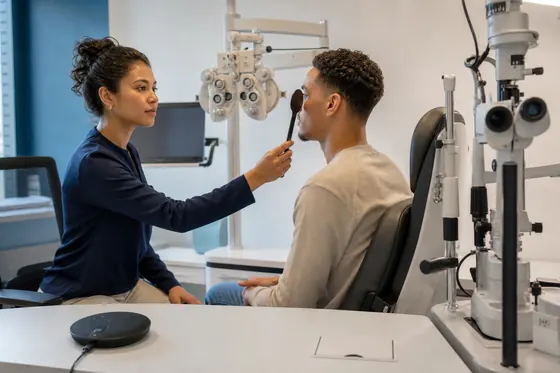
A structured report in your professional terminology
From care encounter to report
Hysio turns spoken information into a report. Choose the report format for the conversation you are documenting.
Document
Record the conversation and clearly state your own findings and agreed actions.
AI assistants
You stay in control of what gets saved.
In your workday
More attention for the conversation, less typing afterwards.
State relevant information, your own findings and agreed actions aloud so you can find them in your report.
The information appears under the headings of your chosen report format, so you can review each section.
Check names, facts and agreed actions. Edit the text where needed before using the report in your records.
Try it yourself
Try Hysio free for 14 days or schedule a personal demo.
For your team
Quick answer
Hysio distinguishes between optometric consultation, intake and care coordination. Visual acuity, refraction, intraocular pressure and eye observations remain recognisable examination data when they have been recorded. Hysio does not make an ophthalmological diagnosis, does not determine urgency and does not refer, so the optometrist retains the professional interpretation and the follow-up.
Here you can see, for each examination, what Hysio records about the complaint, visual acuity, refraction and eye pressure, and what you assess yourself as an optometrist.
In the eye record, Hysio Optometric Consultation remains a format for an optometric consultation with a visual request for care, laterality, measurements, conclusion and follow-up. The structure follows the encounter itself: request for care and reason for the encounter, optometric case history, optometric examination, evaluation, treatment plan and advice, treatment carried out, communication and consent, closure and follow-up appointments. There is no SOAP structure (SOEP in Dutch); OD, OS and ODS remain notation within an examination line and do not become fixed headings. The evaluation contains only the judgement that you as the optometrist have expressed. [1] [3]
For the optometric intake with complaint, medical history, risk factors and examination plan, Hysio Optometric Intake is intended for the eye record. The format runs from registration and request for care via case history and examination plan to the examination carried out, the analysis and the care plan. Examinations you actually performed stay separate from examinations you explicitly did not perform, postponed or considered not possible. Silence in the source is not a status: a missing visual acuity, refraction or intraocular pressure stays open and is never copied from the other eye. [1] [4]
Hysio Optometric Care Coordination Report is for care coordination around eye findings, urgency, recipient, consent and agreed handover in the eye record. It is an internal record product of an encounter that actually took place, not a letter: no salutation, closing or sending instruction appears in the text. The format keeps the reason, the healthcare professional involved with contact status, the optometric data shared, your assessment and decision, consent and purpose limitation, and the outcome apart. Whether coordination is needed is your decision. [1] [5]
Hysio Optometric Intake is for a first examination with a visual request for care, course of the complaint, relevant medical history and an examination plan. Visual acuity, refraction, intraocular pressure and other measurements actually performed stay linked to their source for each eye. The optometrist assesses the findings, determines the professional conclusion and approves the eye record. [1] [2] [4]
Within the eye record, Hysio Optometric Consultation organises the information spoken during the encounter, both when captured live and in dictated examination lines. What you say ends up under request for care, case history, examination, evaluation or follow-up, with the laterality and time of measurement that you named yourself. Hysio does not convert anything, does not round anything and does not fill in any missing data. A test that is mentioned or planned does not count as performed. You read back whether complaint, measurement and conclusion come from the same source. This keeps voice-driven reporting in optometry accurate per eye and per time of measurement. [1] [2] [3]
The report structure for optometric examination stays strictly source-bound for an eye care encounter with case history and examination. Hysio does not make an ophthalmological diagnosis, does not assign a warning label, does not determine urgency and does not write a referral. Images from OCT, fundus photography, perimetry or corneal topography are not read; only your spoken finding goes into the record. Hysio also makes no suggestion for eye drops, dosage or administration. If your conclusion is missing, that place stays open until you fill it in yourself. [1] [2] [3]
In the eye record, the optometrist separates the visual complaint, laterality, visual acuity, refraction, any intraocular pressure, conclusion and follow-up by their actual origin. What the client says about vision, distortion or discomfort stays in their own words. Your observation also receives laterality, measurement method, numerical value, unit and date of the examination. Your interpretation is again kept separate and attributed to you. That way, weeks later it is still clear who said, measured or concluded what. [1] [2] [3]
Before saving to the eye record, the optometrist compares laterality, measurement method, numerical value, unit and date of the examination with the original note. Check that OD and OS have not been swapped and that an unclear side stays marked as unclear. Then check whether complaint, measurement and conclusion come from the same source and whether your assessment is attributed to you. Only when origin and terminology are correct do you save that version in the eye record. [1] [2] [5]
The eye care record is not automatically connected to every medical record system. You transfer the report text into your own system yourself, checking laterality, unit, date of the examination, conclusion and the correct GP or ophthalmologist. The format follows your practice's way of working. Access, authorisation and version control stay with the record in which you save. A documentation format does not prove technical integration; the handover remains human work. [1] [2] [5]
For the eye record, the optometrist chooses between consultation, intake and care coordination based on the actual purpose of the encounter. The consultation fits an eye examination with evaluation and advice, the intake a first complaint with medical history and examination plan. Care coordination only fits an encounter with another healthcare professional that actually took place, with consent and purpose limitation. A standalone request to write a letter falls outside these three formats. [1] [2] [3]
The optometrist records the request for care and the visual complaint in the eye record with origin and time of the encounter. Note the question as the client puts it, including when the complaint started, during which task and at which distance it occurs, and which correction was worn at the time. Hysio Optometric Intake keeps that registration and request for care separate from case history, examination and analysis. If part of that account is missing, that passage stays open rather than being filled in. [2] [4]
The case history in the eye record describes what the client says about their vision: complaint, circumstances, medical history, medication and work. Within it, the course of the complaint is the timeline: since when, during which task, and whether the picture has stayed the same, increased or decreased since the previous encounter. Both remain in the client's words. Visual acuity, refraction and intraocular pressure stand separately, with method, unit and date. Your conclusion again gets its own section. [2] [4]
Within the optometric cycle of request for care, examination, conclusion, plan, monitoring and completion, visual acuity and refraction belong under the optometric examination, not in the case history and not in the conclusion. Record them per eye in the form in which you measured them: visual acuity as a decimal or as a Snellen fraction, refraction with sphere, cylinder, axis, sign and dioptre. State the correction status and measuring distance. Hysio does not convert anything to another notation. The methodical choice and the approval stay with you. [2] [3]
Record intraocular pressure, slit lamp findings and other examination values per eye with method, unit and date of the examination. An intraocular pressure value includes mmHg, the instrument used, the laterality and the time. A result belongs with the note in which it was actually measured. If values contradict each other, you check laterality and source before you adjust the conclusion. The consultation format does not choose between two measurement results on its own. [2] [3]
In the eye record, the optometrist gives binocular vision the same certainty as the source. Describe which test you performed, at which distance and with which correction, and which outcome you stated. A single test result is not yet a statement about how both eyes work together as a whole. A suspicious finding does not become an ophthalmological diagnosis in the text, nor a referral. The professional meaning remains your work. [2] [3]
In the eye record, the optometrist selects only context around the recorded conclusion that clarifies the purpose of the encounter: the complaint in the client's words and the findings you base it on, with laterality, measurement method, numerical value, unit and date of the examination. If you compare with an earlier measurement, that comparison only appears if you stated it yourself. Hysio Optometric Consultation does not add a trend or cut-off value and leaves out background that is not relevant. [2] [3]
In the eye record, link the advice to the client only to a measurement or observation you actually performed. Note the method, laterality, outcome, unit and date as far as the source shows them. For a reading complaint, for example, that is the visual acuity with the correction used and the reading distance, not a value you add in your head. A test that is mentioned or planned does not belong there. What the advice means for this client is up to you. [2] [3]
In the eye record, connect the coordination with the GP or ophthalmologist to the reason you discussed during the encounter or established yourself. Note who you spoke to and whether the contact was planned, attempted, completed or received; that status is a source fact. Record separately which data you were allowed to share and for what purpose. Then follow the outcome, the follow-up action, the person responsible and the evaluation moment. The documentation format does not create a plan from separate data on its own. [2] [5]
For evaluating the agreed follow-up, Hysio Optometric Consultation is the appropriate format: you see the client again, go through the agreement that was made and assess the result. You only use the intake for a new complaint with its own medical history, and care coordination only for a real contact with another healthcare professional. If you repeat a measurement, record the new value per eye with the same correction and distance. Whether the difference is meaningful is for you to decide. [2] [3]
At completion, the eye record states per eye the course of the complaint, the most recently recorded measurements, the professional conclusion and the agreed advice or follow-up. The optometrist checks laterality, method, unit and date of the examination and leaves a measurement that was not performed open instead of estimating it. A follow-up appointment is stated as it was made, with date and reason. This documentation format does not determine urgency, nor any referral. The optometrist approves the final text. [2] [3]
The OVN professional profile and the record-keeping guideline together form the professional basis; optometry is an article 34 profession without article 3 registration. The professional profile describes what belongs to your scope of practice, the guideline describes what makes an eye record traceable. When you refer to either of them, note the version and year, so that it is clear later which document applied. Professional standards of the association and legal rules stay separate in the record. [6] [7] [10]
The optometric guideline from 2021 requires a traceable request for care, eye measurements, conclusion, consent and agreed follow-up in the eye record. That is the Richtlijn Optometrische dossiervoering (optometric record-keeping guideline) of the Optometristen Vereniging Nederland. For each part, use the section that actually covers it and note which document version you followed. An agreement that only applies within your practice stays recognisable in the record as a local agreement and not as a guideline. [7]
The optometrist holds a protected educational title, but the title alone does not prove BIG registration or authority from another profession. Optometry falls under article 34 of the Wet BIG (Dutch Individual Healthcare Professions Act): the area of expertise is described by decree and there is no register in which you are entered as an optometrist. Only state a status in the eye record that you can demonstrate. If you also work in another healthcare role, you check that capacity separately. [10]
In the event of a complaint, an optometry practice records the actual eye care encounter and the follow-up, separate from the legal judgement. Note the date, what was said and done, who is handling the report and which agreement results from it. The Wkkgz (the Dutch Healthcare Quality, Complaints and Disputes Act) also requires you to refer the client to the practice's complaints officer and to the disputes body you are affiliated with. The eye record contains facts and no independent legal judgement. [12]
For the retention period of eye care data, you assess the treatment relationship, legal basis, OVN guideline and local contract terms together. The statutory period is tied to the medical record and runs from the last change to it, so record when you last added something. Also note the specific care relationship and the guideline version used. If a contract term or the treatment context changes, you assess that separately before the practice policy follows. [7] [11]
A professional or quality registration can demonstrate training; it does not thereby make the optometrist an article 3 healthcare professional. The Kwaliteitsregister Paramedici sets quality criteria per period, for example for 2025 to 2030. So state the register holder, the criteria period you follow and the date on which the registration was verified. In the eye record, training or re-registration clearly remains something other than a statutory article 3 status. [9] [10]
For an eye examination, you note the specific question, the answer and the time. Consent for a procedure and consent for sharing data are two different things: agreeing to an examination plan is not yet agreement to eye drops or to a phone call to the ophthalmologist. Record each time which purpose, which data and which recipient it concerns. Earlier consent does not automatically apply to a new purpose. You check wording and timing before saving. [4] [7]
Limit an optometric handover to the relevant laterality, findings, conclusion and follow-up for the verified recipient. Check the purpose, recipient and scope beforehand, and keep visible in the eye record which data you did and which you deliberately did not share. Eye drops or a test condition that fell outside the agreement stay out of the handover. You arrange the method of sending and the verified destination within your own eye care practice. [5] [7] [11]
The optometrist interprets visual acuity, refraction and intraocular pressure and decides independently whether the source is sufficient for documentation in the record. Conclusion, urgency and the question of whether care coordination is needed are your professional decisions. An ophthalmological diagnosis stays attributed to the physician who made it. Hysio chooses no label, no recipient and no follow-up. With voice-driven admin too, you approve the version that is kept. [2] [3]
Reassess OVN knowledge documents for version and status, because a knowledge document and a professional profile do not have the same scope. Do so at fixed moments: before you cite a document in a protocol or eye record, as soon as the association publishes a new version or a withdrawal, and during the periodic review of your practice agreements. Then compare the current list with the professional competence profile and note publication status and target group. An unclear status stays visible as uncertain. [6] [8]
Visual acuity, refraction, intraocular pressure and slit lamp findings stay linked per eye to the method, unit and date of the examination. The same applies to keratometry, pachymetry, gonioscopy, pupil examination, Amsler, perimetry and fundoscopy: only what you actually performed goes into the eye record. A test that you mentioned or planned has not been performed. Check laterality before saving. A difference from an earlier measurement only takes on meaning in your conclusion. [2] [4] [7]
In an eye care encounter with case history and examination, the optometrist only uses terminology that was actually spoken. OD stands for the right eye, OS for the left eye and ODS for both, but only when the source carries that notation. Hysio does not swap OD and OS and does not turn an unclear side into ODS. A suspicious finding does not become a diagnosis in the text. In AI reporting, you assess before saving whether every side is correct. [2] [3] [6] [7]
The optometrist leaves the relevant part of the eye record empty when the source does not mention visual acuity or refraction. Silence is not an outcome: nothing said means unknown, not normal. If you did perform a test without stating the result, it stays visible as performed without a recorded result. If you deliberately did not measure, or the measurement was refused or postponed, you note it as such. If needed, ask a targeted question and fill it in yourself. [2] [4]
When information about intraocular pressure or slit lamp findings conflicts, the optometrist keeps source, moment and wording separately in the eye record. Both statements remain with their own time and laterality; no single version is chosen silently. If you correct a value, you do so from the original measurement record for that eye and record who reviewed the correction. An unresolved difference stays visible as unresolved. [2] [4]
The boundary around binocular vision is that the report structure makes no diagnosis, no urgency assessment and no referral and does not stretch your scope of practice. Orthoptic occlusion, amblyopia and exercise protocols belong to the orthoptist and do not enter the eye record as optometric treatment. What you measured and assessed yourself stays linked to its source per eye. Persuasive wording does not replace a missing measurement. The meaning of a difference is for you to decide. [2] [3]
A potentially worrying eye finding is recorded per eye with measurement method, unit, date and the client's words about the complaint. The optometrist keeps the measurement outcome separate from their professional assessment and the follow-up discussed. The consultation format organises this information, but does not determine urgency and makes no referral decision. [2] [3]
A visual complaint enters the eye record from the client's account, while visual acuity, refraction and intraocular pressure are measurement data per eye. The optometrist states method, unit and date of the examination with the values and writes the conclusion separately. Advice or care coordination only follows after that assessment. The layout does not merge these different types of information into an ophthalmological judgement of its own. [4]
A visual acuity, refraction or intraocular pressure value belongs with the original measurement, together with laterality, method, unit and date. Hysio does not turn it into an eye code, diagnosis or urgency class and does not fill in anything from an earlier note. For optometry, no automatic translation into a terminology or coding system has been established; a code only appears when the source literally carries it. The optometrist weighs complaint and examination themselves and formulates the conclusion and any care coordination separately. [2] [3] [7]
Perceived improvement in vision, corrected visual acuity and change in refraction remain different data. For evaluating the agreed follow-up, you note what the client reports in their own words and, separately, the measured value with laterality, method, unit and date of the examination. Do not write that the correction resolved the complaint when you only have a number and a statement. Hysio does not calculate a trend and provides no proof of efficacy or causal link. [2] [5]
Before saving to the eye record, compare laterality, measurement method, numerical value, unit and date of the examination with what you actually said. Pay attention to terminology: if there is a term you did not use or an abbreviation the source does not carry, remove it. Missing data stays open. Delete any sentence that independently suggests a diagnosis, urgency or referral. Then approve the text. [2] [5]
The pricing question for an optometry practice starts with the general Hysio offer: Starter €20, Pro €40 and Unlimited €80 per month, excl. VAT. With yearly billing, you pay for ten months. Check the current terms on the pricing page. There is no separate rate for voice-driven reporting in optometry. Compare your volume of encounters and the time it takes to transfer text into your own system. [13]
Measurements per eye, visual complaints and conclusions only belong in the eye record insofar as the purpose of care requires them. As a practice, record who may view which data, which findings may go to a GP or ophthalmologist and on what legal basis. Arrange the processing agreements and division of roles in writing before you start. The optometrist verifies client, laterality and recipient each time. Hysio does not decide on disclosure itself. [14] [15]
For the eye record, the optometrist compares writing by hand with dictation. Writing by hand takes time but keeps the origin with you by default; dictation is faster and then requires careful checking of laterality and unit. A general chatbot does not know OD, OS, Snellen or dioptre as a fixed notation and can convert or add a value you never measured. A profession-specific format only organises what was said. You weigh up which route fits. [2]
Optometrists can assess Hysio during a 14-day trial, including the profession-specific formats for measurements per eye and care coordination. For that test, the optometrist chooses one consultation with measurements per eye and a professional conclusion. Laterality, method, unit, date of the examination, source comparison and the time needed for corrections together form the assessment criteria. [13]
No, Hysio does not place measurements in a record system of its own accord and does not automatically work with every software package. For optometry, no link with a supplier, form or field has been established, so the transfer remains your action. Keep an outcome on binocular vision per eye and with the test condition used, so that the value stays traceable after that transfer too. The consultation format does not choose a destination and does not fill in a missing value. [2]
The optometrist checks measurements per eye, method, unit and date before a report is saved. Agree within the practice when that check takes place, who carries it out and who signs off on the version that is kept. In the case of care coordination, that same person records which data were actually shared. Conclusion, urgency, advice and any referral remain the optometrist's own decision. [2] [3]
When correcting, the original values per eye are kept and only the verified measurement, unit or date of the examination is adjusted. The optometrist distinguishes a change in the advice to the client from a correction in visual acuity, refraction or intraocular pressure. The eye record shows who reviewed the change and which version may go to any recipient. [2] [3]
When care coordination is missing, the optometrist checks the contact note in which the GP, ophthalmologist, recipient or follow-up was actually discussed. If the contact was only planned or attempted, the eye record says so and does not present it as completed. Measurements per eye do not prove that a handover took place. Without a second source, that section stays empty and you ask a targeted question. The consultation format does not choose a recipient and does not invent advice. [2] [3]
For eye care, a time measurement belongs to one fixed type of follow-up consultation or evaluation, so that you compare like with like. First measure your current situation: the time spent dictating, checking values per eye, formulating the conclusion, making corrections and any care coordination. Then measure the same type of encounter again. There is no proven saving, so only your own baseline and follow-up measurement show what admin with AI brings you. [2]
The practice checks values per eye, method, unit, conclusion, recipient and record storage against the original sources. Start with one type of encounter and one optometrist, and agree who checks the text and where the approved version goes. Agree beforehand which data you may share and for what purpose. Other types of encounter only follow once this first setup proves reliable and workable. Then evaluate with your own measurements. [2]
Hysio creates the report. You remain responsible for what you save in the record.