Document
Keep your attention on the care encounter.
Record the conversation and clearly state your own findings and agreed actions.
Hysio Medical Pedicure
Hysio organises medical pedicure encounters around the request for help, foot care findings, procedures carried out and agreed aftercare in a source-bound report structure.
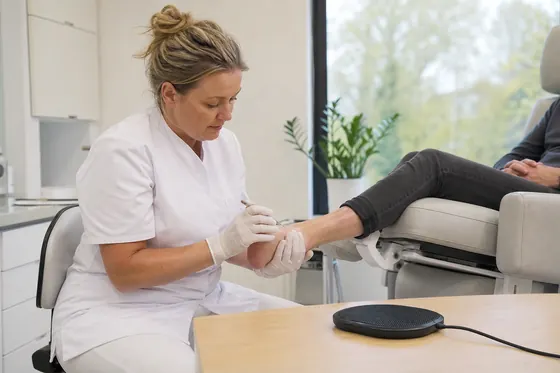
A structured report in your professional terminology
From care encounter to report
Hysio turns spoken information into a report. Choose the report format for the conversation you are documenting.
Document
Record the conversation and clearly state your own findings and agreed actions.
AI assistants
You stay in control of what gets saved.
In your workday
More attention for the conversation, less typing afterwards.
State relevant information, your own findings and agreed actions aloud so you can find them in your report.
The information appears under the headings of your chosen report format, so you can review each section.
Check names, facts and agreed actions. Edit the text where needed before using the report in your records.
Try it yourself
Try Hysio free for 14 days or schedule a personal demo.
For your team
Quick answer
Hysio supports medical pedicure reports with a clear separation between the request for help, skin and nail observation, foot care carried out and follow-up appointments. The medical pedicurist keeps the professional responsibility. Hysio does not extend foot care into podiatric diagnostics, risk classification or medical treatment.
For each contact, you can read what Hysio records about skin, nails, risk factors and treatment, and what you assess as a medical pedicurist.
For the foot care record, Hysio Medical Pedicure Consultation remains a format for a medical pedicure encounter with skin and nail findings, procedures and client instructions. This applies to a foot care encounter with inspection and treatment. The request for help, skin and nail observation, risk factor and foot care carried out each keep their own source alongside the request for help and the foot history in the foot care record. For the request for help and the foot history, check the pressure area, fissure, nail finding and foot care carried out separately against the notes. [1] [3]
Within the foot care record, Hysio Medical Pedicure Intake is the format for the medical foot care intake covering the request for help, risk factors and treatment goal. This format fits a foot care encounter with inspection and treatment. In the foot care record, the medical pedicurist links "Summary" to the first source of information. "Registration, request for help and targeted history" stays separately readable for a foot care encounter with inspection and treatment. A fissure, pressure area or nail abnormality that was not observed is not added to the foot care record after the fact when information about the skin and nail observations is missing. For the skin and nail observations, check the pressure area, fissure, nail finding and foot care carried out separately against the notes. [1] [4]
Hysio Medical Pedicure Examination is for foot inspection, risk characteristics, findings and treatment boundaries within medical foot care in the foot care record. In a foot care encounter with inspection and treatment, the medical pedicurist keeps the request for help, skin and nail observation and risk factor separately recognisable. Foot, treatment site, observation method and date make a foot care finding traceable when documenting pressure areas and fissures. The foot care professional safeguards the boundary of expertise, the procedure carried out and any moment of referral for the interpretation of pressure areas and fissures. [1] [5]
Hysio Medical Pedicure Intake is intended for a first appointment with the request for help, relevant risk factors, skin and nail observations and the agreed treatment goal. The layout shows what the client says, what the medical pedicurist observes and which foot care is agreed. The practitioner safeguards the boundary of expertise and approves the foot care record. [1] [2] [4]
Within the foot care record, Hysio Medical Pedicure Intake organises the information from the contact described. In a foot care encounter with inspection and treatment, the medical pedicurist can organise the request for help, skin and nail observation, risk factor, procedure carried out and client instruction. Their origin stays visible in the foot care record for instrumental foot care. In the foot care record, the medical pedicurist does not fill in a missing detail about instrumental foot care. For instrumental foot care, check the pressure area, fissure, nail finding and foot care carried out separately against the notes. Voice-driven reporting does not change the boundaries of your own foot care. [1] [2] [4]
For a foot care encounter with inspection and treatment, the report layout for medical foot care remains a profession-oriented structure and does not make a podiatric diagnosis, risk classification or medical treatment choice. If the hygienic working method is missing, the medical pedicurist leaves that part of the foot care record open. A risk factor is not turned into a diagnosis or treatment indication without a documented basis when the hygienic working method is worded. Only the medical pedicurist can add a conclusion or choice for the foot care record. [1] [2] [4]
In the foot care record, the medical pedicurist separates the request for help, skin and nail observation, risk factor, procedure carried out and client instruction based on where each actually came from. For the client instructions in a foot care encounter with inspection and treatment, what the client said stays visible. The medical pedicurist places the observation about the client instructions in the foot care record alongside the foot, treatment site, risk characteristic, method used and date. Professional interpretation gets its own origin and assessment with the medical pedicurist. [1] [2] [4]
Before saving to the foot care record, the medical pedicurist compares the foot, treatment site, risk characteristic, method used and date with the original note. For follow-up appointments, check the pressure area, fissure, nail finding and foot care carried out separately against the notes. Later, the medical pedicurist only keeps a version of the foot care record in which the origin and terminology are correct. [1] [2] [4]
A foot care report is not sent to every record system via a promised standard link. When handing over the foot care record, the medical pedicurist specifically reviews the foot, side, foot care carried out, hygiene instruction and any referral. The practice's way of working for the foot care record determines the format within a medical foot care practice. Access and version control stay tied to the foot care record. The report layout for medical foot care does not prove any technical integration for the foot care record; the handover remains human work. [1] [2] [5]
For the foot care record, the medical pedicurist chooses between consultation, intake and foot examination based on the actual purpose of contact. The intake is intended for the request for help and risk factors, the examination for foot inspection and professional boundaries, and the consultation for foot care carried out and instructions. A referral to other foot care is not a separate documentation format. [1] [2] [4]
The medical pedicurist documents the request for help and the foot history in the foot care record with their origin and moment of contact. In a foot care encounter with inspection and treatment, the medical pedicurist links the moment of contact and care goal to the request for help and the foot history. Hysio Medical Pedicure Intake keeps the risk factors separate. The practitioner checks the text before saving. [2] [4]
What the client says about pain, load or previous foot care remains client information in the foot care record. Skin, nails, pressure areas and fissures are described as observations with foot and side; a risk judgement only follows after that. The medical pedicurist checks that order of sources themselves. With voice-driven admin too, no medical risk class is calculated from separate data. [2] [3]
Within the profession-specific history, inspection, treatment and evaluation, you document pressure areas and fissures in the phase where this part belongs. In a foot care encounter with inspection and treatment, assess that place in relation to the request for help, the examination, the professional conclusion and the plan. The documentation format Hysio Medical Pedicure Examination preserves that order without itself deriving a cause or choice for pressure areas and fissures. For pressure areas and fissures, the methodical choice stays with the medical pedicurist; they approve the text. [2] [5]
Keep a risk factor mentioned by the client separate from what the medical pedicurist observes on the foot, skin or nail. The foot, side, date of contact and source of information stay with the description. Contradictory data are checked with the client or kept side by side; the documentation format does not turn them into a medical risk class or referral decision. [2] [5]
In the foot care record, the medical pedicurist gives instrumental foot care the same certainty as the original source. A risk factor does not become a diagnosis or treatment indication without a documented basis. Put the professional term next to the goal of the contact. What a finding means for the client and the follow-up is for you to assess. [2] [3]
In the foot care record, the medical pedicurist only chooses context around the hygienic working method that clarifies the purpose of a foot care encounter with inspection and treatment. That can include the foot, treatment site, risk characteristic, method used and date, provided the source contains these details. For data about the hygienic working method, the foot care practice only uses skin, nail and risk data needed for this contact. Hysio Medical Pedicure Consultation leaves out background that is not relevant; the medical pedicurist decides what is readable and necessary. [2] [3]
In the foot care record, only link the client instructions to a measurement or observation that was actually carried out in a foot care encounter with inspection and treatment. The medical pedicurist notes the known method, site or side, outcome and date as far as the source shows them. Suitable examples are skin and nail findings, pressure areas or risk factors when you actually document them; only an observation or measure actually used belongs in the report. The professional meaning remains for the medical pedicurist to assess. [2] [3]
In the foot care record, link follow-up appointments to a goal that the medical pedicurist discussed or professionally established during a foot care encounter with inspection and treatment. Keep the request for help and the foot history separate; the medical pedicurist then notes the follow-up action, the person responsible and the appropriate moment of evaluation. The documentation format Hysio Medical Pedicure Consultation does not create a plan from separate data. The foot care professional safeguards the boundary of expertise, the procedure carried out and any moment of referral for the interpretation of follow-up appointments. [2] [3]
For the evaluation of foot care, Hysio Medical Pedicure Consultation is the documentation format that most closely fits a foot care encounter with inspection and treatment. In the foot care record, the medical pedicurist compares the required set of sources and layout with the actual moment of reporting. The report layout for medical foot care does not select anything independently. The foot care professional safeguards the boundary of expertise, the procedure carried out and any moment of referral for the interpretation of the evaluation of foot care. [2] [3]
When referring, the foot care record describes the observed pressure area, fissure or nail abnormality, the foot care carried out and the reason for the agreed follow-up. The medical pedicurist states the verified recipient and only passes on necessary information. This documentation format does not choose a risk classification or referral. The practitioner approves the handover within their own boundary of expertise. [2] [3]
The Branchekwalificatiedossier Voetzorg (sector qualification file for foot care) and the ProVoet professional code are sector frameworks; medical pedicure is not an article 3 or article 34 profession. The foot care record names the ProVoet professional competence profile and the Professionele Standaard (professional standard) with publisher, date and type of source. In a foot care encounter with inspection and treatment, the foot care record shows the legal status. A medical foot care practice separates professional standards from government rules. [6] [8] [10]
The Servicedocument Voetzorg (foot care service document) helps document skin and nail findings, risk factors, foot care carried out and client instructions carefully. For the skin and nail observations, the medical pedicurist only uses the applicable part of the ProVoet professional competence profile and the Professionele Standaard. The foot care record keeps the document version and scope. In a foot care encounter with inspection and treatment, a local agreement stays recognisably local. [7]
The professional title does not give BIG registration or legal title protection; any other professional qualifications are stated separately. The legal position of the medical pedicurist is kept in the foot care record apart from a second care role. The medical pedicurist only states a demonstrable status for a foot care encounter with inspection and treatment. Any other capacity is reviewed separately for the foot care record. [10]
Where applicable, a medical foot care practice follows the Wkkgz and documents complaint facts apart from a sector or dispute ruling. After a foot care encounter with inspection and treatment, a report in the foot care record gets facts, date and follow-up. A medical foot care practice chooses the applicable complaints procedure. The foot care record contains facts and no independent legal judgement. [12]
Determine the retention period from the specific agreement, legal basis and your own practice policy, not from an invented sector figure. The medical foot care practice documents which agreement, basis and policy version support retaining the foot care record. A sector publication does not in itself produce a universal period; a change requires a new assessment for this practice context. [7] [11]
A private registration or ProVoet membership can support quality, but is never presented as a government register. The medical pedicurist only mentions ProCert or another private registration with the register name, date of check and demonstrable validity. The foot care record does not turn that into a legal title, authorisation or government status. An expired registration is visibly treated as such. [9] [10]
In medical foot care, document the question asked and the answer; a discussed image or audio recording or data disclosure remains a separate fact in the record. The foot care record links the question about treatment or recording to the literal answer and the moment of contact. When data disclosure has been discussed, the medical pedicurist states the purpose, recipient and foot information involved separately. An unanswered question stays open and is not saved as consent. [4] [7]
A foot care handover only states necessary skin, nail and risk data for a recipient verified in advance. For a handover from the foot care record, the medical pedicurist checks the care goal, recipient and scope of data. In a foot care encounter with inspection and treatment, the foot care record keeps the client's words apart from the request for help, skin and nail observation, risk factor, procedure carried out and client instruction. A medical foot care practice uses the verified destination and the local method of sending. [5] [7] [11]
The medical pedicurist determines the treatment goal, professional boundary and moment of referral and approves every saved wording. In the foot care record, the layout can separate the request for help, skin and nail observation, risk factor, procedure carried out and client instruction. You interpret an inspection and treatment yourself. With voice-driven reporting, the follow-up and the saved version remain your work. [2] [4]
For ProVoet sources, check the publication version and distinguish the qualification file from the professional code and the service document. The medical pedicurist compares the Branchekwalificatiedossier, the professional code and the service document by edition and scope. The foot care record does not adopt a lapsed training or sector requirement as a current practice standard. An unclear version is not used. [6] [8]
An observed pressure area, fissure or nail abnormality is described with foot, side and date of contact. The medical pedicurist only mentions a scale or classification if it was actually used within their expertise and is evident from the source. The documentation format does not calculate a medical risk class. A threshold for referral or other foot care remains their professional judgement. [2] [5] [7]
In a foot care encounter with inspection and treatment, the medical pedicurist only uses professionally documented terminology for the skin and nail observations. In the foot care record, the term stays linked to the foot, treatment site, risk characteristic, method used and date and the correct source. A risk factor is not turned into a diagnosis or treatment indication without a documented basis when the skin and nail observations are worded. Before saving, the medical pedicurist assesses necessity, precision and readability. [2] [4] [6] [7]
The medical pedicurist leaves the relevant part of the foot care record empty if, after a foot care encounter with inspection and treatment, the source contains no information about pressure areas and fissures. A detail about the foot, treatment site, risk characteristic, method used and date that was not mentioned stays unknown. The medical pedicurist asks a targeted follow-up question or states in the foot care record that information about pressure areas and fissures is missing. [2] [4]
When there are contradictions about the risk factors, the medical pedicurist keeps source, moment and wording separately in the foot care record. During a foot care encounter with inspection and treatment, the medical pedicurist compares the relevant parts of the request for help, skin and nail observation, risk factor, procedure carried out and client instruction. A foot care correction follows the inspection note or documented procedure and adds nothing new when the risk factors are corrected. [2] [4]
The boundary around instrumental foot care is that the report layout for medical foot care does not make a podiatric diagnosis, risk classification or medical treatment choice. The request for help, skin and nail observation, risk factor and foot care carried out each keep their own source for instrumental foot care in the foot care record. A convincing wording for a foot care encounter with inspection and treatment does not replace a missing source. The foot care professional safeguards the boundary of expertise, the procedure carried out and any moment of referral for the interpretation of instrumental foot care. [2] [4]
A wound, pressure area or hygiene signal is described in the foot care record with foot, side, moment of contact and source of information. The medical pedicurist keeps what the client reports, their own observation and the instruction given apart. The documentation format does not draw a medical conclusion and does not decide on a referral. The practitioner assesses the signal within their boundary of expertise and documents the agreed follow-up. [2] [4]
In a foot care encounter, the medical pedicurist distinguishes what the client says about pain or load from what is visible on the skin and nails. A pressure area, fissure or risk factor stays linked to foot, side and source of information. The procedure carried out and client instruction are then described separately. The layout does not turn these data into a medical risk classification or podiatric conclusion. [5]
A pressure area, fissure, nail finding or risk factor is described as it was reported or observed during the foot care encounter. The documentation format does not assign a medical code or risk class here and does not calculate anything from separate client data. The medical pedicurist checks foot, side and source and decides within their boundary of expertise which follow-up is needed. [2] [4] [7]
The client's experience, visible skin change and foot care carried out remain separate parts of the report. For the evaluation of foot care, the medical pedicurist follows, in the foot care record, the certainty of the request for help, skin and nail observation, risk factor, procedure carried out and client instruction. During a foot care encounter with inspection and treatment, a reported change stays separate from the foot, treatment site, risk characteristic, method used and date and from the assessment by the medical pedicurist. The report layout for medical foot care does not provide a medical foot care practice with any proof of efficacy or causal relationship. [2] [5]
Before saving to the foot care record, compare the foot, treatment site, risk characteristic, method used and date with the request for help, skin and nail observation, risk factor, procedure carried out and client instruction. If information about the referral to other foot care is missing, that part stays open. The medical pedicurist removes from the report text for the foot care record any autonomous podiatric diagnosis, risk classification or medical treatment choice. For the referral to other foot care, check the pressure area, fissure, nail finding and foot care carried out separately against the notes. [2] [5]
On the Hysio pricing page, a medical pedicurist finds the general Starter plan from €20 per month, excl. VAT, alongside Pro and Unlimited for a larger volume of contacts. With yearly billing, you get two months free. Compare the plan, your actual volume of contacts and the record route based on the current terms on the pricing page. [13]
Information about skin, nails, risk factors and foot care carried out is limited to the purpose of the contact. Under the GDPR, the foot care practice documents who has access and which data are necessary for a referral. The medical pedicurist checks the client, foot, side and recipient. The report layouts do not take over this selection. [14] [15]
For the foot care record, the medical pedicurist compares writing by hand with dictation. In a foot care encounter with inspection and treatment, the Hysio format for the foot care record is intended as a third option. Within a medical foot care practice, every way of working requires review of the request for help, skin and nail observation, risk factor, procedure carried out and client instruction. A general dictation function does not automatically know the foot, treatment site, risk characteristic, method used and date. The practice therefore decides for itself which way of working best suits the foot care record. [2]
A medical pedicure practice can try Hysio for 14 days. The documentation formats for foot inspection, foot care and aftercare are part of that trial. For a first professional test, the medical pedicurist can select one contact around a pressure area, nail or risk factor. Foot, side, observation, foot care carried out, instruction, comparison of sources and time for corrections each get their own assessment point in advance. [13]
No, that does not happen without review. A foot care report does not get an unchecked link to an arbitrary record system: for every handover, the medical pedicurist first assesses which skin, nail and risk data the recipient actually needs. The practice itself chooses the format used, the access and the moment of sending for the foot care record. A documentation format does not determine that process independently; the review stays with the medical pedicurist. [2]
The medical pedicurist checks whether what the client reports, skin and nail findings, foot care carried out and instruction correctly stay apart. They safeguard their boundary of expertise and decide themselves when referral or other foot care is appropriate. Only after that check does a version go into the foot care record. The report layout organises data, but does not draw a medical conclusion and does not choose a risk class. [2] [4]
A correction to the foot care carried out, foot, side or client instruction must go back to the corresponding contact note. The medical pedicurist keeps visible whether the error concerned an observation, procedure or advice. The earlier entry stays traceable and the foot care record states who reviewed the amended text and which version is kept. [2] [4]
If the follow-up after foot care has not been documented, the medical pedicurist checks the client instruction or appointment note from the same contact. A description of skin, nail or procedure carried out does not prove a follow-up appointment. Without a confirming source, they ask a targeted follow-up question or leave that part open. The report layout does not fill in a moment of review or referral. [2] [4]
Measure administration time for a recurring foot care evaluation contact, not for arbitrarily different treatments. The medical pedicurist records dictation, checking of foot and procedure, corrections, client instruction and transfer to the record. The report layouts have no proven time advantage. Only your own comparison per contact type, over several weeks, shows what admin with AI brings your practice. [2]
For foot care, the introduction starts with one type of contact, a fixed reviewer and clear boundaries for saving. The medical pedicurist checks foot, side, observation, procedure, instruction and any referral in every first example. More contact types only follow after a successful review of content and of the local record. [2]
Hysio creates the report. You remain responsible for what you save in the record.