Document
Keep your attention on the care encounter.
Record the conversation and clearly state your own findings and agreed actions.
Hysio Clinical Psychology
Hysio organises a dictated intake, session, MDT meeting, evaluation or psychodiagnostic assessment into a clinical psychology report; the professional formulation remains the clinical psychologist's.
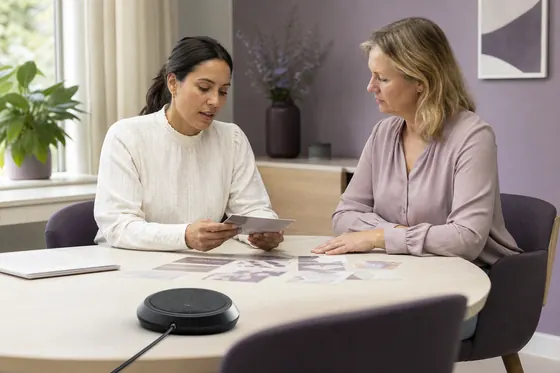
A structured report in your professional terminology
From care encounter to report
Hysio turns spoken information into a report. Choose the report format for the conversation you are documenting.
Document
Record the conversation and clearly state your own findings and agreed actions.
AI assistants
You stay in control of what gets saved.
In your workday
More attention for the conversation, less typing afterwards.
State relevant information, your own findings and agreed actions aloud so you can find them in your report.
The information appears under the headings of your chosen report format, so you can review each section.
Check names, facts and agreed actions. Edit the text where needed before using the report in your records.
Try it yourself
Try Hysio free for 14 days or schedule a personal demo.
For your team
Quick answer
Five documentation formats for the clinical psychologist: intake, treatment session, MDT meeting, evaluation and an assessment report. The diagnostic weighing and the choice for the record are yours.
For clinical psychology, Hysio focuses on fixed report structures around the diagnostic question, test use and professional formulation, and around the MDT meeting, treatment plan and evaluation.
For the clinical psychologist, Hysio groups five profession-specific documentation formats: the Clinical Psychology Intake, the Treatment Session, the Clinical Psychology MDT Meeting, the Clinical Psychology Evaluation and the Clinical Psychology Assessment Report. The intake follows a specialist referral, the treatment session describes a single session, the MDT meeting a discussion with multiple voices, the evaluation a defined period and the assessment report a psychodiagnostic assessment. The choice follows the purpose and the source of the encounter. Consent, professional formulation and choices about the record stay with the clinical psychologist. [1] [2] [3] [4] [5] [6] [7] [10]
The Clinical Psychology Intake organises a spoken specialist intake into fixed sections: referral and request for help, symptoms with functioning and context, relevant history and sources of information, and then the diagnostic question with the professional formulation. Risk information and safety agreements, goals, treatment plan and responsibilities, and consent, follow-up and open points each get their own heading. The diagnostic question therefore stands apart from the description of symptoms and from the history, so you can read back what your formulation rests on. [1] [2] [6] [7]
The Clinical Psychology Treatment Session fits a single completed session for which a recording or dictation has been made. The report keeps session focus and course of symptoms, the client's perspective and other sources, the interventions discussed and the response to them, observations with professional assessment, progress towards goals and measurement information, medication and risk information, and the agreements made apart from each other. If the conversation covers a whole period instead of a single session, the Clinical Psychology Evaluation is the right fit. The assessment in the report remains that of the clinical psychologist. [1] [3] [6] [7]
The Clinical Psychology Evaluation describes a periodic evaluation of an ongoing course of care. In turn, it covers the evaluation period with setting and sources, the goals with evaluation criteria, the client's perspective alongside other perspectives, progress with interventions and measurement information, and medication and risk information. Then follow the professional evaluation with the explicit choice about next steps, the adjusted plan with responsibilities and the next evaluation point, and finally what remains open or contradictory. The clinical psychologist makes the choice about next steps themselves. [1] [5] [6] [7]
The intake describes a first specialist encounter: referral, request for help, functioning, history and the diagnostic question with the professional formulation that starts a course of care. The evaluation looks back on a defined period: goals with evaluation criteria, progress, measurement information and an explicit choice about next steps with an adjusted plan. In short, the intake opens the question and the evaluation weighs what has happened with it since. In both cases, the professional judgement stays with the clinical psychologist, who decides what goes into the record. [1] [2] [5] [6] [7]
The diagnostic question gets its own heading in the Clinical Psychology Intake, together with the professional formulation. That is where what you want to find out, and why, is recorded, in the wording used during the encounter. The symptoms, functioning, context and history are in the sections before it, so a reader can see which information prompted the question. A working hypothesis stays recognisable as provisional. Hysio does not sharpen the question and does not add to it. [1] [2] [6] [7]
Yes, insofar as they were stated in the source. In the Clinical Psychology Intake, the instruments, scores, administration conditions and normative context mentioned belong with the sources of information and with the diagnostic question, with their origin and date. Hysio calculates nothing, applies no norms and does not derive a classification or risk statement from a score. What an outcome means for this client, the clinical psychologist writes themselves, and they also decide whether the passage goes into the record. [1] [2] [6] [7]
In these documentation formats, interpretation always sits in its own section, never mixed with what someone said. The intake places it in the professional formulation, the treatment session under observations and professional assessment, the MDT meeting under the explicit decisions and the treatment plan, and the evaluation under the professional evaluation with the choice about next steps. Everything before that is source: request for help, course of symptoms, perspectives and measurement information. That way it stays readable which sentence comes from the client and which from the clinical psychologist. [1] [2] [3] [4] [5] [6] [7]
Every voice gets its own place and its own label. What the client says sits under the client's perspective, what the referrer or an external letter reports under the sources of information, what colleagues contribute under the input per participant in the MDT meeting, and what you establish under the professional formulation or assessment. Discrepancies between those sources remain; they are not smoothed into a single version. As a result, who made which statement remains traceable. [1] [2] [3] [4] [5] [6] [7]
In every documentation format, a section starts with the source: who said something, when, and through which channel it came in. Observations stand apart from that, and the professional assessment is separate again. What the clinical psychologist concludes therefore never takes the place of what the client or the referrer reported. That makes it possible to see afterwards who provided the information and who made the clinical judgement, even when a colleague reads the record later. [1] [2] [3] [4] [5] [6] [7]
Write the question as a question: what do you want to know, about which aspect of functioning, and with which decision in view. You call a working hypothesis provisional and open to revision, not a classification. In the Clinical Psychology Intake, that formulation sits under the diagnostic question, after the symptoms, the context and the history, so it stays visible what it rests on. Hysio does not record a classification, diagnosis, indication, risk assessment or treatment decision on your behalf. What you do not yet know stays as an open point. [1] [2] [6] [7]
It does include the referral and request for help, the symptoms with functioning and context, the history with the sources of information used, the diagnostic question with professional formulation, risk information and safety agreements as stated, and the goals, the treatment plan, the responsibilities, the consent and the open points. It does not include a classification, indication or treatment decision that was not made in the conversation, nor a supplemented history. If something is missing, it stays visible as an open point instead of being filled in. [1] [2] [6] [7]
The intake builds up the picture: request for help, symptoms, context, history, the diagnostic question with professional formulation, and from those, goals and a treatment plan. The treatment session describes a single session within that plan: session focus and course of symptoms, the client's perspective, the interventions discussed with the response to them, observations with professional assessment, progress towards goals and measurement information. So the intake records the question and the plan, the treatment session what happened in that one appointment. Both leave the assessment to the clinical psychologist. [1] [2] [3] [6] [7]
The Clinical Psychology MDT Meeting fits a meeting in which several disciplines discuss the same client. The report records the purpose of the meeting with participants and sources, then the client's context and the client's perspective, the input per participant, the discrepancies with open decision points, the explicit decisions with the treatment plan, the responsibilities with risk, crisis and cover arrangements, the actions with deadlines and the evaluation point, and finally consent, limits on information sharing and where it goes in the record. A decision only appears if it was stated in the meeting. [1] [4] [6] [7]
The course of symptoms comes from what the client and other sources report and therefore sits with the sources, not with your assessment. In the treatment session it belongs under session focus and course of symptoms, in the evaluation under progress and measurement information. For each statement, who made it and when stays recorded. If the client says something different from a relative or an earlier letter, both versions remain. Hysio does not turn that discrepancy into a summarised judgement. [1] [2] [3] [4] [5] [6] [7]
While dictating, name who is saying something: the client, a relative, the referrer, a colleague or you yourself. For the client, use their own wording as much as possible and keep your professional terminology out of it. In the treatment session, those statements end up under the client's perspective and other sources, in the MDT meeting under the input per participant. Hysio does not move a statement to a different voice and does not add a speaker. What was not said stays empty. [1] [2] [3] [4] [5] [6] [7]
For each follow-up step, say who does it, what it relates to and when it has to be done. In the intake, that lands under goals, treatment plan and responsibilities, in the MDT meeting under actions, deadlines and the evaluation point, and in the evaluation under the adjusted plan with the next evaluation. An agreement that was not made is not added. If the deadline or the person responsible stays unnamed, that appears as an open point in the report. [1] [2] [3] [4] [5] [6] [7]
Describe what was observable: what someone did, said or showed, and in which situation. Leave out words such as avoidant, dysregulated or adherent as long as you do not mean them as your own assessment. In the treatment session, observations and professional assessment sit in the same section but in separate sentences; in the evaluation, the judgement only appears under the professional evaluation. Hysio does not turn an observation into a conclusion and leaves out an interpretation that was not stated. [1] [2] [3] [4] [5] [6] [7]
Then it stays empty or it goes under the open points. The intake has its own heading for this, the treatment session ends with agreements and open points, and the evaluation with open and contradictory information. The same holds with voice-driven reporting: Hysio does not fill in a missing measurement, history or risk agreement and does not derive it from the rest of the conversation. That way, when you read it back, you can see which part you still need to ask about before the text goes into the record. [1] [2] [3] [4] [5] [6] [7]
Afterwards, you dictate in sequence: what the client said about what prompted the contact and about the symptoms, what the referral letter reported, which instruments were administered and under which conditions, and only then what you formulate from this as a question. The Clinical Psychology Intake keeps that order in separate sections, with source and date per part. A reader can then see whether a sentence comes from the conversation, from a letter, from an administration or from your own judgement. [1] [2] [3] [4] [5] [6] [7]
The record contains the question itself, the reason for it, the sources that informed it and the professional formulation you attach to it. For each part, this includes the origin and the date, plus what was agreed about consent and information sharing. Because a record is kept for a long time, a later reader must still be able to see what the question rested on. Hysio only organises what was stated; the clinical psychologist decides which passage is ultimately saved. [1] [2] [3] [4] [5] [7] [8]
The client's perspective is a section of its own in the treatment session and in the evaluation, and it is recorded in the client's own wording. Your interpretation sits later in the report, under professional assessment or professional evaluation. In practice, that means no combined sentence in which a symptom and your explanation for it run together. If your view differs from the client's, both remain. Hysio does not choose between them and does not rewrite either of them. [1] [2] [3] [4] [5] [7] [8]
Information from a relative, a previous practitioner or a school is collateral information and gets its own entry with source and date. In the intake it sits under relevant history and sources of information, in the assessment report under history and collateral information. It does not replace the client's own account and is not merged with it. Whether that information may be shared depends on the agreements made; Hysio does not assess that. [1] [2] [3] [4] [5] [7] [8]
What was said about consent belongs in it: with whom information may be shared, for what purpose, and what the client indicated about this. The intake ends with consent, follow-up and open points; the MDT meeting ends with consent, limits on information sharing and where it goes in the record. If consent was not discussed, that point stays open instead of being assumed. Hysio does not fill in a legal basis and does not assess whether processing is lawful. You make that judgement within the agreements of your organisation. [1] [2] [3] [4] [5] [7] [8]
A discrepancy gets its own sentence alongside the two statements, not in place of them. The evaluation has a fixed place for it under open and contradictory information; in the MDT meeting it sits under discrepancies, agreement and open decision points. Say who said what and when, so the discrepancy can still be dated later. Hysio does not choose between the two versions, does not average them out and does not drop either of them. [1] [2] [3] [4] [5] [7] [8]
A handover relies on what was recorded in the Clinical Psychology Evaluation: the period with setting and sources, the goals with their evaluation criteria, progress with interventions and measurement information, medication and risk information as discussed, the professional evaluation with the choice about next steps, and the adjusted plan with responsibilities and the next evaluation point. What remains open or contradictory is explicitly included. What is not in it, Hysio does not invent; you decide what the recipient receives. [1] [5] [7] [8]
A decision is recorded as a decision, with who made it and what it concerned. In the MDT meeting it has its own section alongside the discrepancies and the decision points that are still open; in the evaluation it belongs with the explicit choice about next steps. A consideration, a proposal or a suggestion from a participant is not a decision and stays that way in the text. If nothing was decided, the point stays open. Hysio does not turn a consideration into a decision. [1] [2] [3] [4] [5] [7] [8]
Statements about suicidality, safety, substance use, sexuality, a criminal justice context and information about third parties call for extra restraint. They belong in the report as they were stated, with source and date, and not magnified or summarised into a judgement. Information about a third party stays limited to what is needed for this care. In the MDT meeting, the section on consent, limits on information sharing and where it goes in the record serves this purpose. The clinical psychologist decides what is ultimately saved. [1] [2] [3] [4] [5] [7] [8]
A letter from a referrer or a previous practitioner gets its own entry with sender and date, under the sources of information or under history and collateral information. What it says remains a statement by that sender, even when it confirms your own view. If you adopt a conclusion from the letter, it stays visible that it comes from the sender. With voice-driven reporting, Hysio does not put an external finding in your name and does not add a new conclusion to it. [1] [2] [3] [4] [5] [7] [8]
A classification, diagnosis, indication, risk assessment or treatment decision that was not stated in the encounter does not belong in the text. The same applies to a supplemented history, consent that has been filled in, a calculated score or a conclusion attributed to you without you having drawn it. Hysio does not add these, and where the source is silent, the report stays empty. The clinical psychologist links the source to their own professional judgement before a sentence is adopted into the record. [1] [2] [3] [4] [5] [7] [8]
What comes back is what you state: which instrument was administered, when, under which conditions, which score or outcome was mentioned and against which normative context you read it. In the assessment report, that has its own section for assessment design, instruments and administration conditions, and a separate section for the results as stated. Which instrument is appropriate remains a professional choice that you justify yourself. Hysio does not choose an instrument, does not convert a score and does not compare with a norm group. [1] [2] [3] [4] [5] [7] [8] [9]
Note what you saw and heard during the administration: effort, understanding of the task, fatigue, interruptions, and whether the conditions differed from what is usual. In the assessment report, that belongs under observations and validity of the assessment, separate from the results. Such observations can affect how usable an outcome is, but you write that judgement down yourself under the professional conclusion. Hysio attaches no result, no classification and no advice to an observation. [1] [2] [3] [4] [5] [7] [8] [9]
That information has its own place in every format: in the intake under risk information and safety agreements, in the treatment session and the evaluation under medication and risk information, and in the MDT meeting under responsibilities with risk, crisis and cover arrangements. What was stated is recorded, with source and date. Hysio does not turn a score or a statement into a risk assessment and predicts nothing about safety. The assessment and the agreements that follow from it remain the clinical psychologist's. [1] [2] [3] [4] [5] [7] [8] [9]
What was said about medication or substance use comes back as it was said: which substance, what the client or another source reported about it, and when. Prescribing is not part of this profession, so a change in medication is context from another practitioner and not a decision by the clinical psychologist. Hysio gives no advice on dosage, stopping or starting and draws no conclusion from medication data. You note consultation with the prescriber as an agreement when it has been discussed. [1] [2] [3] [4] [5] [7] [8] [9]
Note that the administration took place, which instrument it involved, when, and that an outcome has not yet been discussed or had not yet come in. Add what that means for the follow-up: who reports back the result and when. In the assessment report, the results appear as stated; if a result is missing, that section stays empty. Hysio does not estimate an outcome and does not fill in a score. That way the difference between done and interpreted stays visible. [1] [2] [3] [4] [5] [7] [8] [9]
Put both side by side: the outcome as mentioned, and what the client or a relative says about it. You name the discrepancy itself as a discrepancy. In the assessment report, this touches on the validity of the assessment and on the limitations of your conclusion; in the evaluation it belongs under open and contradictory information. Hysio does not choose which source is right. Whether the outcome is usable in this case, you weigh yourself and write down as your own conclusion. [1] [2] [3] [4] [5] [7] [8] [9]
Write down what you did and what followed, in that order. In the treatment session, that sits under interventions discussed and response: which technique or assignment came up, how the client responded, and what was agreed about it. An intention for next time belongs with the agreements, not with the part that was carried out. Hysio does not turn a proposal into an intervention that was carried out, nor a response into an effect. [1] [2] [3] [4] [5] [7] [8] [9]
Link progress to the goal as it was formulated and to what has concretely happened since. In the treatment session, that belongs under progress towards goals and measurement information, in the evaluation under the goals with evaluation criteria and under progress with interventions. If no measurement was taken, progress stays descriptive and you say what you base it on. Hysio does not calculate improvement, does not compare scores over time and does not formulate an achieved result. [1] [2] [3] [4] [5] [7] [8] [9]
The professional terminology you state yourself stays in: terms from the diagnostic process, the names of instruments used, the label of a working hypothesis and the role of lead practitioner (regiebehandelaar) or co-practitioner (medebehandelaar). Hysio does not translate professional terminology into lay language and does not make it a heavier term either. A classification stays a classification and does not become a diagnosis, and a hypothesis does not become a conclusion. If a term does not match what you meant, you adjust it before the text goes into the record. [1] [2] [3] [4] [5] [7] [8] [9]
Before saving, check three points: does each statement show who made it and when, are observation, measurement information and your assessment still apart, and has no classification, indication or treatment decision been added that was not made. Then check whether the professional terminology is correct and whether open points have stayed open. Using voice-driven admin does not mean that Hysio approves the text. The clinical psychologist decides which passage ends up in the record. [1] [2] [3] [4] [5] [7] [8] [9]
For a diagnostic question, record what prompted it, which information comes from the client, referrer or treatment team and which assessment question is open. Add which instruments you are considering and which agreements have already been made. State the source and the date for each part; that saves searching later. Hysio organises what you say and adds nothing. The clinical psychologist chooses the formulation and decides what goes into the record. [1] [2] [3] [4] [5] [6] [7]
Fixed report sections mean you do not have to work out again each time where something belongs. The client's perspective, observation, measurement information, professional assessment and agreements each have their own place, with source and date. As a result, a report can be followed later by you, by a covering colleague and in a meeting, and you can see at a glance which part is still missing. The content of each section remains the clinical psychologist's; Hysio only determines the structure. [1] [2] [3] [4] [5] [6] [7]
In the clinical psychology diagnostic process, the practitioner's assessment question stays distinct from information from the conversation or the record. Hysio can arrange that data, but does not attach a classification, diagnosis, indication, risk assessment or treatment decision to it. The clinical psychologist assesses the meaning and approves the outcome. A single impression only gains meaning with the question, the source and the circumstances in which it arose; that is why that context sits in the same report. [1] [2] [3] [4] [5] [6] [7]
No. The AI assistant only structures the information recorded during the encounter. A classification, diagnosis, indication, risk assessment or treatment decision calls for assessment by the clinical psychologist. So check which source supports each formulation, leave missing information open and only adopt text that fits your professional judgement and your choices about the record. [1] [2] [3] [4] [5] [6] [7]
Profile code 072 belongs to clinical psychology. The identifier links this page to the questions, source references and AI assistants of this profession. The code is not proof of authorisation or individual registration; that is found in the BIG register, where the clinical psychologist is listed as a specialist. So use the code to find your healthcare field, not as justification in a record or towards a referrer. [1] [2] [3] [4] [5] [6] [7]
In three places. Your professional code of ethics and the standard for test use set the professional boundaries; the agreements of your own organisation determine what you may share with whom; and Hysio's privacy policy and legal information describe what the platform does with data. In the report itself, the source, date and purpose of each processing activity stay recognisable. Hysio does not fill in consent or a legal basis and does not assess whether processing is lawful. [1] [2] [3] [4] [5] [6] [7]
If no fixed format fits this encounter, describe what happened yourself and follow your own practice's procedure. State explicitly which part you are missing, so it stays visible as an open point. Hysio does not choose a clinical route on your behalf, does not fill in data and does not turn a non-standard encounter into a standard report. The clinical psychologist compares the note with the source and decides on the final wording for the record. [1] [2] [3] [4] [5] [6] [7]
After a busy working day, note the diagnostic question, the relevant source and the agreed next step while the context is still clear. For each encounter, dictate briefly and completely rather than at length and reconstructed afterwards. Hysio can arrange those points into the fixed sections. The clinical psychologist checks date, meaning and completeness and removes sentences that do not follow from the encounter. A colleague can then trace where a statement comes from and what is still open. [1] [2] [3] [4] [5] [6] [7]
The clinical psychologist is a healthcare psychologist (GZ-psycholoog) with an additional specialisation and works mainly with severe, complex and multiple problems, often within a treatment team and sometimes as lead practitioner (regiebehandelaar). You see this reflected in the documentation: more emphasis on the diagnostic question with professional formulation, on psychodiagnostic assessment and on consultation between disciplines. For healthcare psychology (GZ-psychologie), the same structure applies with a different scope. In both cases, Hysio only organises what was stated. [1] [2] [3] [4] [5] [6] [7]
A source-based clinical psychology note shows which information the client, referrer, treatment team and clinical psychologist contributed, and which sentence of it is your own judgement. Hysio brings that information together without inventing a conclusion. The clinical psychologist assesses the professional meaning, decides which passage belongs in the record and thereby sets the final text. A reader must be able to see afterwards the difference between source and interpretation. [1] [2] [3] [4] [5] [6] [7]
Hysio creates the report. You remain responsible for what you save in the record.