Document
Keep your attention on the care encounter.
Record the conversation and clearly state your own findings and agreed actions.
Hysio Intensive Care Nursing
Hysio organises the ICU admission, monitoring and nursing observations, through to the acute handover.
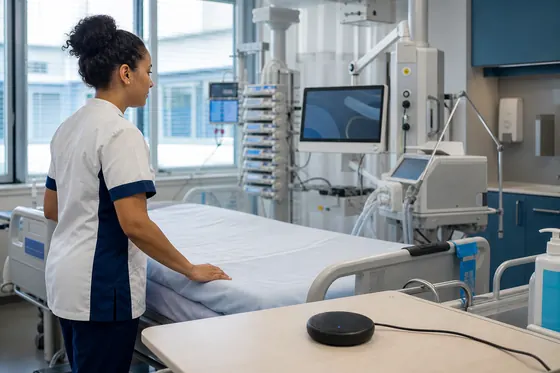
A structured report in your professional terminology
From care encounter to report
Hysio turns spoken information into a report. Choose the report format for the conversation you are documenting.
Document
Record the conversation and clearly state your own findings and agreed actions.
AI assistants
You stay in control of what gets saved.
In your workday
More attention for the conversation, less typing afterwards.
State relevant information, your own findings and agreed actions aloud so you can find them in your report.
The information appears under the headings of your chosen report format, so you can review each section.
Check names, facts and agreed actions. Edit the text where needed before using the report in your records.
Try it yourself
Try Hysio free for 14 days or schedule a personal demo.
For your team
Quick answer
Four documentation formats that follow the ICU shift, with times, pump settings and measured values tied to their own source.
A short overview of the ICU reports in Hysio. You decide what goes into the record after reading it back.
The ICU profile covers ICU Admission, ICU Ward Round & Shift Report, ICU Handover and ICU Discharge Report. They describe, respectively, the first nursing assessment, a ward round or shift, a transfer handover and the course of admission at discharge. Choose based on the purpose of your document. Measured values, support, professional decisions and delivery stay with their source and time, without Hysio making treatment choices of its own. With voice-driven reporting, you dictate your information after an admission, ward round or shift; Hysio organises it by document and you check times and measured values. [3] [4] [5] [6]
This documentation format begins with the first nursing assessment after the decision to admit to the ICU has been made by an authorised person involved. The report organises the admission context, medical history, observations, organ support, medication and care plan. Hysio does not decide whether admission is needed and does not give any device or medication instruction. Check which information applies on arrival and which comes from older documents. [3]
Yes. The source determines whether you record a ward round, a single shift or explicitly both. Hysio does not automatically turn a shift report into a ward round report with team agreements. State the reporting moment, the participants and the care discussed or provided. Keep a doctor's decision, a nursing observation and an open shift action separate, so that the text reflects the actual contact. [4]
ICU Handover creates a compact nursing transfer handover for one client. The current condition, support, medication, equipment and open actions are shown with their source and reference time. It is not a medical discharge letter or a complete description of the course of admission. State the intended recipient and check which information is relevant for this handover and has actually been confirmed. [5]
The nursing discharge report brings together the course of the ICU admission, the condition at departure and the agreed follow-up. Events keep their date; older values do not automatically become departure data. Hysio does not make a discharge decision and does not create a medical discharge letter. Check the source of medication and support, and keep preparation, actual departure and receipt by the next ward apart. [6]
State the observation or measured value with unit, method and time, insofar as these have been mentioned. Keep information from the referring ward separate from your own first assessment. Hysio must not estimate missing values or present a device setting as a treatment instruction. Check that the text makes clear what was actually established at admission and what is still unknown. [3]
A ward round decision describes what has been agreed; the shift report can also state what has actually been carried out. Hysio must not turn one into the other. State who made the decision, who received an instruction and which action has already been taken. Check open shift actions separately, including times and any feedback that has not yet taken place. [4]
A shift report describes the shift in question, the care and open actions. A transfer handover focuses on an intended recipient and the current information passed on with the transfer. The same measurement can be relevant in both, but the purpose of the document differs. Hysio does not independently choose a destination and does not assume acceptance by the receiving ward. [4] [5]
For intensive care nursing, Starter costs €20 per month, Pro €40 and Unlimited €80, excl. VAT. Pay per year and two months are free. The price does not vary by ICU admission, ward round, handover or discharge report. The ICU nurse assesses the source, observation and follow-up before text goes to the record in line with local agreements. [7]
Align your use of Hysio with the privacy agreements of the healthcare organisation. Decide which information is needed, who has access and on what basis data may be processed or shared. Several people may speak during an ICU ward round; their presence does not automatically give consent to share all information further. The privacy policy describes the division of roles and data processing at Hysio. [9]
Nursing is a protected article 3 profession under the Wet BIG (Dutch Individual Healthcare Professions Act). BIG registration and the required competence are separate from the question of whether a report has been neatly written. An ICU report describes the care provided, but does not prove the registration or authorisation of the writer. So check professional requirements separately and state in the record what actually happened. [25]
A high-risk procedure can cause harm to health if carried out carelessly. Reserved procedures are a legally designated group to which specific authorisation rules apply. So not every high-risk procedure is reserved. For the specific procedure, check the applicable instruction and competence. The report records the performance, but does not retrospectively put right a missing authorisation or instruction. [20]
No. The title ICU nurse does not give general independent authorisation for all reserved procedures. The Wet BIG distinguishes between independently authorised professional groups and performing certain procedures on instruction. For nurses, functional independence may apply, within their field of expertise and with sufficient competence. That remains performance on instruction. So do not confuse a mention of a procedure carried out in the report with an independent treatment instruction. [20]
Functional independence applies to certain designated reserved procedures, within the nurse's field of expertise and with sufficient competence. The procedure is still carried out on instruction, but supervision and intervention by the person giving the instruction are not required. It is not an authorisation to start any treatment independently. The instruction and your own competence therefore remain important. [20] [21]
The Besluit functionele zelfstandigheid (the Dutch decree on functional independence) designates the procedures and professional groups concerned. Check the exact procedure and the conditions, rather than deriving a general authorisation from the title ICU nurse. Functional independence remains performance on instruction and requires competence. A report must describe the procedure actually carried out and must not invent an instruction or supervision agreement. [21]
Authorisation concerns the legal scope to carry out a procedure; competence concerns the knowledge and skills needed for that specific procedure. Authorisation alone is not enough when someone is not competent. Also check the instruction and local agreements. An ICU report records the procedure and source, without Hysio independently establishing authorisation or competence. [26]
The ICU guideline states that ICU nurses are given time and budget for at least two days of external or accredited training during working hours, at the employer's expense. This concerns professional development and the organisation of work. It is not information that belongs in every client report. So record your training and the related agreements separately. [16]
The ICU quality indicators of Stichting NICE cover, among other things, the ratio of nurses to clients, bed occupancy, length of stay and duration of ventilation. They describe aspects of ICU care and are not a count of the total number of ICU nurses in the Netherlands. So use such an indicator for the purpose for which it was designed, and not as evidence of the size of the professional group. [17]
When you type yourself, you determine the text and layout directly. When you dictate, you supply the ICU information verbally and then check the result. Do not look only at speed. A pump setting, measurement time and intervention carried out must stay exactly with their source. Compare how much correction is needed before the note is usable for your shift or handover. [10]
The trial lasts 14 days. Use a made-up shift with an admission, a ward round and a handover. See whether observations, times, pump settings and agreements come back correctly, each at its own moment. Also notice how much you need to correct before the text is usable for the next shift. [8]
Use the profession-wide V&VN framework Verpleegkundige en verzorgende verslaglegging (nursing and care documentation) alongside the agreements for your ICU. The ICU guideline mainly covers organisation, collaboration and handover. A chosen Hysio structure replaces neither of them. Make sure the specific contact note fits the nursing process and that goals, care provided and evaluation can be followed in the record. [22]
The Leidraad Organisatie van Intensive Care in Nederland (the Dutch guideline on organising intensive care) describes how ICU care is organised, including collaboration and transfer. It is not a fixed template for every nursing report. Use the guideline to assess agreements about handover in the organisation. The individual report should then contain the relevant information about the specific care moment and the agreed follow-up. [13]
The guideline asks for attention to treatment goals recorded in writing and a structured handover with relevant information. Unnecessarily extensive or duplicate documentation does not automatically move care forward. Make clear in your report which current agreements and open points matter to the recipient. The organisation must also allow room for explanation and questions at handover. [15]
No. A standard for electronic handover has a specific exchange purpose and is not the same as the complete nursing record. A Hysio handover report is also not automatically a technically validated eOverdracht message. Check the fields and route your organisation uses. A readable text does not in itself prove that all technical exchange agreements have been met. [19]
A contact note records part of the nursing process, such as observations, interventions carried out or an evaluation. The goals and rationale must remain traceable in the record as a whole. The profession-wide V&VN framework helps with this. A single shift report does not need to repeat every earlier part, but must not lose its link to current care and agreements. [22]
Stichting NICE collects standardised information to improve the quality of ICU care. This includes admission and discharge data, severity of illness, organ failure, length of stay, complications and capacity. Its own definitions apply to that registration. An individual nursing report has a different purpose and does not automatically form a complete submission. Check the registration agreements and the person responsible within your organisation. [17]
Logging makes actions involving personal health information traceable afterwards. NEN 7513 describes a framework for this, including access and search events. This concerns how information systems are set up and is not an extra text field in every ICU report. A reference to the standard does not prove that a specific platform complies with it. Check the actual access and logging arrangements separately. [24]
Tailor the handover to what the recipient needs to continue care. The ICU guideline recommends a structured handover with relevant information and room to ask questions. Important data must also be retrievable in the record. More text is not automatically better: unnecessary details can actually make current problems and open agreements less visible. [13] [14] [15]
Read through the result before using it in the record in line with your ICU's agreements. Check in particular the client, the reference time, the medication facts and open shift actions. A generated text is not yet in the record. Ask your organisation which route is available, and after transferring check that the correct version is in the intended place. [11] [10]
Read and correct the report first. For an ICU ward round or shift report, check in particular who observed something, when that was and which next step was actually agreed. Voice-driven admin saves typing, but this comparison with the original information remains your job. Hysio does not take over the nursing assessment. [10]
State the score mentioned, the source and the corresponding time of measurement. These instruments are used, among other things, in the national ICU quality registry and have their own definitions and measurement agreements. Hysio must not calculate a score from separate values or interpret the result independently. Before transferring, check that the score belongs to the correct time and the correct source. [17]
Use the fields and definitions of the exchange standard your organisation applies. With the content, state the value, unit and time of measurement, so that the recipient can place the information. A pain score or vital sign without context can be unclear. Hysio organises supplied text, but does not confirm technical validation or automatic connection to an exchange standard. [19]
The ICU Discharge Report is intended to bring together the course of admission, the condition at departure and the agreed follow-up. A handover to the next shift has a different document purpose and mainly calls for current care and open actions. So do not use the name discharge report for every change of shift. The course of admission covers several contact moments, whose source and time must stay recognisable. [6]
Hysio records the nursing conclusion that was stated and the agreed care plan, but does not choose an admission indication, treatment limit or medication policy. The admission report organises the supplied context and observations. Check whether a part of the plan was actually discussed and whether delivery and intention stay distinct. A well-filled heading is no proof that a treatment has been prescribed or already carried out. [3]
State which source carries a piece of information and what its status is. A pump setting is not automatically the prescription, and a prescribed dose has not automatically been administered. Hysio must not harmonise or convert that information. Check the drug, dose, unit, route and time, and leave a discrepancy visible until it has been clarified by the right source. [4]
Give the handover a reference time and keep current measurements separate from older admission data. For support and equipment, state the source, setting and time insofar as these were stated. Hysio does not infer stability from separate values or an alarm. Check which data still apply and which information the recipient needs for this transfer. [5]
In the ICU Discharge Report, events during the admission stay separate from the current condition at departure. As a result, an earlier measured value or pump setting is not described as the departure status without a current source. Future agreements also get their own place. The ICU nurse checks the times and sources before the report is used; Hysio does not make a discharge decision and does not confirm receipt by the next ward. [6]
No. Hysio must not fill in or advise on an oxygen setting, ventilator setting, infusion rate or any other missing value. The admission report uses the information that has been explicitly supplied. An unknown unit or unclear pump setting remains a point to check. Check the data with the right source; a plausible-sounding setting is not a sufficient basis for transferring it to the record. [3]
Start with the piece of information that is not correct, for example a measurement time, unit or the status of an administration. Compare it with the original ICU information and adjust the passage in a targeted way. Look for the same error in the summary and handover too. If the text has already been used in the record, follow your organisation's correction route so that the change remains traceable. [10]
Do not fill in an unclear pump setting, dose or measured value based on likelihood. Trace the original information or ask the responsible person involved for clarification. Admin with AI only works safely if an uncertain item stays recognisably open. Then check that the correction belongs to the correct ICU moment. [10]
The guideline mainly describes how ICU care and documentation are organised. It asks for recording of goals and handover and at the same time warns against unnecessary documentation. It does not provide a personal percentage of administration time or a guaranteed saving. Measure the documentation burden in your own work separately and, besides time, also assess completeness and usefulness for care. [13] [14] [15]
Stichting NICE collects standardised data on ICU admissions to improve quality, including admission data, organ failure, complications and capacity. Its own definitions and submission agreements apply to this. A nursing report describes the individual care moment and is not automatically a complete NICE submission. For registration, check which data are needed according to the current definitions and who handles the submission within the organisation. [17]
The ICU guideline recommends periodically discussing with receiving nursing wards where transfers cause bottlenecks. This way, the assessment also covers what happens after departure from the ICU and which information or support the ward is missing. This is part of the joint quality cycle. It is not an extra standard part of every individual ICU report, nor an automatic external data submission. [13] [14] [15]
Keep your training activities and the related evidence in your own professional portfolio. The Kwaliteitsregister V&V (the Dutch quality register for nurses and carers) can play a role in this; check the current register requirements and the agreements with your employer. That information belongs to your professional development and not in every client report. Moreover, a record of an activity completed does not replace the assessment of whether you can competently carry out a specific procedure. [23]
State the action, source, person responsible and agreed time insofar as these are known. Keep an attempt to make contact separate from consultation that actually took place. Hysio does not add urgency, monitoring frequency or escalation criteria. Check in the report what has already been carried out and what is still open, so that the next colleague does not rely on an assumed completion. [4]
No. Preparing, offering, sending, receiving and accepting are different statuses. Hysio must not infer one step from another. State what has actually been confirmed and by whom. Before use, check that the text does not suggest a receipt or acceptance of tasks that is still open. The report supports the handover, but does not carry out that action itself. [5]
The report describes dated events and the condition at departure without adding its own explanation. An extubation, stopping medication or reduced support does not automatically prove recovery or stability. Hysio only takes over a professional assessment if it has been stated. Check that older values and future plans are not inadvertently summarised as the current departure condition. [6]
State who gave the information and to which moment or period it relates. A report from a relative is not the same source as your first nursing observation. Hysio keeps those contributions recognisably separate. Include only relevant context and check that an older description does not appear as a current finding at admission. [3]
For comparable ICU reports, measure the time for recording, reading through, correcting and transferring. Also assess how often the unit, time of measurement or delivery status needs correcting. A quick first text is of little help when the handover then needs a lot of correction. Compare your own complete way of working and do not use a general figure on documentation burden as a personal promise of time savings. [10]
Start with fictional ICU cases in which times, medication facts and open shift actions are clearly described. Agree with your organisation who checks the result and how an approved text is used. AI reporting only fits the daily shift once the privacy agreements are in place too. A successful practice run is a first step, not a replacement for those agreements. [10] [9]
Hysio creates the report. You remain responsible for what you save in the record.