Document
Keep your attention on the care encounter.
Record the conversation and clearly state your own findings and agreed actions.
Hysio Dialysis Nursing
You say how the session went: weight, vascular access, values and complaints. Hysio organises it into a clear dialysis report.
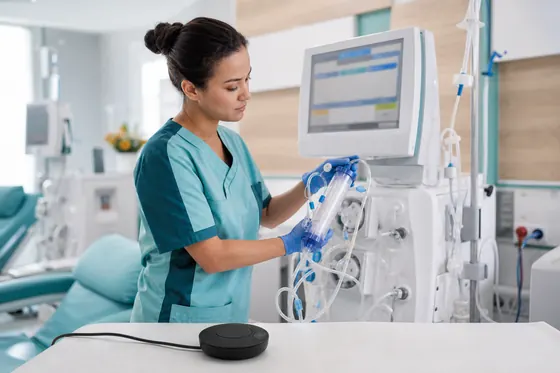
A structured report in your professional terminology
From care encounter to report
Hysio turns spoken information into a report. Choose the report format for the conversation you are documenting.
Document
Record the conversation and clearly state your own findings and agreed actions.
AI assistants
You stay in control of what gets saved.
In your workday
More attention for the conversation, less typing afterwards.
State relevant information, your own findings and agreed actions aloud so you can find them in your report.
The information appears under the headings of your chosen report format, so you can review each section.
Check names, facts and agreed actions. Edit the text where needed before using the report in your records.
Try it yourself
Try Hysio free for 14 days or schedule a personal demo.
For your team
Quick answer
Four documentation formats for haemodialysis and peritoneal dialysis: intake, treatment, complication and handover with evaluation.
This is how Hysio records a dialysis treatment. You read every report back before it goes into the client's record.
There are four formats. The Intake is for the first conversation. The Dialysis Treatment Care Report follows one session. The Complication & Observation Report is for a deviation around a session. Handover & Evaluation is for the shift change or the periodic evaluation. With voice-driven reporting, you say after the session what happened, and you check the text. [3] [4] [5] [6] [1]
The Intake organises the first care encounter into a report with fixed sections: summary, context and sources, data collection, professional assessment, follow-up and additional information. Each item gets a recognisable place. What you did not discuss stays open. Hysio does not make a diagnosis or set a prescription. [3]
The care report organises one dialysis session. Weight and fluid balance, vital and dialysis parameters, the vascular access, complaints and interventions each get a place. For each item, the source, the moment of measurement and the status stay visible. That way every session can be read back well later. [4]
You use this report for a deviation during or around a session. Complaint, measured value, action, consultation and response stay strictly separate, each with a time. The status stays exactly as you state it. Hysio does not turn a suspicion into an established complication. [5]
This format organises a shift handover, a periodic evaluation or both. The report resembles SBAR: situation, background, assessment and what needs to happen. You see the goals, the care delivered, the evaluation and the follow-up. You decide what the next shift or the team needs to know. [6]
State the type of vascular access, where it is and what you saw on inspection. Also say what the client tells you about it, such as pain or earlier problems. Hysio puts that under data collection. A judgement on the quality of the fistula stands apart, as your assessment or the doctor's. [3]
State the weight before and after the session, with the moment of weighing. Say what was removed and what the client said about drinking. Hysio does not calculate anything and does not adjust a target value. The report shows exactly what you measured. [4]
When something deviates during or around the session that you want to record separately. Think of a complaint, a deviating value or a problem with the vascular access. The regular care report stays for the session itself. That way a colleague quickly finds the deviation. [5]
Starter costs you €20 per month, excl. VAT. You do not pay per session or per report. If you want to compare the price with typing yourself, also count the time for reading back. You decide what goes into the record. [7]
On a dialysis unit, clients often sit next to each other for hours. So record in a place where others cannot listen in. Only include what is needed for this client. Your centre decides who may read, edit and approve a report. [9]
The nurse may carry out a reserved procedure on the instruction of an independently authorised doctor, provided they are competent and within the legal and local conditions. Examples are cannulating a vascular access and a catheter procedure. Record what you did and on whose instruction. The professional responsibility stays with you. [12] [21] [22]
Since 1 October 2023, there has been no new intake into the existing CZO training for dialysis nurses. The training requirements stay in force until the last diploma of that training has been awarded. Nothing changes for your documentation: you describe what you saw and did at this contact. [13]
According to Zorginstituut Nederland, haemodialysis can take place in a centre, a hospital or at home. Peritoneal dialysis usually takes place at home. With home dialysis, you hear a lot through the client. Name the client as the source, so that your own observation stays recognisable. [23]
About 19,000 people, according to the figures for 2025 that have been available since April 2026. That covers dialysis and a functioning donor kidney together. It is a national figure and says nothing about one client. In your report, you only describe what you saw, did and discussed at this contact. [25]
A shift handover is about now: how the client is doing and what the next shift needs to do. An evaluation looks back on a period and on the goals. Handover & Evaluation can handle both, separately or together. When recording, say which of the two you mean. [6]
You discuss the medical history, the medication, the vascular access and how the client experiences the treatment. For each item, state the source: the client, the referral or the record. Hysio puts it under the right headings. Missing information stays visibly open. [3]
State the settings and values you read off, with the time. If something changes during the session, say who changed it and why, if that is known. Hysio does not adjust any setting and draws no conclusion. The values go under observations. [4]
Use the complication and observation report. State when it happened, which value you measured, what the client felt and what you did. Also say whom you consulted. Hysio does not interpret the drop. You state the response to your action with a new measurement. [5]
When you type, you often work after the session, with loose notes. When you dictate, you say straight away what happened and Hysio organises it in the chosen format. Then you read it back. After a few weeks, see whether you need to correct less and whether the text is clear for colleagues. [10]
The trial lasts 14 days. Make up a few sessions, for example a quiet session and a session with a complication. Record them as you would after a real session. Check whether weight, values and actions stay properly apart. [8]
Under the WGBO, article 7:454 of the Dutch Civil Code, every treatment relationship with a dialysis client falls under the care provider's duty to keep a record. So for each contact, note what was established. Keep fact and assessment apart, so that the record is easy to read later. [16]
Under article 7:454, paragraph 3 of the WGBO, at least 20 years, counted from the last change. Longer is allowed if that is needed for good care. That applies to your organisation's record. For your own reports, follow your centre's retention agreements. [17] [18] [19]
The Richtlijn Verpleegkundige en verzorgende verslaglegging (nursing and care documentation guideline) was published on 8 September 2011. It is a predecessor of the current guideline. When in doubt, use the latest version. In any case, describe the contact as it really went. [14] [15] [25]
Health data are special categories of personal data under the GDPR. You may only process them with an appropriate legal basis and appropriate security. So only record what is needed for the care. Hysio is built for the GDPR: data are processed in line with the GDPR, and this is set out in a data processing agreement. [20]
Start with the client's situation now. Then briefly give the background, your assessment and what needs to happen. Handover & Evaluation puts it in that order. Hysio does not add an assessment you did not state. [6]
Say that it is a report from the client and when the complaint occurred. Use the client's own words as much as possible. Hysio does not turn it into a medical term. What you see or measure yourself, you state separately. [3]
State when you cannulated, how it went and what you saw. If it did not work first time, say so too. Voice-driven admin makes it easy to say this straight after cannulating. A judgement on the fistula, you state as your assessment. [4]
State when you consulted, what you said and what the nephrologist advised or decided. Say whether the advice has already been carried out. Hysio does not turn advice into a completed action. That way the order of events stays right. [5]
No, Hysio has no write access to your centre's record. After reading back, you transfer the text to your centre's system. Then check once more that you have the right client and the right session. There is no link. [11] [10]
Read the whole report and compare it with your measured values. Are weight, times and settings right? Does every action have the right status: done, requested or still open? Only then do you approve it. [10]
SNOMED CT helps to name problems in care unambiguously. It is the basis for the Nationale Kernset Cliëntproblemen (national core set of client problems), with links to NANDA-I, Omaha and ICF. In your report, it stays clear what you heard, saw and did yourself. Which codes your centre uses follows from the local agreements. [24]
State the goals as they are in the plan. For each goal, say what you saw and what the client experiences. Hysio does not assess whether a goal has been achieved. You make that judgement, together with the team. [6]
State the dry weight as it was set, with who set it and when. Hysio does not set a dry weight and does not adjust it. If you want to propose a change, state it as a proposal. The decision lies with the treating doctor. [3]
Say when the complaint began, what the client felt and what you saw. Then state what you did. In the care report, complaint, observation and action each have their place. You record a serious deviation separately in the complication report. [4]
Leave the status open and say that it is still unclear. Hysio does not turn it into an established complication. State what still needs to happen to make it clear. That way the next shift does not read a conclusion that does not exist yet. [5]
State what still needs to happen, who takes it up and when, as far as that is known. In Handover & Evaluation, they go under follow-up. Hysio does not turn an open question into a decision. That way the next colleague knows where to start. [6]
Use the client's own words and state when the conversation took place. Say what was agreed, for example a conversation with the nephrologist. Hysio does not assess whether home dialysis is suitable. That decision follows from the conversation with the treatment team. [3]
First state what you did and when. Then say what you saw or measured after that action. Hysio sets intervention and response side by side, but does not draw a causal link you do not mention. That way the report stays honest. [4]
First check whether the error was in your dictation or in the organisation of the text. Only adjust that part. If the item also appears in the handover or the evaluation, correct it there too. Hysio does not adopt a professional correction by itself. [10]
Do not guess. Listen back to the passage or check with your colleague. A value you are not sure about, you leave open. That way you prevent a guess from ending up in the record. [10]
Say them in that order, each with a time. The complication report has separate sections for this: reason, observations and measured values, response and follow-up. Hysio does not mix them up. That way a colleague can follow exactly what happened. [5]
Yes, that is what this format was made for. When recording, say which part is handover and which part is evaluation. Hysio keeps those parts apart. Check that the evaluation has not ended up among the current actions. [6]
State what you do know and from whom. What is missing stays open. Hysio does not fill in the medical history. Request the data and add them yourself later, with the source. [3]
Say how long the session lasted and why it stopped early, if that is known. Name who made the decision. Hysio does not fill in a reason. What was agreed afterwards goes under follow-up. [4]
Describe what you saw, felt or heard at the vascular access, and when. State what you did and whom you consulted. Hysio does not establish a cause. Record it in the complication report if it is more than a minor detail. [5]
State what the client says about the treatment and the goals. Put your own observations separately. Hysio does not turn a statement by the client into a conclusion. What you agree together goes under follow-up. [6]
Use the same Intake, but state that it concerns peritoneal dialysis. Discuss the catheter, the exchanges at home and what the client says about them. State the source for each item. What you do not know yet stays open. [3]
State both values with their date. Hysio does not calculate a trend and draws no conclusion. AI reporting does set the values neatly side by side, each with its own session. If you want to name a course yourself, say it as your assessment. [4]
Keep track for a few shifts of how long reporting takes now, including reading back. Then do the same with Hysio for comparable sessions. Also check whether the report is more complete. A faster text only counts if you have less to correct. [10]
Start with one format, for example the care report of a session, and practise with made-up cases. Agree with your centre who approves reports and how you handle privacy. Evaluate after a few weeks. Then expand step by step. [10] [9]
Hysio creates the report. You remain responsible for what you save in the record.