Document
Keep your attention on the care encounter.
Record the conversation and clearly state your own findings and agreed actions.
Hysio Primary Care for Older People
Hysio keeps the accounts of the older person and their relatives, observations at home, measurements, MDT meeting decisions and personal care wishes clearly separate.
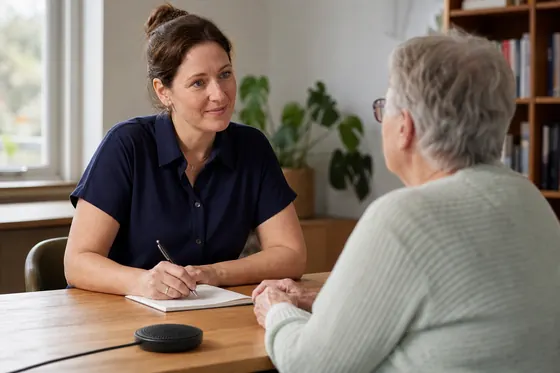
A structured report in your professional terminology
From care encounter to report
Hysio turns spoken information into a report. Choose the report format for the conversation you are documenting.
Document
Record the conversation and clearly state your own findings and agreed actions.
AI assistants
You stay in control of what gets saved.
In your workday
More attention for the conversation, less typing afterwards.
State relevant information, your own findings and agreed actions aloud so you can find them in your report.
The information appears under the headings of your chosen report format, so you can review each section.
Check names, facts and agreed actions. Edit the text where needed before using the report in your records.
Try it yourself
Try Hysio free for 14 days or schedule a personal demo.
For your team
Quick answer
Hysio keeps the accounts of the older person and their relatives, observations at home, measurements, MDT meeting decisions and personal care wishes clearly separate.
Multidomain history, home visit, MDT meeting and the older person's care wishes each get their own structure. What a relative says gets its own place.
Hysio Older Person Intake is for a multidomain history covering living context, health, functioning, network, wishes and care plan. The format organises summary, history for older people's care, multidomain examination, analysis and follow-up. You keep the account of the older person and their relatives separate from your observations and a professional assessment. Hysio does not fill in frailty, risk or a representative role. [1] [2] [7] [8] [9] [3]
Hysio Older Person Home Visit is for a contact at the older person's home with visit context, source roles, accounts, observations on site, professional evaluation and actions. A remark from a relative stays recognisable as a source, and an observation about the home or functioning does not receive an automatic risk classification. You assess the situation and decide the next step together with the network. [1] [2] [7] [8] [9] [4]
Hysio Older Person MDT Meeting & Advance Care Planning is for multidisciplinary team meetings and conversations about values, wishes, treatment limits and follow-up. The structure keeps participants, input, decisions, advance care planning wishes, confirmation and open items separate. Hysio does not decide on behalf of the older person, relative or healthcare professional. You check source, consent, representation and status before an agreement is saved as a decision. [1] [2] [7] [8] [9] [5]
Hysio Older Person SOAP Note is for a regular older people's care contact with Summary, S. Subjective, O. Objective, A. Assessment and P. Plan. You separate what the older person or relative tells you from an observation, a measurement that was actually carried out and a professional assessment. A plan or treatment limit only appears when it follows from the contact or the consultation. [1] [2] [7] [8] [9] [6]
Older Person Intake is intended for a broad assessment, Home Visit for observation and agreements in the home situation, MDT Meeting & Advance Care Planning for joint consultation or future wishes, and SOAP Note for a regular follow-up contact. The contact purpose determines which format fits, not only age or diagnosis. For a home visit without an MDT meeting decision, you do not present observations and actions as a multidisciplinary decision. [1] [2] [7] [8] [9] [3]
Write down what the older person considers important, what they are struggling with and which wishes or goals have been expressed. Also note when a relative or healthcare professional adds something. An expression of tiredness is not automatically a refusal of care, and a wish is not automatically a decision. You check source, context and confirmation in the care plan. [1] [2] [7] [8] [9] [3]
Only describe what you actually see or measure at home, for example mobility in the home, medication in an agreed place, nutrition, safety or support from a relative. Note location, source and moment, and avoid a general conclusion about self-reliance without a professional assessment. You decide which observation is relevant to the care request and which action follows with the network. [1] [2] [7] [8] [9] [4]
You document an MDT meeting decision with the date, those present, the source of the decision and the agreed action. Also note who takes on the action and when it will be reviewed. The primary care support professional in older people's care keeps the words of the older person and their relatives, their own observations and the professional assessment apart. Missing information stays visibly open. [1] [2] [7] [8] [9] [5]
Hysio does not fill in a frailty risk, medication list, representative role, care wish or MDT meeting decision. Hysio can organise accounts, observations, agreements and status. You assess the meaning of signals, discuss wishes with the older person and the network, and only document an action or decision that was actually agreed. When you flag a concern, also record which observation raised the question and who carries out the professional assessment. [1] [2] [7] [8] [9] [3]
A wish describes what the older person considers important; a treatment limit describes a joint agreement about care or treatment. Note who expresses the wish, who took part in the decision and whether the agreement has been confirmed. Has the situation changed, or does an earlier note need to be discussed again? You assess that and at the same time decide whether a representative needs to be present. [1] [2] [7] [8] [9] [5]
The Older Person Intake brings living situation, functioning, physical and psychological experiences, social context, network and care wishes together in a recognisable order. This keeps it visible who provided which information. You decide which domains are relevant to the care request, assess signals professionally and do not create an automatic overall picture of frailty or care needs. [1] [2] [10] [11] [3]
Note what you actually observe, where it was observed and what meaning the older person or relative gives it. Think, for example, of a staircase, a mobility aid, the walking route through the home or a moment of support, and do not immediately conclude that this points to a fall risk or an unsafe situation. You discuss the observation with the older person, decide the professional follow-up and record actions with the person responsible. [1] [2] [10] [11] [4]
Make visible why the MDT meeting is taking place, who is taking part, which question is on the table and which source information is being brought in. Distinguish information from the older person, relative, district nursing, the general practitioner (GP) and other disciplines. You make sure that a discussion item does not become a decision before the team has discussed it, and that the older person or representative is appropriately involved. [1] [2] [10] [11] [5]
Use S for what the older person or relative tells you, O for a genuine observation or measurement, A for the professional assessment and P for the agreed follow-up. For example, you keep a report of forgetfulness separate from a professional assessment, and you only note an agreement with district nursing when it has actually been made. [1] [2] [10] [11] [6]
A relative can provide information, be present, offer support or act as a representative, but those roles are not the same. Note which role follows from the contact and which information the relative provides themselves. The formats do not fill in a representative role. You check consent, involvement and the meaning of the information with the older person and the care team. [1] [2] [10] [11] [3]
Only describe what you have actually seen or what the older person or relative says about medication, with source and moment. Do not note a medicine name or dosing schedule as checked when you have not verified it. You discuss a possible discrepancy with the designated healthcare professional and leave a medication decision to that healthcare professional. [1] [2] [10] [11] [4]
For each participant, keep the information or question they brought in separate from the decision the team actually made. Add the action owner and timeframe and keep an open item visible. You check whether participants and the older person or representative have been involved, and make clear which items still need to be assessed by the GP or another healthcare professional. [1] [2] [10] [11] [5]
Note concrete actions, who carries them out, when feedback follows and which question is still open. A wish, advice or possible referral does not automatically become a plan. You check whether the older person understands the agreement and whether the network, the GP or district nursing has confirmed their own action. [1] [2] [10] [11] [6]
Describe values, wishes, treatment preferences and limits in the older person's own words, with source, date and the people involved. Also note which items have been confirmed, which are still open and where the information needs to be available. You assess whether a representative is needed and discuss changes again when the situation changes. [1] [2] [10] [11] [5]
Note which district nurse or home care organisation is involved, in which role and which information was actually exchanged. Describe an agreement as an agreement and a desired update as an open item. You check consent, recipient, action owner and timeframe, and do not let Hysio fill in a care network or responsibilities without a source. [1] [2] [10] [11] [4]
The NHG guideline ADEPD (adequate record keeping with the electronic health record) provides a framework for relevant and structured record keeping in general practice. For POH-Ouderen, this fits contact, observation, evaluation, network and plan. The guideline does not automatically make Hysio suitable for every local practice set-up. You follow the current agreements in general practice and make source, role and status visible. Voice-driven admin does not change that framework. [1] [2] [12] [13] [16] [6]
Distinguish between personal goals and actions for the older person and agreements that several disciplines carry out jointly. Note who is responsible and which healthcare professional coordinates care when that has been agreed. You use the NHG reference model as context, but do not let Hysio derive a responsible person or decision. [1] [2] [12] [13] [16] [5]
The WGBO (the Dutch Medical Treatment Contracts Act) calls for a record with relevant information for good care and gives rights around access and additions or corrections. For POH-Ouderen, this means recording with a clear purpose and not mixing up sources. You follow the record procedure of the general practice and keep the words of the older person, the observation and the professional decision recognisable. [1] [2] [12] [13] [16] [6]
As a general rule, medical information is kept for at least twenty years from the last change, with exceptions and possible longer retention. Hysio does not set that period. You follow the healthcare provider's policy and make sure that MDT meeting decisions, advance care planning agreements and home visit observations can be found as relevant record information. [1] [2] [12] [13] [16] [3]
Record who gives consent, what role that person has and which information or action the consent relates to, when that is needed for the contact. Do not assume representation from presence alone. You check the legal and local procedure, discuss the wish with the older person where possible and record a restriction or refusal separately. [1] [2] [12] [13] [16] [5]
Make visible who the contact person is, which healthcare professional carries out which action, who can be reached and where an MDT meeting conclusion can be found. A role in the network is not proof that someone may make a decision. You check recipient, purpose, consent and status, and let each healthcare professional keep their own responsibility. [1] [2] [12] [13] [16] [4]
Note the wish or limit, the date, the older person or representative involved, the professional participants and the confirmation. Also write down what needs to be discussed again if the health situation changes. You use the local procedure and do not let Hysio present an earlier limit as a current decision without a new assessment. [1] [2] [12] [13] [16] [5]
The POH competency profile names, among other things, network care, collaboration, client safety, self-management and professional documentation. That profile does not automatically determine a diagnosis, representation or medical decision. You work within your competence, make agreements with the GP and district nursing explicit and record open questions or handovers visibly. A good network agreement links each action point to a recognisable responsible person and a feedback moment. [1] [2] [12] [13] [16] [3]
Note who raises the complaint, which contact it relates to, what the older person or relative describes and which complaints route has been agreed. Do not add any judgement about mental capacity, the network or quality of care. The Wkkgz (the Dutch Healthcare Quality, Complaints and Disputes Act) provides the framework for good care and complaints. You follow the healthcare provider's procedure and keep complaint, assessment and action apart. [1] [2] [12] [13] [16] [6]
Record the subject, participants, decision, action owner, timeframe and place in the record. Also note whether the older person or representative has been informed and which items are still open. You check that the conclusion is visible to the care network in line with the local agreement, and that a separate note does not replace the formal agreement. [1] [2] [12] [13] [16] [5]
A multidomain picture can contain information from the older person, relatives, the GP, district nursing and other healthcare professionals involved. Label each source and note date and context. A joint analysis is something different from a single observation. You assess which information is relevant, current and confirmed before it goes into the care plan. [1] [2] [14] [15] [11] [3]
Describe the concrete activity, surroundings and support that you have seen or that someone tells you about. Note a fall, difficulty climbing stairs or a forgotten appointment as a source fact, and make the professional risk assessment separately. You assess the meaning and agree on an action, without letting Hysio invent a risk score. [1] [2] [14] [15] [11] [4]
Note the wish as expressed but unconfirmed when the older person or the network has not yet made a joint agreement. State which question still needs to be discussed, and with whom. The advance care planning format does not fill in a decision or representative. You arrange a new conversation and record confirmation or changes with a date. [1] [2] [14] [15] [11] [5]
Note the type of measurement, value, unit, moment, method and who carried out the measurement. Do not automatically turn the value into a judgement about frailty or safety. You assess the meaning in relation to the care request and record follow-up when it has actually been agreed. For a deviating value, also state the source and discuss its meaning with the responsible healthcare professional. [1] [2] [14] [15] [11] [4]
Place both accounts side by side, each with its own source and context, and note which question still needs clarification. Do not choose the version that seems most plausible, and do not automatically link a difference to memory or mental capacity. You discuss the discrepancy carefully and record the professional assessment separately. [1] [2] [14] [15] [11] [3]
No, Hysio does not derive a frailty, fall or safety risk from an account, observation or measurement value. The formats can organise concrete source information. You assess risk according to your professional working method, discuss it with the older person and the network, and only record the decision or follow-up when it has actually been made. [1] [2] [14] [15] [11] [4]
Distinguish between what the older person mentions, what a medication overview shows, what you observe and what the GP or pharmacist assesses. Do not add any medicine, dosage or advice to stop that does not come from the source. You record a discrepancy as an open question and leave a medication decision to the healthcare professional responsible for it. [1] [2] [14] [15] [11] [3]
Use a factual status such as to be discussed, action assigned, feedback needed or completed when that status actually fits the local agreement. Add the action owner and timeframe. You check whether the team has decided on the item and do not let an open question disappear into a general summary. [1] [2] [14] [15] [11] [5]
Check values, wishes, treatment preferences, limits, the people involved, confirmation and date. See whether the text makes clear what the older person says themselves and what has been jointly agreed. You discuss changes again when the situation changes and do not let a wish that has not been confirmed appear as a final decision. Distinguish between a wish, a decision and consent, so that relatives and healthcare professionals read the same meaning. With voice-driven reporting too, you always read an advance care planning agreement back yourself. [1] [2] [14] [15] [11] [5]
Read back whether the visit context, source roles, observations on site, professional evaluation, actions and follow-up are clear. Also check consent, the relative involved, the moment of measurement and open questions. You correct factual errors, leave uncertainty in place and only approve when the text reflects the actual visit. Check that a change to the care plan is recorded as an agreement and not as an automatic outcome of the measurement. [1] [2] [14] [15] [11] [4]
For weighing up Hysio in older people's care, Hysio lists Starter at €20 per month, excl. VAT. This amount says nothing about how well the four older people's care formats fit your way of working, and nothing about whether a care network uses the same set-up. Compare the current price with your practice process and first assess source roles, consent, MDT meeting status and professional assessment. [1] [2] [17] [3]
Agree which information is needed for the home visit, who may be present, what role a relative has and with whom you share information. Record consent or restrictions when that is needed. Hysio does not change this responsibility. You follow the privacy procedure of the general practice and prevent a home situation from being shared more widely than the care purpose requires. [1] [2] [18] [19] [4]
You can type manually, use a local template in the HIS or assess another dictation solution for conversations at home and in the practice. Every route requires checking source roles, observations, care wishes and actions. So compare above all whether the network can find the agreement and status again, not only whether the first text is produced faster. Voice-driven reporting is one option alongside typing in the HIS. [1] [2] [6]
For POH-Ouderen, the current Hysio product information mentions a free trial of 14 days. Do not use the trial to let care wishes, MDT meeting decisions or risks arise automatically. Choose an intake, a home visit and a consultation as clearly defined examples, agree on review by the POH and the GP, and note corrections. Then discuss whether the older person, relative and network can follow the information clearly. [1] [2] [17] [4]
No, an automatic integration with every HIS, EHR or network message has not been demonstrated. The formats provide a content structure, not a guarantee that MDT meeting or advance care planning data will be transferred. Check for each practice which route is permitted, who reviews the text and how source, consent, status and confirmation are preserved. [1] [2] [5]
Have the POH-Ouderen check whether the source roles, observations, wishes, decisions and actions match the actual contact. Have the GP or a network professional review it too when the local agreement requires this. Hysio does not fill in any risk, representation or decision. Record who authorises, who corrects and which open items will be discussed again with the older person. [1] [2] [3]
First check who expressed the wish and on which date. Correct it according to the record procedure and keep the earlier source, correction date and new confirmation recognisable. Do not change a joint agreement without discussing again who is involved. You check whether the network needs to be informed again and which status now actually applies. [1] [2] [5]
Make visible whether the missing item concerns living context, informal care, medication, functioning, measurement, representation or follow-up. Ask specific follow-up questions when that fits the visit, and otherwise leave it as an open action. You decide with the older person and the network who takes up the missing item. [1] [2] [4]
Measure the time for documenting, checking, correcting and finding actions and decisions separately. Also look at whether the older person and relative stay recognisable and whether network partners understand the current status. No time savings specific to POH-Ouderen have been established. Use anonymised examples and stop when the structure causes extra coordination or lack of clarity. [1] [2] [6]
Start with one older person intake or home visit and agree how the older person, relative, observation, measurement, action and consent will be checked. Then test an MDT meeting with an open decision and a change to advance care planning. Only expand once the POH-Ouderen, the GP and network partners have assessed the content, privacy and status display. [1] [2] [5]
Hysio creates the report. You remain responsible for what you save in the record.